Tag: accounting

  • Comparing Management costs

    Comparing Management costs

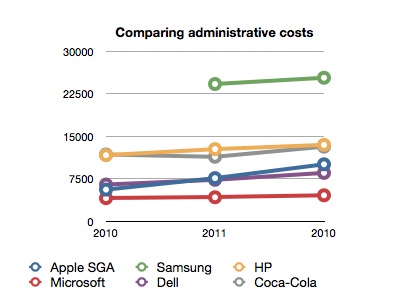
    Telecoms analyst site Asymco has a look at how much Samsung spends on marketing compared to other tech companies, particularly Apple, with Coca-Cola added as a sanity check from outside the bubble.

    While the results are stunning with Samsung dwarfing the others, the Asymco story also touches on the total cost of sales and general administration expenses with the observation that, as a proportion of revenue, Sumsung’s are soaring while Apple’s are declining.

    Teasing those figures out a bit more is interesting, when we track the sales and general administration costs of all the business we see that with the exception of Apple they’ve been remarkable flat in straight dollar terms over the last three years.

    Of course this comparison is a little unfair as this is an absolute number, not as a proportion of revenue and as Horace Dediu points out in the Asymco posts Apple’s expenses as a ratio to sales has fallen.

    For companies like HP, Dell and Microsoft where sales have been stagnant or falling it might be that the ratio is rising while spending is flat.

    We’ll tease these figures out over the next few days.

    In the meantime, the fact that Samsung is spending such an awesome amount on marketing should cause us to treat Android sales figures with caution as that spend in undoubtedly inflating their sales figures. More on that in the future as well.

    Similar posts:

  • Stranded markets

    Stranded markets

    “Stranded assets” are an accounting term for property that’s worth more on the books than it is in the marketplace.

    Often the valuation problem has come about because of market, legislative or physical changes – what was a valuable and useful asset becomes isolated from the rest of a business.

    Customers are biggest asset we have in our business – so what happens if our customer base becomes a “stranded asset”?

    This situation isn’t far-fetched in a time when technology changes a marketplace – a blacksmith providing services to stagecoach companies would have been in this situation a hundred years ago.

    In response to Are Businesses Fleeing the Online Space?, Xero’s Australian CEO Chris Ridd made some points about the problems MYOB have in the accounting software marketplace.

    We see that going online to the cloud is finally allowing many small businesses the opportunity to avoid the “walk into Harvey Norman and fork out hundreds of up-front dollars on on-premise software” experience and instead go straight to the simplicity and cost efficacy of the cloud.

    This is evidenced in our numbers and the fact that 40% of new customers signing up to Xero are coming from no software. (I mentioned last week at the NBN Forum that it was 30%, but we doubled checked and were staggered to find it was actually a lot higher). So we are creating a new market and cloud is therefore increasing the addressable market for accounting software. The cloud changes the economics of doing IT and makes automation of the business accessible and attractive to  a whole new category of SMEs.

    Chris’ point is interesting – the new generation of businesses aren’t going to the computer superstore and buying box software. Which is a problem for those who sell box software such as MYOB and Harvey Norman.

    What’s more, customers have moved away from those same superstores along with things like phone directories and classified ads, which is the problem companies like Sensis and Fairfax have to deal with.

    A decade or so ago, MYOB, Sensis and Fairfax were dominant in their markets with a loyal band of customers. Today the remaining customers – many of whom have not changed their business plans for decades – are”stranded markets” made up of holdouts who won’t move to new technologies.

    Those holdouts aren’t particularly profitable and they are slowly leaving their industries through retirement or, increasingly for these slow adopters, going broke.

    Being dominant in a market that’s declining in both profits and sales is not the place to be for any business.

    It’s difficult for the managers of these enterprises to move as their existing products are their core business, which is the classic innovators dilemma, but the alternative is to end up like Kodak or Sony.

    One thing missed in the eulogies for Steve Jobs is how he overcame the innovator’s dilemma problem within Apple. When it became apparent the old Mac OS was a barrier to innovation, he killed it along with the floppy disk and Apple Device Bus.

    Apple’s customers hated it as most of them had a substantial investment in the hardware which Jobs had made obsolete overnight. But almost all of them came back and became greater fans.

    News Corporation are trying a different tack to Steve Jobs in splitting the operation into an “old” business and a “new’ business. That way the old business can find a way to make money or quietly fade away without affecting the newer, more dynamic entertainment and electronic arms of the organisation.

    The challenge for MYOB – along with Harvey Norman, Fairfax and Sensis – is to move their customers to the new technologies, those who won’t go are the past and those stranded customers will isolate the business from the mainstream.

    Similar posts:

  • Building an ecosphere

    Building an ecosphere

    One of the keys to success for a software platform is its ecosphere  the community of developers, consultants and advocates that grow around a service.

    By far the most successful company in building a community around its products is Microsoft, who over the years have attracted hundreds of thousands of developers and partners to support Windows.

    Microsoft’s thousands of partners are the company’s greatest asset in beating back the threat posed by Google, cloud computing and Apple. The sheer size Microsoft’s supporter base gives it a natural buffer against competitors.

    Apple too have that buffer, in the company’s darkest days during the late 1990s it was the true believers who kept the flame burning. The ecosphere that has developed around the iPhone and iPad has now cemented Apple’s iOS as being the dominant mobile platform.

    The same thing happens around various industry software packages, as one company becomes identified as the leader in their sector they develop a following among users in that industry.

    At the Xero conference last weekend, the cloud accounting software company showed how an ecosystem of developers, accountants and bookkeepers are developing around their software platform.

    Companies as diverse as inventory management, point of sale system and document scanning services are plugging into Xero’s accounting data which adds functionality for customers.

    In turn, those third party services makes Xero more attractive to the bookkeepers and accountants looking for ways to make their jobs, and those of their clients, easier.

    Xero’s biggest competitor, MYOB, also has that strength with an army of certified consultants from long being the incumbent in their market.

    The battle between Xero and MYOB for dominance in the business accounting software market will depend upon how well the incumbent can hold onto their existing markets and the effectiveness in the incumbent building a ecosphere that makes the newer product more attractive.

    Disclaimer: Paul travelled to Melbourne and attended the Xero Partner conference courtesy of Xero.

    Similar posts:

  • When tails wag dogs

    When tails wag dogs

    A recent Business Insider examination of how patent “aggregator” Intellectual Ventures works is a good example of one of the problems in modern business – essential ancillary processes have overtaken doing business itself.

    Intellectual property rights are an important part of doing business, however what should be an adjunct to doing business has consumed many enterprises.

    As the Business Insider article point out, Intellectual Ventures has become some sort of modern day privateer, extracting loot from hapless companies that cross its path.

    This problem with intellectual property is part of a larger problem with lawyers, where they have been given too important a role in business.

    In any civilised society lawyers are essential and carry out an important role but in western society over the last fifty the scope of the legal system has expanded so dramatically that now the legal tail wags the business dog.

    Today company directors, business owners and entrepreneurs live under the shadow of breaching some obscure law that they had no inkling existed. Of course, the lawyers can help with this.

    A similar thing has happened in the financial world, accountants have also moved from being an essential adjunct of business into being at the centre of most enterprises.

    Much of this explosion in lawyering and accounting has been due to the increased role of government in our lives; each time a new law or regulation is enacted it makes it harder for the average person, or business owner,  to understand the system.

    A cynic can argue this is by design but most government actions are intended to address some injustice or flaw in society. The problem is there are always unintended consequences.

    One can also argue that the increased growth in business overheads like lawyers, accountants and patent attorneys is because of fat, prosperous business conditions.

    So maybe what western business has seen in the last fifty years has been because of a favorable market place; politicians have introduced a morass of often contradictory financial and legal rules because they know business, and society, can afford it.

    Now times have changed and both business and society can’t afford unnecessary overheads it will be interesting to see exactly how our laws and regulations evolve to respond.

    Maybe they won’t and we’ll see a black economy develop where whole groups of society ignore the rules, dispense with lawyers and accountants and hope for the best. This would not be good.

    Possibly we’ll see legislatures and courts winding back and reigning in some of the more silly and egregious excesses as they recognise society can’t carry the burden and remain productive.

    Whatever happens we can be sure the lawyers, accountants and people like Intellectual Ventures will fight hard against any change that reduces their status and income.

    Similar posts:

  • The creative deadbeat

    The creative deadbeat

    This post originally appeared on the Xero Accounting blog under the title “Sorry, we’re not paying you”.

    “Your star readings were negative after you serviced my computer,” the astrologer said sweetly, “so I’m afraid I will not be paying you.” Then she hung up. It was a good start to the week.

    In business, bad payers are an unfortunate fact of life, one of the redeeming features is most of us end up with a great collection of reasons deadbeat customers give to justify not paying their bills.

    Along with the downright strange is the quasi-legal; “your tax file number is in the wrong format, so we can’t pay your invoice” is one of the better excuses I heard in the years of running my business.

    “I gave your technician a cup of coffee while she was here, so you’ll have to give me a credit” was another great claim.

    A teacher once threatened to report my business to her union on the basis we were exploiting low paid women workers. The funny thing was we’d cut her a big discount because I realised she’d struggle to pay the full rate.

    Big boys’ excuses

    Those excuses were from smaller customers, but the corporate sector can be no better, some of them treat their suppliers as banks who give them an interest free loan

    One multinational suffering cash flow problems decided to pay all bills after 270 days, regardless of the agreed payment terms. They didn’t bother with excuses and their accounts team were blunt – if suppliers didn’t like it, they could sue and wait five years for their money.

    That company had its come-uppance when every supplier in the country put the company on a cash up-front basis to avoid a nine month wait.

    Another big corporation decided to tangle their contractors in knots by implementing an arcane system involving submitting an invoice by the 30th of month one, backing it up with a statement of account by the 20th of month two paying thirty days later. Make a mistake or miss a date and the whole cycle started again.

    Probably the most irritating excuses can come from government departments, a common one being, “our budget has run out for that item, so we can’t pay your invoice until the next financial year. Would you be able to reissue it under a new purchase order for paperclips?”

    Chasing the bad news

    A truism with collecting debts is the longer we let them slide, the less likely it is they will be paid so we have to be on the ball in chasing those late payers.

    In Xero’s accounting software you nominate the due date when creating the invoice and this will appear on the copy the customer receives.

    As soon as the due date has passed without payment, follow up with a reminder or a phone call.

    Whenever you have a slow payer, it’s best to talk to them. Showing you watch our money closely indicates to the customer that you are serious about your bills.

    Identify problem customers

    The good thing about late payments is it’s a pretty reliable guide to who is a bad customer – if they constantly pay bills late, then you don’t need them in your business life and it’s time to get rid of them.

    More insidious is the good client gone bad – a previously good payer who suddenly starts making excuses could be in financial trouble. If so, it’s worthwhile making sure your business isn’t too exposed if that client suddenly goes under.

    At one client the secretary insisted on paying most of our bill out of petty cash. Two weeks later the company, a Scotch whisky broking service, closed shop and left thousands of angry customers and suppliers out of pocket. It took the creditors ten years to get a fraction of their money back and the secretary did us a great favour.

    Not every late payer is a bad guy though, even in the best of times good customers can hit a bad patch so making arrangements with a good customer who has hit a rough patch can be a good long term strategy.

    Incidentally, the astrology lady eventually did pay her bill. Attached was a note explaining something about planets transiting Scorpio during a waxing moon. We never heard from her again.

    At least with bad payers we get to have a laugh at their excuses later, what the best stories you’ve heard from deadbeat customers?

    Similar posts: