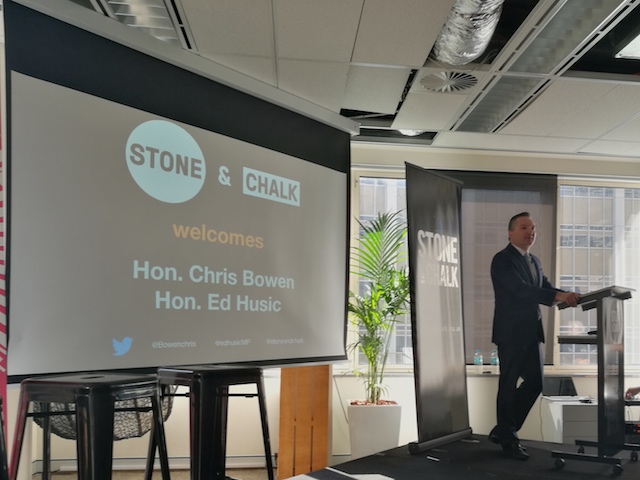
“It’s like we lived through five minutes of innovation sunshine,” says Federal shadow treasurer Chris Bowen about the Australian government’s innovation policy.
Bowen was appearing at the Future of Innovation panel at Sydney’s Stone and Chalk fintech hub with his colleague Ed Husic where laid out the Labor Party’s platform for the tech industry and the changing workforce.
Both Husic and Bowen represent Western Sydney electorates which, along with outer suburban Melbourne, are key election battlegrounds and the districts dealing with most of Australia’s surging population growth.
Uneven spoils
As Bowen indicated in his speech, those regions haven’t shared in the country’s economic growth over the past ten years.
Some parts of the Australian economy are doing well. Other parts are doing it tough.
Half of all the jobs created in Australia in the last decade have been created right where we are: in a two kilometre radius of the Sydney and Melbourne CBDs.
The economy feels good from this vantage point.
Not understanding the mismatch between different parts of the economy was one of the failures of the government’s 2015 Innovation Statement. The multi million dollar advertising campaign was full of fine buzzwords but none of the rhetoric resonated with the broader electorate, something not helped by the Prime Minister retreating from his policies at the first opportunity.
Spreading the gains
Bowen and Husic made a good case for their policies being focused on the wider population as a changing workforce is going to affect all parts of the economy.
So I spend a lot of time travelling to and talking to people in regional economies. It doesn’t feel as good there.
Regional central and North Queensland. Tasmania. South Australia.
Here, unemployment and youth unemployment are high and show no signs of budging.
So Bowen’s commitment for his party to work on innovation, education and industry policies that help suburban and regional Australia – not just the leafy bits of upper middle class Sydney and Melbourne – is welcome and essential for the nation.
Refreshingly Bowen also acknowledged many of the jobs that currently exist in suburban and regional Australia are very likely to be automated and that education, reskilling and investment are all critical factors in dealing with employment shifts.
A familiar tale
However we have heard this before, the Rudd Labor government came in with high hopes when it was elected in 2007 which it quickly dispelled and then compounded its errors with cancelling the COMET commercialisation program and making a mess of employee option schemes.
Given this history of poorly conceived thought bubbles posing as policy, this writer asked (or rather begged) Bowen to consult with industry and the community before announcing major policy changes – something both parties have become notorious for.
In answer to the comment about consulting with the electorate before substantive policy changes, Bowen suggested a Shorten ALP government will be requiring senior public servants to be more engaged with industry.
Suggesting that senior public servants should engage with the community and industry is a good idea. That the idea is seen as revolutionary illustrates the problem found by former Digital Transformation Office boss Paul Shetler when he arrived in Australia with the country’s top bureaucrats being isolated and aloof from the citizens they deign to rule. This isolation is in itself a challenge facing Australian governments.
Memories of earlier oppositions
The Sydney tech community’s lauding Husic and Bowen bought back some memories. Fifteen years ago Australian technologists were doing the same thing with another Labor shadow spokesperson, Kate Lundy. We ended up with factional warriors Stephen Conroy and Kim Carr when Labor finally won. While both were no doubt wonderful at delivering the numbers to party faction warlords their understanding of the changing economy was marginal at best.
While the Rudd government at least paid lip service to the Twenty-First Century, unlike the Howard government which was firmly focused on taking Australia back to the 1950s – with some degree of success it should be said, the Labor Party did little apart from getting the National Broadband Network underway.
In opposition, the Liberal Party too made similar noises however communications spokesperson Paul Fletcher, like Lundy, has been marginalised since winning power and Paul Keating’s description of Malcolm Turnbull as ‘Fizza’ has never seemed more apt since Malcolm became Prime Minister.
For Australians hoping some of the Lucky Country’s luck would be applied to the nation’s tech sector, government policies from both parties have been a succession of broken dreams.
Husic and Bowen are promising this time it will be different. Many of us hope it will be, it may be the last chance for Australia to have a fair economy fit for the 21st Century.