Australia is one of the world’s most urbanised countries with the bulk of the nation’s population clustering in half a dozen centres mainly strung along the east coast of the continent.
The northernmost of Australia’s population centres is South East Queensland, a sprawling collection of suburbs extending from the upper class enclave of Noosa Heads down to the Gold Coast and the New South Wales state border.
Cisco believe this sprawling region of three million people can become a ‘Smart Region’ with the use of technologies such as intelligent lighting and parking, citizen applications, and smart power metering could add up to 30,000 jobs and $10 billion of value to the community over coming years.
“The residents of South East Queensland told us they want to experience greater convenience and integration of public transport, greater digital engagement and intimacy in their cities, more reliable local government services, and new digital ways to further reduce the cost of red tape,” said Cisco Australia & New Zealand Vice President Ken Boal in releasing the South East Queensland: A Smart Region report.
Local civic leaders in the cities making up the South East Queensland conurbation see this as an opportunity to grow their economies. “The future of cities and regions and their ability to create enduring employment opportunities are entirely linked to their digital capabilities,” says Sunshine Coast Mayor Cr Mark Jamieson while Ipswich Mayor Paul Pisasale said Ipswich was already preparing for a strong future as a digital city.
“We have recognized that building and taking advantage of digital highways now will set Ipswich on a secure and successful path to capitalise on the ballooning digital economy,” said Cr Pisasale.
For South East Queensland, the challenge in creating new industries and jobs is becoming acute. The Australian miracle economy has left the region – like most of the nation – hopelessly uncompetitive and the bulk of employment is in domestically facing service industries underpinned by property prices.
In fact, the residential construction industry has been the mainstay of the SE Queensland economy and the region remains probably the most economically volatile of the Australian conurbations given its high dependence upon the building sector.
The digital economy does hold out hope for diversifying South East Queensland’s economy from building and domestic tourism, but the work is just beginning. Cisco’s smart region initiative is a first step, but there’s much more work to be done by business and civic leaders.
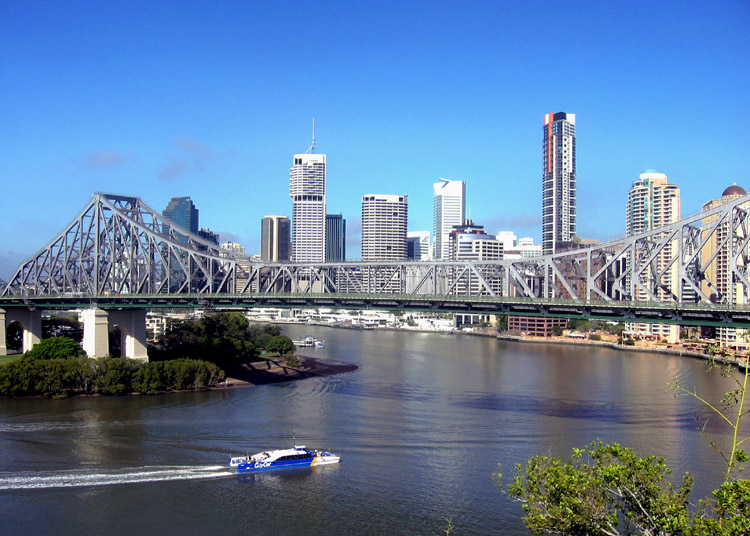
Brisbane image, “Brisbane CBDandSB” by Stuart Edwards. – Own work. Licensed under CC BY-SA 3.0 via Wikimedia Commons – https://commons.wikimedia.org/wiki/File:Brisbane_CBDandSB.jpg#/media/File:Brisbane_CBDandSB.jpg
Today Cisco launched their latest Internet of Everything Innovation Centre in Perth, Western Australia. The facility joins the seven existing centres around the globe which includes Rio de Janeiro, Toronto, Songdo, Berlin, Barcelona, Tokyo and London.
As a joint venture with resources company Woodside and Curtin University, the centre will initially focus on the gas industry and will include a state-of-the-art laboratory, a technological collaboration area, and a dedicated space to show the Internet of Things in action.
Oil and Gas is one of the key sectors for targeted by Cisco in their Internet of Everything push with Brad Bechtold, the company’s Energy Lead, telling Decoding the New Economy earlier this year how the IoT is expected to deliver an eleven percent reduction of costs for the $1.5 trillion dollar a year industry.
Bechtold believes remote sensing and operations will be the driver of many of the cost reductions along with detailed analytics enabling more efficient operations.
Many of these technologies will be tested as part of Woodside’s Plant of the Future gas project with CEO Peter Coleman saying the scheme will link company’s knowledge base with artificial intelligence, data analytics, and advanced sensors and control systems.
“We are taking a collaborative approach to enhancing our operations as part of our digital transformation journey. This partnership will create a globally competitive centre for excellence that could be leveraged in our LNG operations, as we progress our remote operations capabilities,” Coleman said.
The Perth centre intends to bring together start-up companies, industry experts, developers, researchers and academics in an open collaboration environment to create a “connected community” focused on cloud, analytics, cyber security and IoT network platforms.
The Australian Commonwealth Science, Innovation and Research Organisation (CSIRO) has also flagged it intend to join the hub as part of its Square Kilometer Array deep space mapping project.
Another branch of the Australian hub is expected to open in Sydney later this year.
“We have an addressable market of four hundred million dollars a year. It’s a huge opportunity and we could win half of it.”
The business manager speaking – who we’ll call John – was talking about the potential market for his company’s small business product that promises to earn around two hundred dollars a year.
How John came to the four hundred million dollar number was simple. He multiplied the two hundred dollars by the two million small businesses in Australia.
John had fallen for the ‘Chinese sock fallacy’ where a simplistic assumption creates the illusion of a huge market. The idea being that there are a billion people in China all of whom will own five pairs of socks so therefore there’s demand for five billion pairs of socks.
The key part of the fallacy is not knowing whether those billion Chinese or two million Aussie small businesses want your socks or cloud computing services.
Other complications include who are the incumbents currently selling to that market, how many pairs of socks do most Chinese people own, how often do they replace them and what do they pay for a new set?
Suddenly things get complex and the assumptions don’t look so promising as we find with John’s projection of his market.
Looking at the figures for Australia’s small business sector with 61 percent of enterprises having no employees, it’s hard not to conclude most are contractors or consultants who mostly don’t need John’s cloud service.
Earlier this week Deloitte Access Economics released Australia’s Digital Pulse, an overview of how the nation is responding to the needs for the IT related jobs required in a changing global economy.
Deloitte pointed out that most of the Australian economy’s IT jobs aren’t actually in the IT industry with less than half the sector’s employment being with technology companies and the majority of software writers and engineers employed by everything from finance companies to retailers.
This ties in with results found by recruitment website Indeed.com whose Senior Vice President, Paul D’Arcy, visited Australia last month and pointed out globally three quarters work of software developers work for non-tech organisations an in the US that proportion drops to seven percent.
As technology becomes more embedded in industries the need for workers who understand the tools becomes critical. This isn’t a new thing as we saw word processing and spreadsheet software enter workplaces twenty years ago which required typists, secretaries and accountants to become far more acquainted with the workings of personal computers than they otherwise would have cared to.
Intriguingly in Australia during the twenty-five years that computers and the internet have taken over the workplace interest in IT careers and enrolments in computing subjects has risen and fallen.
Between 2000 and 2008 the number of students doing IT related courses halved as Australian businesses cut back on tech spending, offshored their work and bought in an army of 457 visa workers to replace local workers.
Coupled with an economy where renovating kitchens or driving mining trucks is better rewarded than most technical jobs, it wasn’t surprising that students chose not to study computer science related subjects. In the last few years undergraduate numbers have started to tick upwards as the resources boom has faded and coding has become cool due the successes of people like Facebook’s Mark Zuckerberg.
Interestingly, despite the dearth of entrants into the sector over the last fifteen years, Deloitte found the overall Australian ICT labour market appears to be adequately supplied at present, however the expected increase in future demand for ICT workers means that skills shortages could constrain future economic activity.
With many things Australia has been lucky for the last twenty years and our neglect of ICT training has been one of many fields we’ve been able to neglect. As we’re seeing with the internet of things, cloud computing and big data all becoming a common part of business the skills we’re going to need in our workers are going to change.
The challenge for both companies and our education system is give today’s kids the skills they, and the nation, needs to be globally competitive. We may not stay so lucky over the next two decades.
Last week convicted fraudster and one time Australian national hero Alan Bond passed away. In many respects Bond’s rise, fall and comfortable dotage tells us much about Australia today.
Originally born in England, Bond was a ‘ten pound pom’ – like this writer and two of Australia’s last three Prime Ministers – whose family took advantage of subsidised immigration programs to leave the cold climate and dismal British economy for sunnier, more prosperous parts.
Building the Australian dream
In Australia Bond prospered. On leaving school he became a sign writer and set up a business where he quickly gained a reputation for sharp practices and cutting corners. However as with much of his generation real wealth was to be made in property speculation.
As Australian cities expanded through the 1960s, developers and speculators were at the forefront of the nation’s economic growth. Perth, Bond’s home town, doubled in size between 1961 and 71 and the once dodgy sign maker made his mark as a wheeler and dealer as he traded properties and build his fortune.
As the 1980s began a cashed up Bond was ready to take advantage of the economic orthodoxy of the time that to compete internationally, Australian businesses had to consolidate domestically to gain the scale required to be global players.
Bond added to his claims in 1983 when he wrested the America’s Cup out of the cold dead hands of Long Island’s Newport Yacht Club. Suddenly businessmen were the national heroes and Australians, particularly politicians, fell over themselves to bask in the glow of the nation’s entrepreneurial summer.
Dancing on the world stage
Around the time of the America’s Cup win the newly elected Hawke Labor government deregulated the Australian banking industry providing a ready supply of hungry financiers prepared to fund the global ambitions of Bond and his contemporaries.
The rest of the decade saw Bond leading a wave of Australian entrepreneurs using easy money to build international empires. Bond himself ended up building one of Australia’s brewery duopoly, holding prime Hong Kong property, buying the nation’s most popular TV station and owning a Chilean telephone company.
Naturally much of his money ended up in Switzerland and Lichtenstein, something that would work in his favour early in the 1990s.
The larrikin streak
Bond’s disregard for the law, investors and anyone unfortunate to get between his cronies and a bag of money – politely described as a ‘larrikin streak’ by many – continued as regulators and governments indulged his behaviour.
One good example of the free pass he received from Australian regulators in the 1980s were his insider dealings with his then mistress Diana Bliss, the latter of whom exquisitely timed a purchase of a small energy exploration company stocks in 1988 a week before Bond Corporation announced a take over offer.
Regulators at the time dismissed any claim of insider trading after being assured that neither Bond nor Bliss would ever countenance such behaviour, the Sydney Morning Herald later reported.
When the luck runs out
Eventually the 1980s Australian economic miracle and the entrepreneurs leading it proved to be chimeras based upon property valuations. When the 1990 downturn hit, the rampaging Aussie business heroes all quickly fell as their overindebted empires collapsed.
Bond’s personal fortune however survived thanks to his judiciously salting away assets controlled by loyal advisors. His 1994 bankruptcy hearing ended in farce when he successfully convinced the court he was suffering dementia and couldn’t remember anything of his business dealings.
He couldn’t stay too far ahead of the courts however and ultimately Bond served two prison terms totalling four years for dishonestly pillaging companies to keep his operation afloat.
At the same time Bond was being chased through the courts, Australia’s banks were licking the financial wounds incurred from their irresponsible exposure to the nation’s entrepreneurs. The lessons they learned define modern Australia.
Bearing the brunt
The country’s small business community eventually bore the brunt of the Australian banks’ losses as lenders’ balance sheets were rebuilt through high interest rates, massively increased fees and charges and tightened lending criteria. Many of those high fees and rates continue to cripple Australian business twenty-five years later.
Adding to the Aussie small business sector’s woes, the 1998 Basel I Accords were coming into force favoring property lending over business finance. Increasingly it became harder for any Australian businessperson to raise money from local banks while property speculators were welcome.
Over the next twenty years the result was stark. One chart from the Macrobusiness website illustrates the huge growth in Australian residential property lending and the stagnation of business finance since 1991. Only at one stage, in 2008, has business lending matched the levels of the late 1990s.
That shift to an economy based upon property prices, particularly speculation on residential accommodation, has served Australia well with the nation not experiencing a recession since the 1990s downturn.
The Australian economic miracle
Australia’s success allowed Reserve Bank governor Glenn Stevens to sneer in 2010 that Microsoft founder Bill Gates’ warnings about the Australian economy lack of diversity were misguided and foolish – the mining boom coupled with never ending property price growth guaranteed the nation’s prosperity.
In this respect, all Australians have become Alan Bond. Just as the bold riders of the 1980s boom based their future on property valuations so too have Australian households and the entire economy thirty years later.
Hopefully for Australians in general it will end better than it did for Alan Bond in 1996.
One though should not weep too much for Alan Bond, after being released in 2000 he quietly rebuilt his empire and in 2008 BRW magazine estimated his wealth at $265 million and named him among the 200 wealthiest people in Australia.
Time will tell if Australians share the deceased tycoon’s luck but in a way we’ve all become little Alan Bonds now in our dependence upon the valuations of our real estate holdings and the indulgence of those financing our lifestyles.
It may well be having a few bob hidden away in Switzerland might the best way for Australia’s indebted homeowners to protect their future.