Tag: Australia

  • Travel review: Jupiter’s Hotel and Casino, Gold Coast

    Travel review: Jupiter’s Hotel and Casino, Gold Coast

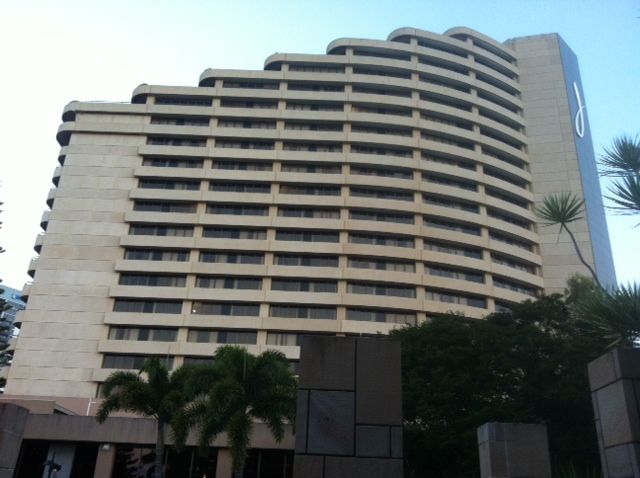
    Jupiter’s was built in the late 1980s as part of Australia’s initial casino mania. Today it’s looking its age despite several refurbishments in recent years.

    Apart from the gambling room, the complex’s main attraction is its proximity to the Gold Coast Convention and Exhibition Centre.

    Location

    Jupiter’s Hotel and Casino is located centrally on the Gold Coast in Broadbeach, around 4km South of Surfers Paradise and 20km North of the Airport, right next to the Pacific Fair shopping mall.

    The Casino sits on its own island some 500m away from the beach. The Gold Coast Convention Centre is a 200m walk from the hotel across an open air walkbridge.

    Most of the time that walk will be fine but be prepared to get soaked in wet weather.

    There is also a cheesy and largely pointless monorail that runs to the shopping complex across the highway. The $3 fare is reportedly waived for hotel guests but check at reception first.

    Check-in

    The front desk staff are friendly and helpful. There was no problem with checking in two hours before the official check-in time.

    Asking reception for some fresh milk for the tea making facilities was no problem.

    Rooms

    While it’s claimed there have been ongoing refurbishments since 2008, the rooms are dated and tired, despite a relatively recent paint job.

    Beds are comfortable and the blackout blinds do a good job of plunging the room into darkness and keeping the early morning or late evening sun out of the room on a hot day.

    The bathroom, mini-bar and tea making facilities are basic but adequate. Each room has a digital combination safe as well as ironing equipment.

    One aspect of the 1980s legacy is the scarcity of power points with only one double power outlet next to the fixed desk unit. Luckily there are nearby shopping centres to buy a powerboard if you can’t borrow one from reception.

    Rooms have wireless and wired Internet available for a fee, although it may waived for convention guests. Surfing and downloads are extremely quick.

    Amenities in the room are satisfactory with the standard range of free to air and cable TV stations including CNN, Bloomberg Asia and Sky.

    Unfortunately the room doesn’t have dressing gowns and it’s little touches like that which let the hotel down.

    Fitness Facilites

    the Gym is well equipped with the usual range of weights, rowing and walking machines and open from 5.30am on weekdays.

     It’s open to the public and could get crowded at busy times. The weekend times are fairly limited with Sunday being a stingy 8am to 4pm, Saturday’s are 7 to 5.

    If you want a swim, there’s a large, warm pool next door to the gym and lap swimmers can get a 25m stretch if it isn’t busy. The pool area is open from 6am to 9pm and also has two spa baths.

    Overall impressions

    Jupiter’s desperately needs an investor to spruce the place up. The public areas are looking  run down with chipped tiles and scuffed walls. Generally there’s a faded 1980s vibe about the place.

    That 1980s feel also comes from the patrons, a midweek stay at Jupiter’s will find you sharing with a lot of grumpy seniors who are presumably playing the pokies (slot) and games in the casino.

    In many respects Jupiter’s reflects much of what is wrong with Australian hospitality — a 1980s property that hasn’t had the investment to compete in the 21st Century catering for a declining, low value segment of the marketplace.

    Overall the hotel is adequate but there are better deals to be had on the Gold Coast.

    If you’re attending a conference at the Gold Coast Conference Centre then it may be worth checking out rooms at the nearby Sofitel or the many serviced apartments in the Broadbeach area.

    Paul stayed at Jupiter’s Hotel and Casino courtesy of Microsoft when attending the 2012 Australian TechEd conference.

    Similar posts:

  • Google announces eTown awards for Australian towns

    Google announces eTown awards for Australian towns

    I don’t normally post media releases onto the site, but it appears there’s no posting of the Google eTowns announcement. As I’m writing a story for Technology Spectator on it, here’s the release.

    One thing that leaps out when reading the media reports on this is how many outlets just copy and paste. Only the Fairfax entertainment reporter went to the effort of rewriting the release and adding some additional context. You have to wonder how long ‘churnalism’ can survive given readers are onto this laziness.


    EMBARGOED UNTIL THURSDAY 30th AUGUST, 4:30PM (EST)


    Perth wins top spot in Google’s eTown Awards

    Western Australia capital beats out eastern states as centre of digital boom

    Perth leads the list of Australia’s top 10 eTowns, Google announced today. This new Google award recognises and ranks those communities which are outpacing the rest of the country in having its small businesses use the web to connect with customers and grow.

    The web is transforming all businesses in Australia, not just those typically considered to be “Internet businesses”. The digital economy is already worth as much as Australia’s iron ore exports, according to Deloitte Access Economics, and it’s forecast to grow by $20 billion to $70 billion by 2016.

    To provide a snapshot of this vital economic activity, Google looked at more than 600 local government areas to analyse which communities are contributing the most to the digital economy. The top 5 metropolitan and top 5 regional eTowns for 2012 are:

    Metropolitan

    1. City of Perth, WA
    2. City of Yarra, VIC
    3. City of Adelaide, SA
    4. North Sydney, NSW
    5. Ryde, NSW
    Regional

    1. Byron Shire, NSW
    2. Meander Valley, TAS
    3. Cessnock, NSW
    4. Wingecarribee Shire, NSW
    5. Scenic Rim Regional Council, QLD

    Federal Small Business Minister Brendan O’Connor, who is launching the inaugural eTown Awards at an event in West Perth today, said;

    “The digital economy is fuelling Australia’s economic growth and it’s important businesses of every size are well equipped to take advantage of the potential.  I hope this award encourages other small businesses to get online to connect with people who are actively looking for their products and services.”

    Perth’s Lord Mayor Lisa Scaffidi said, “Perth may be known for its mining boom but this award shows that our businesses are actively grabbing hold of the digital boom. The City of Perth is proud of its eTown Award and I am delighted to represent an area whose businesses are so connected with both their local community and the entire world thanks to the web.”

    Online advertising is a growing phenomenon and Google, through its online advertising and other services, is in a good position to act as a barometer for the strength of this commercial activity – particularly in small businesses. To come up with the eTown Awards list, Google analysed data on the number of local businesses in each local government area which are advertising with Google AdWords and/or have created a free website using Google and MYOB’s Getting Aussie Business Online initiative.

    Byron Shire, home to the popular holiday destination, leads the regional eTowns list with a high proportion of accommodation, recreational hire and tours providers using the web to drive their businesses.

    Claire Hatton, Head of Local Business for Google Australia said, “The eTown Award winners show that anyone anywhere can reap the benefits of the digital economy. These days being on the web is as important as having a phone. Australians expect to be able to seek out products and services online, and local businesses need to be found to compete.”

    For more information about the eTown Award winners and for case studies on how local businesses are succeeding online and driving economic growth, visit www.google.com.au/ads/stories [NB: website will be available after embargo lifts].

    Media are invited to attend the announcement of the eTown Awards with the Minister for Small Business, Perth’s Lord Mayor and Google Australia.

    Local businesses located in each eTown may be available for interviews.

    Thursday, 30th August at 2:00pm – 3:00pm
    The Yoga Space
    Shop 11, Seasons Arcade,
    1251 Hay Street, West Perth.

    To RSVP to the event or for interviews please contact:

    Redacted

    Notes to Editors

    1. AdWords is Google’s online advertising system which enables businesses of all sizes to advertise relevant text ads next to Google search results. Businesses decide the text and their budget and only get charged when someone clicks on their ad.
    2. The Google eTown award top ten list was created by comparing the number of small and medium sized enterprises that used AdWords in each local government area and/or have created a website using Google/MYOB’s Getting Aussie Business Online. The results have been normalised for the relative population of each LGA.

    Similar posts:

  • Mosquitoes of the Internet

    Mosquitoes of the Internet

    Sydney Morning Herald urban affairs columinst Elizabeth Farrelly recently fell foul of one the big fish that inhabits the shallow, stagnant intellectual pond that passes for Australia’s right wing intelligentsia.

    As a result, Elizabeth found her personal blog infested with insulting comments from the Big Fish’s Internet followers.

    What focused their ire was Elizabeth complaining about a delivery truck parked across a bike lane. A bit like this genius.

    The funny thing with the righteous defence of the poor truck driver’s rights to privacy and blocking cycleways is where it the driveways to the gated communities for self-righteous and entitled self retirees that these commenters inhabit were blocked in a same way many of them would be reaching for the blood pressure pills.

    One of the great things about the Internet is that it allows all of us to have our say without going through the gatekeepers of the newspaper letters editor or talkback radio producer.

    The down side with this is that it gives everyone a voice, including the selfish and stupid – the useful idiots so adored by history’s demagogues.

    Luckily today’s Australian demagogues aren’t too scary and the armies of useful idiots they can summon are more likely to rattle their zimmer frames than throwing Molotov cocktails or burning the shops of religious minorities.

    Most of these people posting anonymous, spiteful and nasty comments are really just cowards. In previous times their ranting and bullying would be confined to their family or the local pub but today they have a global stage to spout their spite.

    These people are the irritating mosquitoes of the web and they are the cost of having a free and vibrant online society.

    It’s difficult to have a system where only nice people with reasonable views that we agree with can post online. All we can do is ignore the noisy idiot element as the irritations they are.

    This is a problem too for businesses as these ratbags can post silly and offensive comments not just on your website but also on Facebook pages, web forums and other online channels.

    Recently we’ve had a lot of talk about Internet trolls, notable in the discussion is how the mainstream media has missed the point of trolling – it’s about getting a reaction from the target. In that respect The Big Fish and his army of eager web monkeys have succeeded.

    The good thing for Elizabeth is her page views will have gone through the roof. That’s the good side of having the web’s lunatic fringe descend upon your site.

    Similar posts:

  • Is Australia’s blue sky future making way for a red sunset?

    Is Australia’s blue sky future making way for a red sunset?

    Australia’s political and business leaders are convinced the nation will ride on the back of a fast growing China for the foreseeable future.

    Having climbed off the sheep’s back during the 1980s and moved from being an economy dependent on agricultural exports to a ‘clever country’ exporting high value services and products, in the late 1990s Australia turned its back on building a modern economy and decided to stake the future on a never ending coal and iron ore boom driven by Chinese industrialisation.

    Smarter than Bill Gates

    Australia’s success in riding China’s coattails allowed the Reserve Bank Governor Glenn Stevens in 2010 to boast how he and the nation’s politicians were smarter than Bill Gates who nine years earlier warned Australia about being over reliant on commodities.

    Despite the hubris, there are real risks in the Chinese economy that the blue sky mining school of Australian economic management needs to plan for.

    China warnings

    The warning to US Presidential candidates on trade with China by Professor Patrick Chovanec of Beijing’s Tsinghua University’s School of Economics and Management is a good starting point.

    In his warning Professor Chovanec points out that Chinese growth in recent years has been driven by the construction sector, even if building activity were to stay constant this would shave off half of China’s growth rate. The options for stimulating the economy in manner similar to 2008 have narrowed.

    China’s economy is not just slowing, it is entering a serious correction.  The investment bubble that has been driving Chinese growth has popped, and there are no quick “stimulus” fixes left.  There is the very real possibility of some form of financial crisis in China before year’s end.

    China’s stimulus package was the world’s biggest response to the 2008 Global Financial Crisis, followed by the South Koreans (another Australian commodities customers) and Australia itself.

    While the Chinese commodities boom drove most of Australia’s trade, it was domestic spending driven by the Rudd government’s stimulus package that saved Australia from entering recession.

    Squandering a century’s boom

    One of the notable things about Australia’s commodity success in the 2000s is just how little a dent the booming coal and iron ore exports put in the trade deficit. Despite record terms of trade, Australians still manage to spend as much on imports as they make on exported goods.

    Not that this worries Australia’s leaders who seem to spend all of their time worrying about pandering to a tiny number of marginal seat voters who listen to fear mongering talkback radio hosts which is what has driven the last two weeks’ obsession with a few hundred asylum seekers.

    Professor Chovanec points out the Chinese leadership is distracted as well with their struggles over a messy change of Politburo leadership, risking that the policy makers might miss any opportunity they have to engineer a ‘soft’ landing for their economy.

    The biggest risk is that of a crisis engineered to distract a discontented population warns Chovanec;

    in a worst case scenario, China may be tempted to provoke a conflict in the South China Sea to redirect popular discontent onto an external enemy.

    Already such things are happening, as anti-Japanese demonstrations step up around China over an island dispute.

    There are no shortage of island disputes in the South China Sea and almost all scenarios involve allies of the United States – the only one feasible dispute that doesn’t is Vietnam and China’s leadership has had their nose blooded in such disputes with their southern neighbour before.

    Even if we don’t see military tensions between the US and China, we certainly are going to see trade and political disputes in the next few years as both countries adapt to their places in a changed world.

    For Australia’s business and political leaders, it means being prepared for a world more complex than one where a country can get by just lazily skimming a few dollars of easy iron ore exports to China.

    We have to hope Australia’s leaders are capable of dealing with the challenges of a much more dynamic and difficult world where huge growth of one friendly trading partner is not assured. The stakes are too high to be distracted by suburban apparatchiks scoring meaningless political points off each other.

    Similar posts:

  • Economic cholesterol

    Economic cholesterol

    Australia’s productivity isn’t growing and it’s fashionable among business community to blame Australia’s productivity decline on high labour rates.

    While there’s an argument that the cafe worker earning $25 an hour is overpaid – although we don’t hear the same criticism of multimillion dollar packages paid to executives with at best mediocre track records – the argument is far more complex.

    In the McKinsey report linked to above, the mis-investment is put down to the recent resource boom, but is this really true?

    To really understand why Australia hasn’t performed well, we need to look at why the country is so reluctant to invest in assets that will increase our productivity.

    The role of property

    Underlying the recent Australian “economic miracle” is the property industry. The country’s domestic building sector is one of the most efficient job generators in the world. Stimulate the Aussie property market and job growth ripples quickly through the economy.

    This was one the lessons learned in the 1990s recession – successive governments and bureaucrats have learned the mantra “go early, go hard and go residential” when it comes to cutting interest rates and introducing home building incentives like the first home owners grants.

    It was no coincidence that when the Rudd Government was faced by the Global Financial Crisis they launched a wave of initiatives to boost the property industry and shore household wealth. Just as the Howard and Costello governments did in response to the Long Term Capital Bank collapse, Asian economic crisis or the 2001 US recession.

    While those stimulus measures have kept Australia out of recession for two decades, the failure to unwind the measures after the economic shock has passed leaves the nation’s property market remains “hyper stimulated” and over valued. That over investment in property has sucked funds away from other areas which affects the competitiveness of Aussie industry.

    The great property squeeze

    One of the great tragedies of the 1990s was Sydney’s East Circular Quay precinct which could have been one or two of the world’s greatest hotel sites, literally on the steps of the Sydney Opera House.

    Instead, high priced apartments were built on the site and Sydney’s tourism and convention industries are crippled by a shortage of top end hotel rooms.

    Tourism isn’t the only industry affected by the Australia’s obsession with residential property – across the country service stations, sports clubs and convention centres are being demolished to make way for high rise apartment developments. No economic activity seems to trump property speculation when it comes to attracting Australian investors.

    Ideological beliefs

    Adding fuel to the property obsession are the ideologies of the 1980s which are still closely held by the nation’s business and political leaders.

    Capital gains tax concessions introduced by the Howard government in the late 1990s made property and share speculation far more attractive that invention, innovation or entrepreneurship.

    To make matters worse, Australia’s social security policies and taxation laws favour capital gains – any Australian over thirty who has tried to build a business has plenty of mates who did far better out of negatively geared property than those who foolish enough to create new enterprises.

    For those older entrepreneurs facing retirement, they are in for a nasty shock if their businesses don’t sell for what they hope. They would have been far better staying in a safe corporate job and buy a few negatively geared investment properties.

    Again, this ideological belief that capital gains trumps wage or business income means investment is steered away from productive assets and into residential property that can be held for a capital gain.

    The Ticket Clipping Culture

    Australia’s failure to invest in productive assets is not just a feature of the household investor, the corporate sector has a lot to answer for as well.

    While good in theory, the superannuation system has been a failure in providing a capital pool for new and innovative businesses and productive investments.

    The superannuation trustees have largely focused on hugging the index, the ticket clipping funds management culture means that any real investment for productive assets is restricted to funding toll roads where fat management fees and guaranteed commissions mean an easy life for those fund managers.

    In a perverse way, the short term appearance of the ticket clipping might mean increased productivity as costs are cut to improve profits. In the medium and long term, the lack of investment in these assets means in the long term these assets too cease to add productive capacity to the economy.

    Of course there’s more to infrastructure investment than toll roads and airports with crippling parking charges, but the ticket clipping classes of Australia’s investment community don’t see a quick buck in that.

    Increasingly the boards of Australia’s major companies are appointed by those running the superannuation funds and these people have the generational bias away from productive investment. Instead they see slashing IT, training or asset investment as costs to be cut in the quest of boosting bonus delivering profits.

    More fundamentally, three decades of consolidation in most of Australia’s industries has seen a generation of Australian executives whose main expertise is that of maximising their market power at the expense of their competitors. Investing in productive capacity is not a major concern for those corporations.

    Fixing the problem

    Getting Australians – whether mom and dad property speculators or high paid fund managers parking money in the ASX 200 or plonking money in the latest toll road boondoggle – to change attitudes and invest in productive capacity is going to take a generational change.

    As long as the attitude persists that property is a safe investment that doubles in real value every ten years then Australians are going to continue to ply cash into apartments and houses.

    It is possible that a period of Australian Austerity that suppresses property prices may force that change in investment attitudes. An weak property market is one of the unspoken effects of the spending cuts advocated by many right wing commentators,

    The question is whether those commentators, or the political classes who derive their much of their policies from right wing ideologues, view have the stomach for disruption that will come when weaning Australians from the teats of corporate ticket clipping and property speculation.

    Similar posts: