Tag: Australia

  • The saddest sign you’ll ever see

    The saddest sign you’ll ever see

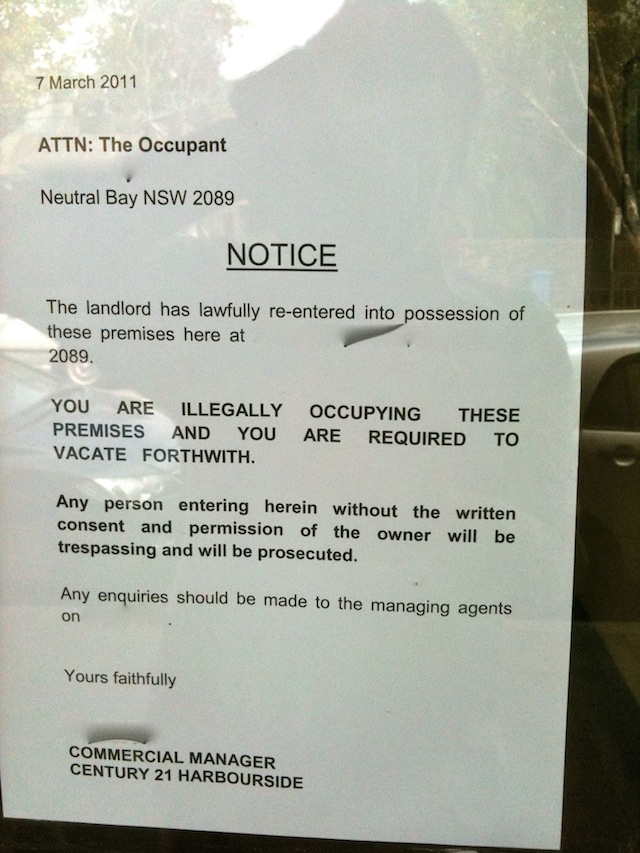
    The sign on an abandoned business announcing “Landlord taken possession” usually hides a pile of pain and distress.

    It’s not cheap or easy for a landlord to take possession of a business premises and for most to do so it’s usually the end of long period of unpaid bills and broken promises.

    Behind that sign is usually months, if not years, of stress and despair as a business owner has held onto a failing enterprise, bluffing their landlord, their suppliers, their staff, their own families and often themselves.

    Almost every one of those signs has a story of failed relationships, destroyed friendships and ruined marriages.

    Often they didn’t understand the cost of doing business and in many cases because they hadn’t consulted a bookkeeper or accountant earlier they didn’t understand their venture was always loss making despite what appeared to be a healthy cashflow.

    When the truth about the businesses becomes obvious, life for the honest owner of a failing enterprise tries to bluff themselves and those around them that things will be okay, that the dream is still alive.

    This is what worries me about many of the businesses that participate in group buying deals, they are desperate to keep their business afloat and believe the cashflow or publicity will save their failing venture. Even worse, many don’t understand how that “50% off” deal will affect their ability to pay staff and the landlord.

    Even where the failed proprietor has been one the “two percenters” – the 2% of our society that runs their affairs with no regard for the pain and suffering of those they hurt – many people, particularly the smaller suppliers and low paid workers, have taken a hit as bills went unpaid and promises were not kept.

    Most business owners though believe in their idea or vision and work long and hard in an attempt to achieve it. The majority of those who end up with the landlord taking possession are often those who ignored the signs and believed things would come good next season, next month or next week.

    I’m always saddened when I see a “landlord taken possession” sign like the one near me in the window of what was an Italian restaurant until recently. What’s the saddest business sign you see?


    Similar posts:

  • Australia’s one trick economy

    Australia’s one trick economy

    Earlier this week, Reserve Bank of Australia Governor Glen Stevens gave a speech to the Australian Industry Group on the world’s changing economic currents.

    That presentation has a number of pointers for Australian businesses on how we use technology, our investments and, most importantly, where the Canberra sees our economy going.

    Much of the Governor’s speech discussed how those of us who at the beginning of the century believed Australia’s economy had to diversify into new industry sectors — such as the IT sector — were proved wrong by the Dot Com Bust and the subsequent boom in the resources sector.

    “Australia would probably do best, in its production structure, to stick to its comparative advantages in minerals or agriculture or various services.” Mr Stevens quoted from ten years ago, “but it was hard going trying to make sensible points against the barrage of market and media commentary.”

    Perfect hindsight

    It’s impressive the Governor had this perfect hindsight which can overlook the role of ramping the housing markets by the Rudd and Howard governments to avoid the 2001 and 2008 US recessions along with the sheer good luck of having a resources boom through the last half of the decade.

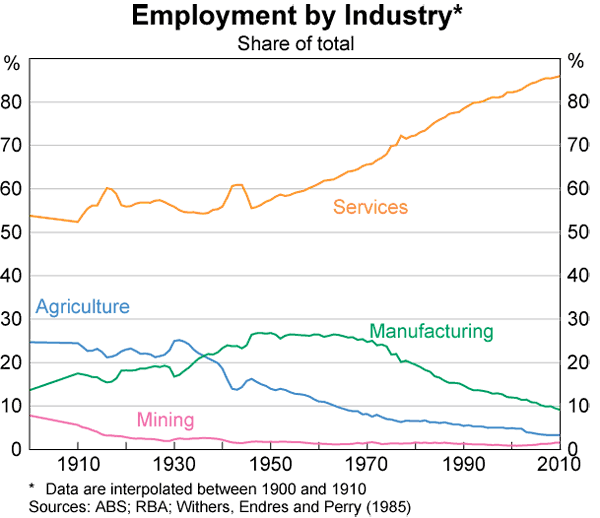
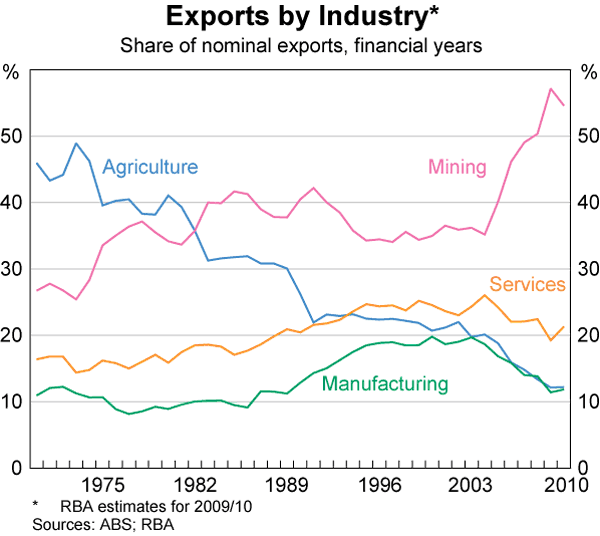
    During his speech the governor referred to an RBA research paper, Structural Change in the Australian Economy which casts an interesting light on the comparative advantages in those “various services”.

    That paper shows that service sector employment has risen to nearly 85% while its share of GDP has stayed around the same for the last twenty years, which to this non-economist’s mind implies the portion of national wealth is declining for service based workers and businesses.

    Sleepwalking into the dutch disease

    Of course those of us in the service sector could make it up by exporting but here again, service sector exports haven’t done much over the last decade which won’t be helped by the current high Aussie dollar — another aspect of the Dutch Disease we seem to have sleep walked into over the Howard and Rudd years.

    Those same statistics show mining employment has declined over that period as well and if you’re considering sending your kids down the pit, or even packing in your own city job to drive a mining truck, you might want to read the interesting work being done by the University of Sydney’s school of robotics.

    Generously, Governor Stevens didn’t completely write off the role of technology observing that, “in the old versus new economy stakes, it was probably in the use of information technology, rather than in the production of IT goods, that the gains would be greatest.”

    Invest in, but don’t develop, technology

    The Governor’s messages are clear to business people; our businesses have to invest in technology to be more efficient and we need to understand that government policy will be geared around the mining sector.

    Most importantly, we need to understand that on a national level there is no Plan B.

    In the last election it was clear both sides of politics based their policies, such as they were, on the assumption the China boom will last for the foreseeable future. Yesterday’s speech shows Glenn Stevens and the Reserve Bank share that outlook and no other alternative is being planned for.

    That’s fine for Glenn, Julia, Tony and their colleagues as they have safe, indexed pensions when they deign to cease giving us the benefit of their visionary leadership.

    In the business community we don’t have that luxury; a plan B is required just in case things don’t quite work out the way we hope. As the Governor says:

    Succeeding in the future won’t ultimately be a result of forecasting. It will be a result of adapting to the way the world is changing and giving constant attention to the fundamentals of improving productivity. That adaptability is as important as ever, in the uncertain times that we face.

    That’s excellent advice. How adaptable is your business in these uncertain times?

    Similar posts:

  • How broadband won the Australian election

    How broadband won the Australian election

    In a dour and negative Australian election campaign, the National Broadband Network was the one issue separated the look alike policies of the two major parties. In the end, it decided the election.

    Privately developed communications networks are rare in the nation’s history for a combination of factors including Australia’s population distribution and commercial appetites for investment risk.

    Australian governments have always been critical to the development of regional communications, from the establishment of state operated railway networks, through the post office owned telegraph and telephone networks and eventually the road system.

    So the National Broadband Network is typical of Australian communications development where the government provides the infrastructure framework and the private sector grows around it.

    There’s no doubt regional communities understood the importance of being connected to the global economy, successive Federal governments have struggled with a patchwork of government programs such as the Universal Service Obligation and Broadband Connect in an effort to guarantee some level of service for all Australian communities.

    The NBN itself was conceived in the realisation that any solution that relied wholly on private funding was not going to deliver a national solution. This was view that regional organisations such as Digital Tasmania had held all along when agitating for their communities not being left behind.

    And Tasmania was were the vote mattered, the coalition failed to win any Tasmanian seats where three would have been won had the state followed the rest of the nation. Those three seats; Bass, Franklin and Braddon would have been enough to give the Liberal and National Parties power.

    Had the coalition focussed on the legitimate criticisms of the NBN such as the government’s failure to quantify the $43 billion price tag or NBNCo’s failure to produce a business plan then they may well have won the election.

    As the country Independents stated, the NBN was one of the key considerations in their decision to support the Labor government, so not getting their NBN policy right cost the coalition government in two ways.

    Now the NBN is going ahead we need to focus on what it can deliver, along with a sensible discussion on the right mix of fibre and wireless infrastructure, the proportion of private and public investment and exactly how much the project is going to cost.

    Now is the time to get on with building what will be the 21st Century equivalent of the roads and railways of the 20th and 19th Centuries.

    Similar posts: