Tag: Australia

  • Can innovation save Australia?

    Can innovation save Australia?

    This is the prepared version of my speech at the Cloud Crowd “Can Innovation Save Australia” debate. I was on the affirmative team, even though in truth I’m probably close to the negative side.

    Australia truly is the lucky country. We entered the Twentieth Century as one of the richest countries on earth and at the turn of millennium we remained so.

    The first fifteen years of this century have been equally kind, however that prosperity has been built on a mining boom and an ever growing property bubble.

    Now those foundations are slipping – the mining boom is over and Australians have became the most indebted people on the planet as housing loans put an increasing burden on Australian families, a situation that is not sustainable.

    The three Bs of Australian Business

    Making matters worse, the good years of the last three decades have seen Australia’s business community become inward looking and complacent, as one of my colleagues recently wrote Australian managers are obsessed with their “Three Bs” – Bonuses, BMWs and their Balmoral Beach Club memberships.

    Australia though has a fine history of invention and innovation, we’ve seen ideas ranging from the stump jump plough and Hills hoist through to the flight data recorder and Cochlear ear implants change the world.

    Cochlear itself forms the centre of an Australian hearing technology hub at Macquarie University which brings together university researchers, private sector R&D and some of the world’s best medical specialists to form a globally competitive centre of excellence. We can do great things.

    Starting from behind

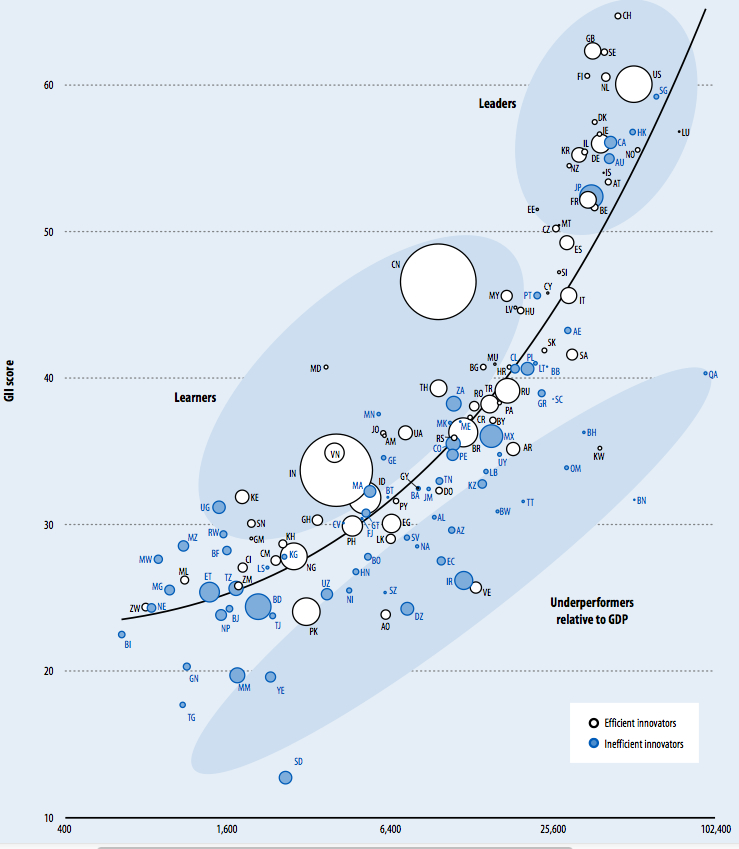
    However we are starting a long way behind the rest of the world. Not only is Silicon Valley speeding ahead but so too are countries as diverse as the UK, Israel and Singapore. One of the understated stories in Australian media is just how heavily China is investing in its pivot into a knowledge and innovation based economy. Others in our region like Japan, South Korea, Taiwan and Malaysia are already well down the path of moving to economies based on 21st Century technologies.

    All of these countries – their governments, their business leaders and the communities – have recognised success in the Twenty-First Century will depend upon investment in education, research, development and businesses that harness the great powers being unleashed by today’s technologies.

    This is where Australia’s opportunity also lies. In the 19th and 20th Centuries the country was the beneficiary of technologies like the steam ship, the telegraph, refrigeration, electrification and, at the end of the Twentieth century, the great global financial deregulations. We truly were the lucky country.

    Staying lucky

    Remaining lucky in the 21st Century is going to take more than riding on the back of sheep, the end of coal train or surfing the wave of easy credit that crashed over our economy in the 25 years after 1990. We are going to have to be smart, canny and adventurous.

    Australians though have shown they can grasp opportunities and with government policies that favour innovation over speculation, investment over ticket clipping, a business community that pulls its weight in research and a community that values education at all levels we can do it.

    So yes, Innovation can save Australia but we as a nation have to be prepared to work at it and change many of our current ways of thinking.

    Similar posts:

  • Hubris and the cloud

    Hubris and the cloud

    A few months back I spoke to Amazon Web Services’ Chief Information Security Officer Stephen Schmidt about how his company was expanding in Australia and East Asia.

    One of the questions I asked was about the Australian footprint where all of AWS’s services are based in Sydney. Many of the company’s customers have questioned the suitability of that setup.

    Schmidt was dismissive of the need for data centres outside of Sydney to serve the Australian market saying, “the Australian footprint is largely based on what the customers tell us. Right now they are happy with the way things work in Sydney, we have POP locations in other areas for edge access.”

    “What we hear from customers is the network connectivity between Melbourne and Sydney is very good,” he added, “it’s really irrelevant whether you’re based in either city.”

    During the storms that hit Sydney last week those words came back to haunt AWS as their data centers were knocked out of action.

    Not a good look and now one suspects a Melbourne based data center, or at least some redundancy down under, is now higher on AWS’s to-do list.

    Similar posts:

  • Invite only collaboration

    Invite only collaboration

    The success of Silicon Valley is partly based on the sharing of information. Can a closed group of business leaders replicate that success?

    Currently I’m in the United States interviewing Australian startup founders who’ve moved to the Bay Area on why they’ve chosen to move their businesses in Silicon Valley.

    Naturally there’s a whole range of reasons for relocating across the Pacific – for some most of their market was in the US, for others it was the accessibility of investors while for many the move was always part of their plan to go global.

    A place you fall in love with

    The almost unanimous comment though from the founders was one of the attractions of the Bay Area are the support networks, “It’s a place you fall in love with straight away – it’s the people and the attitude,” says Holly Cardew.  “People ask what can I help you with.”

    Cardew, the founder of image management service PixC, sums up the consensus on the Bay Area business culture of ‘paying it forward’. Almost every entrepreneur who’d moved to San Francisco mentioned how the question “how can I help you?” was key to building a network and finding customers, staff and investors.

    That openness to helping the ecosystem was greatly appreciated by Carl Hartmann, co-founder of logistics startup Temando. “I’m here today because people were kind enough to pay it forward,” he states.

    Since then Harmann has become one of the ‘go-to guys’ for Australian entrepreneurs arriving in San Francisco and almost everyone we spoke to mentioned Carl as being a great help for them in obtaining initial introductions.

    Building a community

    Those introductions and helpful acts are essential in a community where the most valuable asset is the people, not just investors but the entire complex ecosystem of coders, lawyers, publicists, designers and various other disciplines essential for an industrial hub to thrive.

    Which raises the question about yesterday’s announcement of the TechSydney initiative, a project claiming “to address the Sydney innovation ecosystem’s greatest challenge: collaboration.”

    This is a good idea, and one this writer was involved in seven years ago with the failed Digital Sydney program in 2010 which aimed to bring together the disparate groups that make up Australia’s disparate tech and digital media sectors.

    Government failures

    Digital Sydney failed because the state government is poor executing at such initiatives so the fact TechSydney is being led by experienced startup founders, investors and advisors should give hope this attempt would be more successful.

    However, TechSydney’s press release quickly dispels that hope with the opening line.

    Australia’s most successful startups and global tech giants, including Atlassian, Airbnb and Airtree Ventures are backing a new not-for-profit aimed at turning Sydney into Australia’s Silicon Valley.

    The “Australian Silicon Valley” line shows a focus on the current Bay Area tech startup model funded by venture capital and seed investors who are happy to forgoe profits in the hope of big capital gain when the business is acquired or goes public – the Silicon Valley Greater Fool model.

    Silicon Valley itself is pivoting away from this model with businesses across the Bay Area now frantic to at least have the illusion of being profitable or on the path to making money. In narrowly promoting the tech startup model TechSydney seems to be trying to catch a wave that has already broken.

    Slamming the door

    The main worry from the TechSydney announcement though is that it seems to go against the open door policy that makes Silicon Valley so successful. Rather than encouraging questions and new entrants, TechSydney is slamming the door shut with only the successful and well connected invited.

    The group will launch at an exclusive invitation-only Dinner on May 30 at the Powerhouse. Sydney’s top 200 technology companies will be in attendance. The first 100 have already been invited, and the group is now taking applications for the next 100 attendees at TechSydney.com.au, and is urging companies to register their interest today.

    In some respects this is to be expected of the Sydney business community – the city’s industry is based upon the Rum Corps model of the colony’s early days where success is based upon connections and influence rather than being open and collaborative. This attitude underpins the ‘mates culture’ that is critical to acquiring power and wealth in New South Wales and across Australia.

    With an attitude of having an ‘invite only’ group leading the push the hopes of creating an ‘Australian Silicon Valley’ are doomed. By locking out new entrants or dissenting thinkers, it’s impossible to create a vibrant hub.

    Creating an open mindset

    For Sydney, or any other Australian city, to succeed as a global hub in any industry that legacy of the Rum Corps, the mates network, needs to be suppressed and a more open, collaborative mindset put in place.

    TechSydney can do that if its leaders choose to do so. Hopefully at their invite only meeting at the end of the month the wise men of Sydney’s tech elite will decide that an open initiative that welcomes newcomers and tolerates new ideas is the best opportunity to make the city a global leader.

    Similar posts:

  • Politics enters the age of disruption

    Politics enters the age of disruption

    One of the key features of modern western nations is how stable politics is with very few major parties being less than fifty years old and many boasting a history lasting back a century or more.

    Now in the US and Australia we’re seeing the slow motion implosion of the established parties of the reactionary side of politics – it would be misleading to describe the schoolboy ideologies of most American Republicans or Australian Liberals as being ‘right wing’.

    Tony Wright in the London School of Economics blog asks What Comes After the Political Party?

    Wright’s view is political parties are doomed to extinction as their memberships dwindle and this is an opinion shared by many watching the declining participation in formal politics over the last fifty years.

    One result of that declining participation has been the steady increase in power of the machine apparatchiks who’ve increasingly replaced boots on the ground with corporate funding.

    The consequence of that increase in power has been a steady disconnect between the concerns of the electorate and the priorities of the party leadership.

    In the US that disconnect resulted in the Republicans blindsided by the rise of Donald Trump and the Australian Liberal Prime Minister increasingly looking like Grandpa Simpson as his party shuffles towards what increasingly looks to be a ballot box disaster.

    Both parties are likely to rip themselves apart as the contradictions of the modern reactionary movement – dismantling public services while increasing government powers – come home to roost with the ideologues and pragmatists within the organisation fighting bitterly.

    The truth is political parties are no more permanent than businesses, or indeed nations, and in a time of economic change it isn’t surprising old parties die and new ones are formed.

    While political parties won’t cease to exist, the new political parties that will rise from the wreckage of today’s will be different in both their philosophies, organisation and membership.

    Parties that were formed in the horse and carriage days or the early era of newspapers and radios are always going to find the internet era to be a challenge, that they are being run by men whose political theories haven’t moved for fifty years only guarantees their demise.

    In many ways, what’s changing politics is exactly what’s changing business. However the politicians and their supporter seems far more oblivious to change than their commercial counterparts.

    Similar posts:

  • Innovation as a safe word

    Innovation as a safe word

    After two complacent decades Australia’s pivot away from a mining and housing  based economy is promising to painful. In anticipation of the punishment to come, the nation’s political and business leaders have devised a safe word they hope will ease the pain — innovation.

    That safe word was desperately repeated as a group of “innovation rock stars” gathered last week at Sydney’s Knowledge Nation summit, billed as bringing together the nation’s leaders to drive the implementation of the Australian Government’s National Innovation and Science Agenda.

    Knowledge Nation showed that despite having a safe word Australia’s Anglo-Saxon, male dominated elites aren’t prepared for an economic pivot and true change in the nation will have to be a grass roots movement led by small business and community groups.

    A lack of diversity

    Notable in the selection of “key leaders from the innovation, science and technology ecosystem, including entrepreneurs, business leaders, investors, researchers and scientists, and policymakers” was the lack of diversity.

    A look of the speaker list showed only four of the fifteen speakers being women and only one of the 15 not being from an Anglo-Saxon background.

    One of the baffling things about modern Australian is the how few from non-Anglo groups feature among the ranks of the business, politics or media leaders. Yet Australia’s greatest success has been in integrating the successive immigration waves over the late Twentieth Century.

    A visitor to Australia could be forgiven for not noticing the country’s diverse population as the media, politics and business is dominated by those of British heritage. For the country, this is a tragic wasted opportunity and was reflected in the line up of ‘innovation rockstars.’

    Disjointed government

    The political ‘leadership’ also reflected that lack of diversity with three Federal government ministers — all men and no opposition, state or local figures — lined up to recite the grab bag of thought bubbles that are what now passes as policy in Australian government.

    Ministers offered succession of turgid recitals of disjointed programs which do little to address Australia’s structural barriers towards innovative businesses or the wholesale defunding of education institutions although the Innovation Minister’s snarling response to an academic’s question about R&D spending told much about their defensive posture.

    The political ‘leaders’ illustrated a key problem in the nation’s pivot. The long term failure of consistent planning across portfolios means no Australian investor, entreprenuer or student can have any confidence in government policies over a five or ten year horizon when policies barely survive one ministerial thought bubble.

    Overall though the biggest gap in the Knowledge Nation summit was its focus on government — the real weakness however lies in the corporate sector where inward facing service industries are distributing more on dividends than in research and development.

    Inward focus

    That inward focus, articulated well by Freelancer.com CEO Matt Barrie who described how almost all of the nation’s twenty biggest corporations are domestically focused service businesses, is the real problem facing Australia as it tries to pivot its economy away from being dependent on the fading Chinese commodities boom and domestic property speculation.

    A lack of globally competitive businesses leaves the nation exposed as most employment is in organisations that are unable to survive outside a relatively protected domestic market. It also means these companies don’t see the need to invest in research and development as their fat profits are dependent upon market dominance rather than innovative products and services.

    Barrie also had the only challenging idea in a day that promised many of them, the somewhat tired trope of abolishing Australian state governments.

    Government focus

    It’s quite touching that Barrie sees Australian Federal governments as being havens of intelligent, long term policy making when all the data indicates otherwise. The very idea of Canberra running education given its flip flopping on the Gonski reforms, confused policies on university funding and ideological obsession with funding elite private schools is, quite frankly, derisory.

    That the most challenging idea out of the day was the old chestnut of flattening Australian government speaks volumes of the dearth of original thinking coming out of the nation’s business and political leadership.

    In truth, Australian business needs to be snapped out of its inward rent seeking focus while the household sector needs to be weaned off speculating on residential property. These require real policy reform and cultural change.

    Little leadership

    Knowledge Nation showed there no understanding, let alone no appetite for that reform or change from Australia’s elites and as the Australian economy starts to feel the pain from twenty years of complacency we can expect the safe word of ‘innovation’ to be increasingly used by the nation’s elites.

    The lesson from Knowledge Nation is Australia’s economic pivot will come from the grassroots. It will be startups, small businesses, community groups and local governments that will lead the change. Australians waiting for government support and corporate leadership will be waiting a long time.

    In meantime, squealing ‘innovation’ at every sign of economic pain will be occupying much of the time of Australia’s comfortable Anglo elites.

    Similar posts: