Tag: big data

  • Dealing with the data explosion

    Dealing with the data explosion

    “Last year’s mobile data traffic was nearly twelve times the size of the entire global Internet in 2000.”

    That little factoid from Cisco’s 2013 Virtual Networking Index illustrates how the business world is evolving as various wireless, fibre and satellite communications technologies are delivering faster access to businesses and households.

    Mobile data growth isn’t slowing; Cisco estimate global mobile data traffic was estimated at 885 petabytes a month and Cisco estimate it will grow fourteen fold over the next five years.

    Speaking at the Australian Cisco Live Conference, Dr. Robert Pepper, Cisco Vice President of Global Technology Policy and Kevin Bloch, Chief Techincal Officer of  Cisco Australia and New Zealand, walked the local media through some of the Asia-Pacific results of Virtual Networking Index.

    Dealing with these sort of data loads is going to challenge Telcos who were hit badly by the introduction of the smartphone and the demands it put on their cellphone networks.

    A way to deal with the data load are heterogeneous networks, or HetNets, where phones automatically switch from the telcos’ cellphone systems to local wireless networks without the caller noticing.

    The challenge with that is what’s in it for the private property owners whose networks the telcos will need to access for the HetNets to work.

    One of the solutions in Dr Pepper’s opinion is to give business owners access to the rich data the telcos will be gathering on the customers using the HetNets.

    This Big Data idea ties into PayPal’s view of future commerce and shows just how powerful pulling together disparate strands of information is going to be for businesses in the near future.

    But many landlords and wireless network owners are going to want more than just access to the some of the telco data — we can also be sure that the phone companies are going to be careful about what customer data they share with their partners.

    It may well be that we’ll see telcos providing free high capacity fibre connections and wireless networks into shopping malls, football stadiums, hotels and other high traffic locations so they can capture high value smartphone users.

    One thing is for sure and that’s fibre connections are necessary to carry the data load.

    Anyone who thinks the future of broadband lies in wireless networks has to understand that the connections to the base stations doesn’t magically happen — high speed fibre is essential to carry the signals.

    Getting both the fibre and the wireless base stations is going to be one of the challenges for telcos and their data hungry customers over the next decade.

    Paul travelled to the Cisco Live event in Melbourne courtesy of Cisco Systems.

    Similar posts:

  • Using big data to find the cupboard is bare

    Using big data to find the cupboard is bare

    Last week this blog discussed whether telecommuting was dead in light of Marissa Mayer’s banning of the practice at Yahoo.

    While I don’t think telecommuting is dead, Marissa Mayer has a big problem figuring out exactly who is doing what at the company and abolishing remote working is one short term way of addressing the issue.

    If Business Insider is to be believed, Yahoo!’s absent staff problem is bad.

    After spending months frustrated at how empty Yahoo parking lots were, Mayer consulted Yahoo’s VPN logs to see if remote employees were checking in enough.

    Mayer discovered they were not — and her decision was made.

    Business Insider’s contention is that Mayer makes her decisions based on data analysis. At Google she drove designers mad by insisting on reviewing user reactions to different layouts and deciding based on the most popular results.
    If this is true, then Marissa Mayer is the prototype of tomorrow’s top executives – the leaders in business by the end of this decade will be the ones who manage data well and can sift what matters out of the information deluge.
    For all of us this is going to be a challenge with the probably the biggest task of all being able to identify which signals are worth paying attention to and which should be ignored.
    Of course, all this assumes the data is good quality in the first place.
    An assumption we’ve all made when talking about Big Data is that it’s about marketing – we made the same assumption about social media.
    While Big Data is a good marketing tool, it’s just as useful in areas like manufacturing, logistics, credit evaluations and human resources. The latter is what Yahoo!’s staff are finding out.
    In age of Big Data it may not pay to a slacker, but it’s going to be handy if you want to know what’s going on your business.

    Similar posts:

  • Smelling digital garbage

    Smelling digital garbage

    Excel spreadsheets lie at the core of business computing, but what happens when they go wrong?

    James Kwak writing in the Baseline Scenario blog describes how Excel spreadsheets have an important role in the banking industry and their key role in one of the industry’s most embarrassing recent scandals.

    In the early days of the personal computer spreadsheets; it was company accountants and bookkeeping clerks who bought the early PCs into offices to help them do their jobs in the late 1980s .

    From the accounts department, desktop computers spread through the businesses world and the PC industry took off.

    Over time, Microsoft Excel displaced competitors like Excel 1-2-3 and the earliest spreadsheet of all, VisiCalc, and became the industry standard.

    With the widespread adoption of Excel and millions of people creating spreadsheets to help do their jobs came a new set of unique business risks.

    The weakness with Excel isn’t with the program itself, it’s that the formulas in many spreadsheets aren’t properly tested and often incorrect data is put into the wrong fields.

    In his story Kwak cites the JP Morgan spreadsheets that miscalculated the firms Value-At-Risk (VAR) calculations for synthetic derivatives. The result was the London Whale debacle where traders were allowed to take positions – some would call them bets – exposing the bank to huge potential losses.

    It turns out that faulty spreadsheets had a key role as traders cut and paste data between various spreadsheets and the formulas that made the calculations had basic errors.

    That a bank would have such slapdash procedures is surprising but not shocking, almost every organisation has a similar setup and it gets worse as a project becomes more complex and bigger numbers become involved. The construction industry is particularly bad for this.

    Often, a spreadsheet will show out a bunch of numbers which simply aren’t correct. Someone made a mistake entering some data or one of the formulas has an error.

    The business risk lies in not picking up those errors, JP Morgan fell for this and probably every business has, thankfully to less disastrous results.

    My own personal experience was with a major construction project in Thailand. One sheet of calculations had been missed and the entire budget for lights – not a trivial amount in a 35 storey five star hotel – hadn’t been included in the contractor’s price.

    This confirmed in my mind that most competitive construction tenders are won by the contractor who made the most costly errors in calculating their price. Little has convinced me otherwise since.

    In the computer industry there’s a saying that “garbage in equals garbage out” which is true. However if the computer program itself is flawed, then good data becomes garbage.

    Excel’s real flaw is that it can make impressive looking garbage that appears credible if it isn’t checked and treated with suspicion. The responsibility lies with us to notice the smell when the computer spits out bad figures.

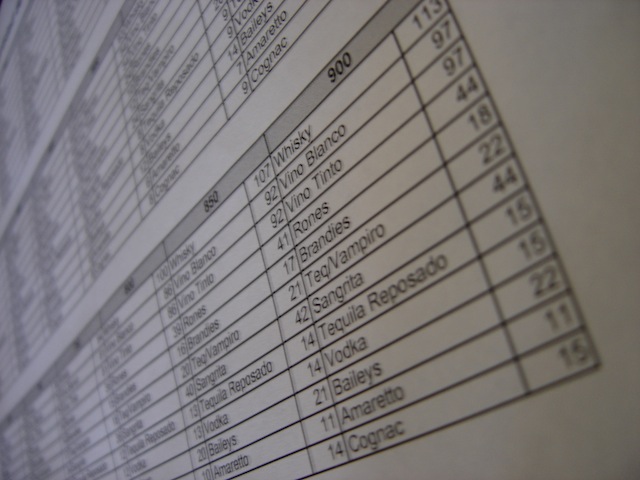
    Spreadsheet image courtesy of mmagallan through sxc.hu

    Similar posts:

  • Democratising Big Data

    Democratising Big Data

    Common Crawl is a not-for-profit web crawler service that makes the data collected open for all to use. A post on the MIT Technology Review blog speculates how the initiative might spawn the next Google.

    One of the problems with Big Data is that it’s held mainly by large corporations and government agencies, both of which have the tendency to keep their data private on that basis that information is power and power means money.

    We see this in the business models of Facebook, Google and many of Silicon Valley’s startups; the information garnered about users is as, if not more so, valuable as an utility from the product.

    Initiatives like Common Crawl tilt the balance somewhat back towards consumers, citizens, and smaller businesses.

    How well Common Crawl and other similar initiatives fare remains to be seen – Wikileaks was a good example of how such projects can flare out, collapse under the weight of egos or be harrassed by corporatist interests.

    In search, Google are open to disruption as they tweak their results to suit initiatives like Google Plus. During the company’s earnings call earlier this week Larry Page spoke of the challenges of staying focused on the opportunities that matter, it may well be the company is more distracted from its core business than it should be.

    Whether Common Crawl disrupts Google is up to history, it could just as well be a couple of kids called Sergei and Larry with a smart idea.

    The imperative now though is to try and keep as much public data available for everyone to use and not lock it away for the privileged few. That will let the future Googles develop while making our societies more fairer and open.

    Similar posts:

  • Tracking the knowledge graph

    Tracking the knowledge graph

    “Married Men Who Like Prostitutes” is juicy search term and the results can wreck marriages, careers and lives.

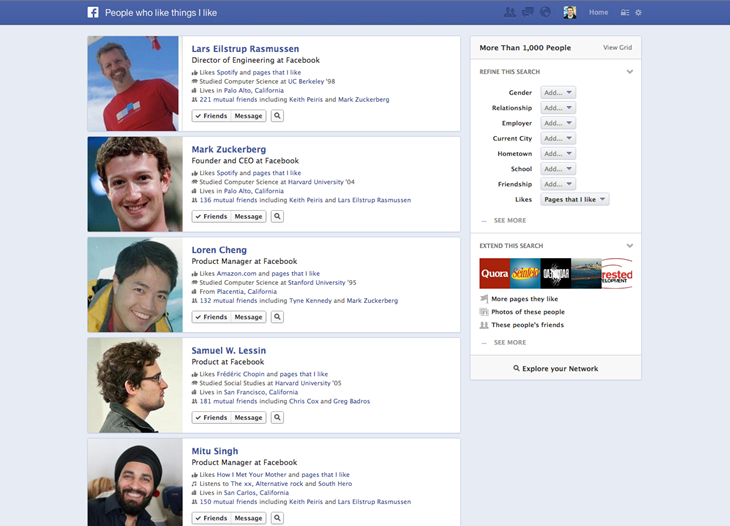
    This is one of the Facebook Graph searches UK tech commentator Tom Scott posted on his Actual Searches on Facebook Tumblr site which lists, mercifully anonymised, the results.

    What should worry anybody who uses Facebook is that this data has been in the system all along, advertisers for instance have been able to target their marketing based on exactly this information, Graph Search just makes it quicker and easier to access. This is why you should be careful of what you like and who you friend online.

    Tom Scott has a terrific Ignite London presentation which looks at just how vulnerable an individual is by over sharing online. In I know what you did five minutes ago, Tom finds an individual, discovers his mother’s maiden name and phone number all within two minutes.

    Facebook isn’t the only service we should be careful of, it just happens to be the one we overshare data with the most. When you start stitching together social media services with government and corporate databases then a pretty comprehensive picture can be made of a person’s likes and preferences.

    The best we can hope for in such a society is that picture is accurate, fair and doesn’t cast us in too unfavourable a light.

    In same cases though that data can be dangerous, if not fatal.

    As potential employers, spouses and the media can easily access this information, it might be worthwhile unliking obnoxious, racist and downright stupid stuff. There’s a very good chance you’ll be asked about them.

    Similar posts: