Tag: big data

  • Big Data, Bad Data

    Big Data, Bad Data

    “What about bad data?” an audience member asked me at a recent presentation where we looked at how social media and big data were changing business.

    His question came from an experience where he had sacked a staff member who now refuses to change their status as being employed by his company.

    The former employee wants to keep up appearances that they are still being employed and this causes reputation problems for their old employer.

    All of this makes that LinkedIn information on the employee and the business junk data. Rather than being useful, it’s misleading noise and that is a risk to LinkedIn’s business.

    This ties into Facebook’s problem with groups, if people can be added without their consent then the risk of mischief making and false information increases. In turn, this makes Facebook’s targeted advertising less effective.

    Similarly, Google’s aim to become an “identity service” becomes less feasible when the information they’ve gathered isn’t accurate – again something that is increases with their opaque policies and poor support.

    In Terry Gilliam’s movie Brazil, a man is arrested and dies under interrogation because of a fly getting stuck in a typewriter. We’re in the age of a billion flies being stuck in typewriters.

    LinkedIn, Facebook and all the other social media and “identity” services need to build in systems where those mistakes can be managed and the consequences limited. If they can’t do this then their value and relevance will be limited.

    Big Data shouldn’t mean bad data, and we all need to be confident that the data about us and the data we use in our lives is reasonably accurate.

    Similar posts:

  • Meeting the solid state Woz

    Meeting the solid state Woz

    When the opportunity comes to meet co-founder of Apple computer Steve Wozniak you jump at it, despite being jet lagged from the previous day’s flight.

    One of the tough things when writing about Steve Wozniak is that he is a fast talker. You have to be quick to keep up with his ideas and words.

    Steve was in town to show off the range of solid state computer memory cards manufactured by Fusion-iO, a company based in Salt Lake City.

    Wozniak liked the idea so much he became Fusion-iO’s chief scientist in 2009. “When I first saw the iO drive, it was so beautiful I had to buy one from the company and put it in a frame just to frame it at home.”

    What enthused Woz were Fusion-iO‘s range of NAND flash memory cards that speed up servers while reducing their power and cooling requirements.

    Those power savings are important for data centres when hundreds of thousands of servers might be in one building, Fusion-iO’s CEO and co-founder David Flynn estimates this could save up the industry a $250 billion a year in operating costs.

    Probably the biggest benefits though are in the corporate space, one Flynn’s boasts is how one movie studio used Fusion-iO’s products to reduce transcoding between formats from two hours to 39 seconds.

    Another case study they show off is how grocery chain Woolworths were able to reduce the 17 hours to run their weekly trading reports to three hours meaning they were able to capture weekend figures for their weekly Monday morning board meetings.

    For smaller businesses, the biggest benefit is these products can turn fairly basic desktop computers into workstations with the $2,500 ioFX card promising some serious post production capabilities for a system although one would expect an entry level box wouldn’t have the data connection, hard drive or – most importantly – power supply to cope with the demands of such a device would put on the typical cheap components in a basic desktop system.

    All of these changes though are heralding some pretty big changes for big and small businesses.

    Where Steve Wozniak sees the greatest application of moving data faster is in Artificial Intelligence applications like voice recognition. Apple’s Siri is a good example of this.

    The barrier to effective voice recognition is the sheer amount of data processing required to effectively understand voice commands. Doing this on cloud services is a far more efficient and effective way of doing this.

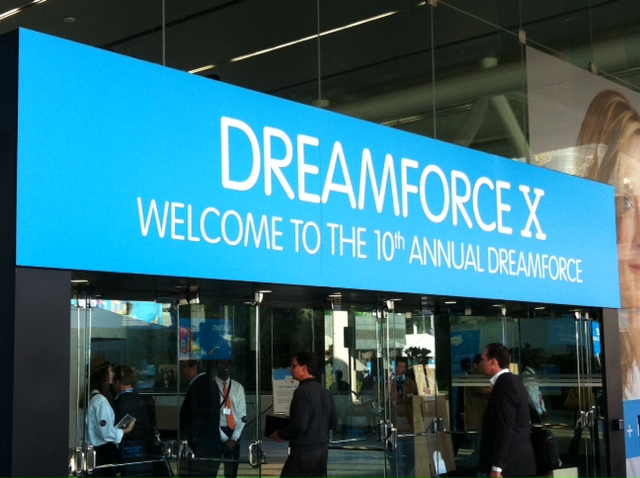
    As we saw at Dreamforce last week, the sheer amount of data pouring into companies is changing how they manage information. Getting access quickly to relevant information is an important part of managing it.

    “I’ve never gotten so excited about or fell in love with a technology like this since Apple.” Says Wozniak.

    Having a chance to speak to Steve Wozniak up close shows that fast talking enthusiasm is for real. The Woz is a real geek.

    Like all true geeks Wozniak is passionate about what he believes in – whether it’s about NAND flash cards or becoming an Australian resident he bubbles with enthusiasm. Just don’t try writing notes down while he’s in full flight.

    Similar posts:

  • Redefining the social business

    Redefining the social business

    Over the last two years Salesforce.com have been one of the more aggressive buyers of cloud computing and social media startups with acquistions of companies like Rypple, Desk.com, Buddy Media and Radian6.

    Today, ahead of the company’s annual Dreamforce conference in San Francisco, Salesforce.com announced a revamped product range that brings together the social media and big data tools from these acquisitions along with some in house innovations.

    Salesforce expect nearly a hundred million enterprise tablet computer users and smartphones by 2016, so like all web based services, they have to make their platform available as an app. Salesforce’s new Touch iOS App allows users to use Salesforce.com as an app on the iPhone.

    Despite Mark Zuckerburg’s disavowal of HTML5 last week, Salesforce remains committed to the standard despite developing an app for the iPhone.

    “Initially we’re rolling out Touch in a way we’ve made sure works the way people want it to work on an iPad,” Peter Coffee, Vice President of Platform Research at Salesforce.com, says.

    “We are reiterating our commitment to HTML 5 as a device and platform neutral cluster of standards.

    “As HTML5 begins to clearly coalesce we’re making a major commitment to that and we’re going to lead the way while the opposition is still trying to work on one browser.”

    Salesforce continues their focus on social media with their Chatter service becoming a key part of their Force.com cloud applications platform. Chatter itself is being extended with a new feature to enable companies to create their own branded communities.

    That social integration continues as the company rolls out Social Key, an application which, as Andy MacMillan, senior vice president and general manager of Data.com says “will empower companies to derive value from social data for the first time.”

    If Social Key does achieve a real measure of value from retweets and Facebook posts it may well mean many social media experts will have to return to multi-level marketing or real estate sales. This in itself is not a bad thing.

    The new Salescloud platform uses Chatter to build business intelligence on customers, bringing data across a business to help sales teams target their efforts more effectively.

    While sales is by definition the focus of Salesforce they are also launching a similar Chatter service for support teams. This compliments the acquisition of Assist.ly at the beginning of the year.

    Marketing too is being targeted by Salesforce with the launch of Marketing Cloud that combines the Buddy Media Facebook marketing service and the Radian6 social media monitoring platform.

    While already the leader in business cloud applications, Salesforce are making a strong bid to dominate the sector in a way that Microsoft did in the desktop computer industry twenty years ago.

    Browsing through the 400 partner stands at the Dreamforce Expo shows Cloudforce  are building a deep ecosystem around their products that will make it hard for competitors to break into the space.

    Whether Salesforce achieve this dominance remains to be seen, but they are certainly giving a new set of tools for businesses to understand their customers.

    Pricing and Availability
    Salesforce Touch is generally available today on iOS devices, and included in all Salesforce editions.

    Sales Cloud Partner Communities is currently scheduled to be available in limited pilot in Fall 2012.

    Sales Cloud Partner Communities is currently scheduled to be generally available the second half of 2013.

    Data.com Social Key is currently scheduled to be generally available the second half of 2013.

    Pricing of Sales Cloud Partner Communities and Data.com Social Key will be announced at general availability.

    Similar posts:

  • Finding the perfect customer

    Finding the perfect customer

    With the rise of social media we’ve spoken a lot about customers’ ability to rate businesses and overlooked that companies have been rating their clients for a lot longer. The same technologies that are helping consumers are also assisting companies to find their best prospects.

    A business truism is that Pareto’s Rule applies in all organisations – 20% of customers will generate 80% of a company’s profits. Equally a different 20% of clients will create 80% of the hassles. The Holy Grail in customer service is to identify both groups as early as possible in the sales cycle.

    Earlier this week The New York Times profiled the new breed of ratings tools known as consumer valuation or buying-power scores. These promise to help businesses find the good customers early.

    While rating customers according to their credit worthiness has been common for decades, measuring a client’s likely value to a business hasn’t been so widespread and most companies have relied on the gut feeling of their salespeople or managers. The customer valuation tools change this.

    One of the companies the NYT looked at was eBureau, a Minnesota-based company that analyses customers’ likely behaviour. eBureau’s founder Gordy Meyer tells how 30 years ago he worked for Fingerhut, a mailorder catalogue company that used some basic ways of figuring out who would be a good customer.

    Some of the indicators Fingerhut used to figure if a client was worthwhile included whether an application form was filled in by pen, if the customer had a working telephone number or if the buyer used their middle initial – apparently the latter indicates someone is a good credit risk.

    Many businesses are still using measures like that to decide whether a customer will be a pain or a gain. One reliable signal is those that complain about previous companies they’ve dealt with; it’s a sure-fire indicator they’ll complain about you as well.

    What we’re seeing with services like eBureau is the bringing together of Big Data and cloud computing. A generation ago even if we could have collected the data these services collate, there was no way we could process the information to make any sense to our business.

    Today we have these services at our fingertips and coupled with lead generators and the insights social media gives us into the likes and dislikes of our customers these tools suddenly become very powerful.

    While we’ll never get rid of bad customers – credit rating services didn’t mean the end of bad debts – customer valuation tools are another example of how canny users of technology can get an advantage over their competitors along with saving time in chasing the wrong clients.

    Similar posts:

  • Extending the knowledge graph

    Extending the knowledge graph

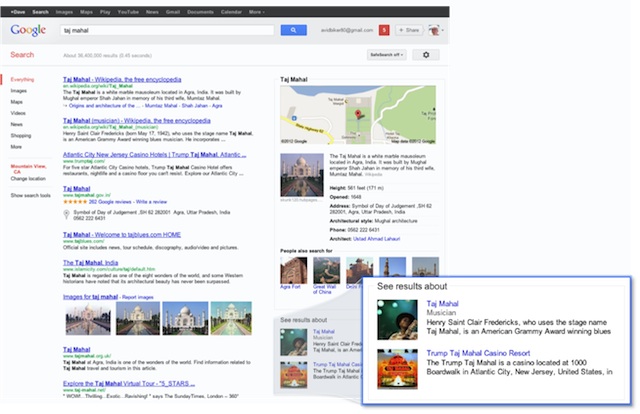
    Google’s latest search changes – introduced by Search Senior Vice President Amit Singhal – are another development, or baby step as Amit would call it, in making data more useful for us.

    The flood  of data that’s washed over us since the web arrived has left most of us befuddled. Increasingly, a basic keyword search just hasn’t been enough to find the information we’re looking for and we’ve had to trawl through pages of irrelevant information.

    One of the aims of Google’s new features is to make data more relevant to a user – so if someone in the US types “Kings” into Google, they will be given details of the Los Angeles Kings hockey team or the TV series “Kings”.

    Those details will include snippets of information about the topic. It could be the teams venue or the cast of the TV show. For tourist locations it could be some basic facts or transport information.

    Amit is particularly proud of integrating tourist information and flight details into search and Gmail which indicates Google is beginning to leverage its buyout of the ITA travel booking network last year.

    Google’s treatment of data reflects what’s happening with other services. At the recent Australian Xero conference and in an interview with MYOB executives, it’s been emphasised how knowledge is being aggregated to give customers and users better, more useful results.

    With Google’s knowledge graph we’re seeing the realisation of what big data can do, there’s many baby steps ahead but there’s a lot of potential.

    Similar posts: