Tag: business disruption

  • The Age of Rattling the Cage

    The Age of Rattling the Cage

    “It’s no longer the big beating the small, it’s the fast beating the slow,” says Eric Pearson, CIO of the InterContinental Hotels Group.

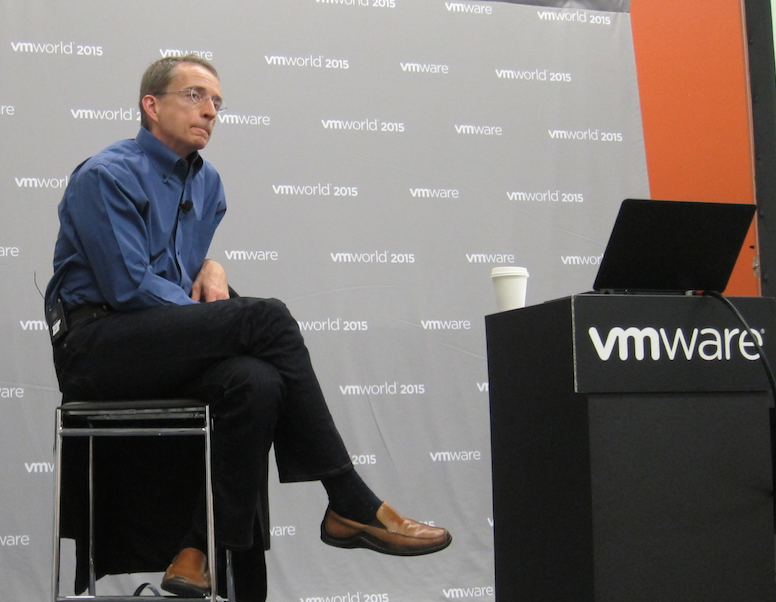
    Pearson was quoted by VMWare CEO Pat Gelsinger in his five imperatives for digital business keynote at the VMWorld 2015 conference being held in San Francisco this week.

    The five are an interpretation of the trends in a radically changing business environment where the barriers to entry have fallen dramatically, industries are globalised and the time to market for new products has collapsed.

    Put together, Gelsinger believes established businesses have to be more nimble as market and industry forces are going to punish those who are too slow to adapt.

    Elephants must learn to dance

    Gelsinger’s initial point is the world of business is now asymmetric – incumbents have everything to lose in the face of new businesses where upstarts have nothing to lose.

    Part of that asymmetry comes from the world of shared resources, which gives startups and smaller businesses access to tools that were once only available to large organisations.

    An obvious example of this are the cloud computing services that is concentrating VMWare’s minds, however another good example of how shared resources will change industries is the self driving car where Gelsinger cites vehicle utilisation will go from 4% to 71%.

    Gelsinger points out using a car on a pay for use basis will change the structure of our cities which in turn changes the economics of living in suburbia and the business models built around it.

    Standardising the cloud

    Cloud computing is at the end of its formative, experimental phase and entering into a professional era where different types of services are going to have to work together.

    “We have the private cloud which is focused on IT as we know it today, pulling out costs, slow and complex applications but also has powerful governance and does what I need it to do while meeting compliance purposes,” said Gelsinger. “On the the other side we have the public cloud which is fast and is able to scale effectively but has weak governance.”

    In a perverse way, it’s Edward Snowden’s revelations that are driving many businesses to maintain their own private cloud networks due to concerns about foreign powers tapping their information flows and the sovereignty of data.

    The consequence of a range of different cloud environments mean they are all going to have to get along with open standards becoming more important as businesses ‘mix and match’ their requirements.

    Meeting the security challenge

    As the Snowden affair shows, IT Security is difficult, complex and messy and becomes more so as workers start using their mobile devices and data is pushed around the cloud.

    Gelsinger sees the online security sector as being the one of the biggest opportunities for startups and one of the fastest growing costs for business, “the only thing growing faster than the spend on security is the cost of security breaches.”

    While Gelisinger’s focus is on VMWare’s security proposition, the security mindset is going to have be adopted by all business people. As the Target and Ashley Madison breaches have shown, the damage that can be done by a security lapse can be crippling and is a tangible business risk that senior managements and boards need to be across.

    Proactive technology

    Artificial intelligence has been through a thirty year gestation and Gelsinger told of his early days as a computer engineer working on AI projects in the late 1980s. Those early days of AI were a failure as the results as the time didn’t live up to the hype.

    Gelsinger sees this as the next wave of computing as it moves from being reactive to proactive as systems become able to anticipate actions based on the data they are seeing.

    While this has major ramifications for the computer industry, it also promises to change management and the role of many professions.

    “This is going to change human experiences,” says Gelsinger however there will be challenges as businesses strike a balance between creepy versus convenience and invasive versus valuable.

    Welcome to the age of rattling the cage

    Half of the firms on today’s Tech 100 list will be gone within 10 years, was the warning in Gelsinger’s final point and he focused on the need for businesses large and small to break out in order to stay relevant.

    “Welcome to the age of rattling the cage,” stated Gelsinger. “A time when taking risk is the lowest risk.”

    Paul travelled to VMWorld 2015 in San Francisco as a guest of VMWare

    Similar posts:

    • No Related Posts
  • The rise of the business digital native

    The rise of the business digital native

    ‘Digital natives’ has been the term to describe people born after 1990 who’ve had computers throughout their entire lives.

    The theory is these folk have an innate understanding of digital technologies from being immersed in them from an early age.

    It’s doubful how true that theory is; the generation born after 1960 were born into the television generation yet the vast majority of GenXers would have little idea on how to produce a sitcom or fix a TV set and the same could be said for the war generation and motor cars.

    Digitally native businesses

    For businesses, it may be the digital native concept is far more valid. Ventures being founded today are far more likely to be using productivity enhancing tools like social media, collaboration platforms and cloud computing services than their older competitors.

    What’s striking about older businesses, particularly in the Small to Medium Enterprise (SME) sectors, is just how poorly they have adopted technology. The Australian Bureau of Statistics report into IT use by the nation’s businesses illustrates the sectors’ weak use of tech.

    The most telling statistic is the number of businesses with a web presence; the SME sector lags way behind the corporate sector that has almost 100% penetration.

    Australian_business_with_a_web_presence

    Many of the zero to four business can be disregarded as most of them are sole trader consultants who’ve had to register a businesses for professional reason, although there is an argument even they would benefit from a cheap or free web presence to advertise their skills.

    The ABS statistics show small business is lagging behind the corporates in social media and e-commerce adoption as well so the argument that local businesses are ignoring the web and using services like Facebook, LinkedIn or Google Places to advertise their services doesn’t hold water.

    Old man’s business

    Part of this reluctance to use digital tools is age; many SMEs were born either in the era when faxes were a novelty or when Windows computers were first appearing on small businesses desktops. They are creatures of another era.

    In the current era cloud, social media and collaborative services are running business. The idea of buying a workstation for a new employee and waiting for the IT guy to set them up on the network is an antiquated memory; today’s workers have their own laptops, tablets and smartphones to do the work – all they need is a password.

    Those services offer a different way of organising a business and this is the most worrying part of the statistics – large organisations are slowly, and not always successfully, adopting modern management practices while many small businesses are locked into a 1970s and 80s way of working.

    For businesses being founded today, this isn’t a worry – they are the true digital natives and are reaping the benefits of more efficient ways of working. Something emphasised by Google’s updates to its Drive productivity services announced overnight.

    That’s something that should focus the plans of established businesses of all sizes as they adapt to working in a connected society.

    Similar posts:

    • No Related Posts
  • Uber’s Travis Kalanick on the highly valued business of disruption

    Uber’s Travis Kalanick on the highly valued business of disruption

    For a four year old business, hire car service Uber is certainly causing a lot of trouble.

    Bloomberg Businessweek’s Brad Stone has an interview with the company’s founder and CEO Travis Kalanick on his plans after announcing a 1.2 billion dollar fundraising that values the venture at $17 billion.

    Seventeen billion dollars is a hefty valuation for the business and many believe it marks the peak of the current tech bubble, although many of us though Facebook’s billion dollar purchase of Instagram two years ago was that marker.

    Kalanick’s views are interesting in his take on that valuation – as he points out the San Francisco taxi market alone turns over $22 billion each year, so Uber’s valuation isn’t beyond the bounds of possibility.

    Uber and Logistics

    Also notable is Kalanick’s view on the logistics market, something that this blog has maintained is the real business of Uber. In that field, Fedex’s stock market value is $44 billion although Kalanick is discounting the company’s potential in that field.

    Right now Uber is on a high, and regardless of any set backs they may get with their ride sharing services, it’s hard to see how the company isn’t going to grab a healthy slice of the global taxi industry and possibly disrupt the logistics industry as well.

    Even should Uber end up being the poster child for today’s tech sector irrational exuberance, the company is a stunning example of how businesses we once thought were immune from global disruption are now being shaken up.

    Similar posts:

    • No Related Posts