Tag: Buzzfeed

  • Jonah Peretti’s seven digital advantages

    Jonah Peretti’s seven digital advantages

    Buzzfeed founder Jonah Peretti laid out his vision of the changing media industry in his year end memo but he missed the one item most important – revenue.

    “Print revenue is decelerating at a rapid pace, cable subscriptions and TV ratings are starting to decrease even for live sports, and traditional media businesses are at various stages of a terrifying decline,” writes Peretti in accurately describes the challenges facing the industry.

    Buzzfeed’s success has largely relied on sharing across social media, particularly Facebook. In his memo Peretti lays out how he sees the modern social and personalised publishers as having seven digital advantages over the push model of the mass media days.

    1. Instant access to fresh content
    2. On-demand access to entire media libraries
    3. Nearly free distribution enabling many free ad-supported services
    4. Global distribution providing access to content from every market
    5. Data about audiences allowing personalization and customization of content experience
    6. A feedback loop between audiences and content creators making media production more dynamic and responsive
    7. Social experiences where people can use content to communicate and connect with the people who matter to them and weave media into their daily lives

    Peretti is absolutely right, those digital advantages put online platforms far ahead of print publishers and broadcasters although the advertisers haven’t quite figured out how to make these positives work for them.

    That advertisers can’t get their models to work on the digital platforms is also a problem for Peretti and Buzzfeed and the site had to half its 2016 revenue estimates earlier this year.

    In the search for new opportunities, Buzzfeed hired a new Vice President of Marketing earlier this month as it appears the branded content model is too labor intensive and video isn’t proving to be the river of gold most online publishers hoped.

    The advertising model appears to be just as broken for online publishers as it is for the traditional channels.

    As Peretti has pointed out in previous end of year memos, new media platforms always struggle in their early years.

    The difference in the modern media world is the internet destroyed the scarcity of publisher and broadcaster controlled advertising space, replacing it with an almost unlimited inventory supplied by Google, Facebook and other services that take most of the profit.

    A better comparison to today’s online advertising conundrum are the early days of radio where it took RCA’s David Sarnoff to figure out how to make broadcasting profitable.

    Like radio, online has great advantages over the older distribution methods but the revenue models that worked for those more traditional businesses don’t work on the newer medium.

    Peretti, like every online publisher, is trying to find that new model and it seems he’s as further away from discovering it as the rest of us.


    Similar posts:

    • No Related Posts
  • Reinventing business in an online world

    Reinventing business in an online world

    Jonah Peretti, the founder of Buzzfeed and formerly of the Huffington Post is widely thought of as one of the smartest thinkers in digital media.

    In a long interview with the Felix Salmon, the former Reuters journalist and himself one of the savviest commentators on the online space, Peretti discusses the direction of both online publishing and business in general.

    “Why do they need so much revenue?” is one of the questions Peretti poses about the recent New York Times’ innovation report and it’s a question worth posing of many organisations – particularly those that are in sectors with declining revenues and margins.

    Reinventing organisations

    As Yammer founder and now Microsoft employee Adam Pisoni told Decoding The New Economy last year, modern collaboration tools mean modern businesses don’t the need the management layers and staff numbers that older companies needed, this is something that has been lost on many modern media organisations.

    Peretti’s views about communications and how stories turn viral is a worthwhile read in itself while his points about fundraising are very pertinent, particularly where he observes that venture capital investors have been reluctant to fund startups which pay writers.

    What stands out in the interview is Peretti’s charitable view towards others in the industry, here’s his view on the New York Times’ innovation report.

    I did read it. There were a lot of interesting things in it. I think in some places, they were a little bit overly critical of their tech and product team. When you look around the industry, The New York Times has a really great website. They’re building lots of things themselves and integrating them. It doesn’t feel like a Frankenstein website with things bolted on from millions of other places. I was a little surprised at the tone, how critical they were of their web products.

    The key question Peretti asks is how do we re-imagine our industries: “What would this be if the readers and the publishers were not focused on making something similar to print?”

    Reinventing industry

    While Peretti’s question is asked of the newspaper industry, it’s a question that every business can ask itself as manufacturing, marketing and supply chains are being reinvented.

    Following that point, Peretti points out the risks in focusing on simple metrics; too much emphasis on one figure can lead to perverse results in the publisher’s view and following a mission rather than chasing a number is a much better strategy to long term success.

    As Salmon says in the introduction, there’s a lot to learn from Jonah Peretti about where the internet and digital media is taking the publishing industry and the business world in general.

    Similar posts:

    • No Related Posts
  • Three business lessons from the New York Times

    Three business lessons from the New York Times

    “The New York Times is winning in journalism,” starts the newspaper’s much discussed internal Innovation Report. Then in great detail it goes on to describe how the audience is being lost to upstarts like the Huffington Post and Buzzfeed.

    Given the number of digital forests that have been felled discussing the report in the last week, it’s not worthwhile giving an in depth analysis of the study – particularly given Nieman Labs’ comprehensive dissection of the document.

    What does stand out though are a number of over-riding themes that apply to almost any business, not just struggling traditional media outlets.

    Being digital first

    A constant mantra in the NY Times report is about being ‘digital first’ – if you’re thinking about that today, then you’re probably too late in your industry.

    Every industry is now digital: If you’re designing widgets, you’re doing it on CAD system; if you’re selling real estate, you’re listing online (one of the great killers of the old metropolitan newspaper model) and if you’re selling doughnuts, you’re placing your suppliers’ order electronically and maybe 3D printing your icing patterns in the near future.

    There isn’t one industry that isn’t being radically changed by digital technology.

    Breaking down silos

    One of the areas that’s been most resistant to digital change, and yet is the most threatened, is management.

    Silos within organisations are a triumph of management power and make it difficult for a business to be dynamic when it’s necessary to negotiate with different fiefdoms just to change the colour of paperclips.

    Those silos are fine when industries are cosy and there’s little competition but when disruptors enter the market those management empires become a dangerous, and expensive, weakness.

    The New York Times study spends a great deal of its pages discussing how to break down silos within its own organisation and this is something every business owner or manager should be exploring.

    With modern communication, information management and workplace collaboration tools many management roles are no longer needed.

    For smaller businesses, this is the greatest strength when competing against larger corporations as Huffington Post, Buzzfeed and Business Insider  have shown in stealing the market from the New York Times.

    You need to be found

    One of the toughest conclusions from the NY Times study is that the quality of content actually doesn’t matter in the marketplace; The Huffington Post and Buzzfeed do an excellent job of taking the NYT’s work, repackaging it and redistributing it in a way readers prefer.

    That might be a transition effect – it’s hard not to think that should original content creators like the NY Times be driven out of business then Buzzfeed will have to start employing more journalists and Arianna paying her writers – however right now gloss beats quality.

    Buzzfeed and the Huffington Post are attracting audiences because their stories are easy to find online and their headlines almost beg you to read them.

    For non-media businesses, the lesson is you need to be found; you may be the best restaurant, electrician or accountant in town but if you’re on the fifteenth page of Google in search results for your industry and suburb then you’re doomed.

    The New York Times faces its own unique set of challenges, as do the publishing and media industries, many of the lessons though from the NYT  Innovation paper though can be applied to many businesses.

    Similar posts:

    • No Related Posts
  • Buzzfeed and the cat problem

    Buzzfeed and the cat problem

    Last week, the viral news site Buzzfeed launched its Australian operation with a visit from Scott Lamb, the company’s Vice President for International operations.

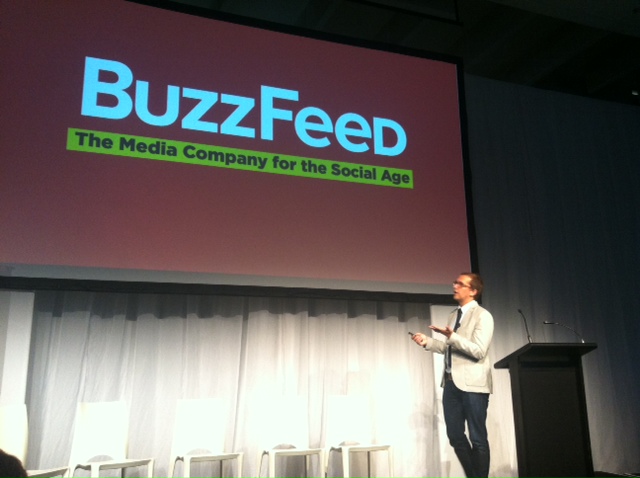
    As the “media company for the social age” in Scott’s words, Buzzfeed has led the way in ‘viral media’.

    The viral media model revolves around audience reach, and revenue, being measured on the amount of sharing on social media services like Facebook and Twitter rather than how many people view or visit their websites.

    Buzzfeed’s Cat problem

    For Buzzfeed attracting this traffic mean cats – people love sharing pictures of cats on the web.

    While Scott likes cats as much as any of his readers, he describes the industry as facing a ‘cat problem’.

    “The cat problem is that we all love cats, but they’re also a barrier to taking the internet seriously,” Scott said. “It’s true for Buzzfeed and it’s true for a lot of other websites as well.”

    Cats may be both a problem and a boon for Buzzfeed but there’s more to the business with Scott describing to the Sydney audience what he saw as the four myths of online media;

    1. Long form writing doesn’t work on the web
    2. Paying attention to clicks leads to lowest common denominator stories
    3. Social is merely a box you need to check
    4. Creating sharing content is easy and trivial

    There’s no doubt that item four is hard, although how much harder re-purposing stuff found on the web is compared to creating original content is open to question.

    Point three is a given for Buzzfeed given its business model and there would be few media sites that weren’t concerned about how often their stories aren’t shared on social media.

    Being taken seriously though weighs heavily on Buzzfeed so it was the two first points that Scott emphasised in his Sydney presentation.

    Long form journalism

    Scott was proud to show off  BuzzRead stories like Why I Bought A House In Detroit For $500 or The Most Dangerous Sentence in US History to show the site’s credibility as a reputable, considered venue for long form journalism, just like the New York Times.

    The problem for Buzzfeed’s aspirations though is the US Presidential story received 1,400 tweets and just over four thousand Facebook shares, the Detroit story gained five thousand tweets and 29,000 shares.

    On the other hand, a quiz on what city should you live in received 578,000 shares and 26,000 tweets. For the record, I got London which is something I’m ambivalent about but certainly beats getting Murmansk.

    That meme proved so good that Buzz Feed repeated it a week later with a what sort of job you should have quiz.

    You can’t blame them for exploiting a meme, particularly one that gets half a million shares.

    Scott though didn’t see the traffic mismatch between the worthy and the tabloid as being a problem; “we know we can’t equate an 8,000 world article to a quiz,” Scott said. “In terms of our business model our revenue isn’t tied to page views.”

    “There is incentive for us to get as many a views for an 8,000 word article as possible.”

    Riding the Facebook tiger

    Regardless of the viability of 8,000 words articles, the real problem for Buzzfeed in its aspirations to become a virally shared New York Times is the site’s reliance on Facebook.

    Relying on Facebook is path to disappointment, the service has shown it’s quite willing to burn partners, including advertisers, small businesses and users in the interests of its own corporate interests.

    For Buzzfeed, the assumption the media site’s corporate interests will always align with Facebook’s is brave assumption.

    Another problem for Buzzfeed is content, the bulk of the site’s material and what drives most sharing are posts that gather pictures from the web – primarily Facebook.

    Using other people’s content lies at the core of viral sharing sites and most of Buzzfeed’s competitors shamelessly steal material from other websites, particularly Buzzfeed, in the aim to drive shares from gullible users.

    Buzzfeed itself isn’t immune from that risk, with a photographer suing the site for $3.6 million over a photograph used in one of its lists.

    Risks in the model

    On the scale of risks to Buzzfeed not being seen as an viral version of the New York Times is quite low; the real risks are of being overtaken by a savvier competitor, falling victim to a Facebook change of policy, or simply turning out to be a transition effect in an industry that’s undergoing massive and rapid change.

    The aspiration of Buzzfeed becoming a New York Times is probably irrelevant anyway, most Facebook users don’t care about long form journalism – they like cats.

    In an era where the public wants animal pictures and celebrity scandals – who needs to be the New York Times?

    Perhaps the cat problem isn’t a problem, but the future for media channels like Buzzfeed.

    Similar posts:

    • No Related Posts