Tag: change

  • Satya Nadella’s grand vision

    Satya Nadella’s grand vision

    From a PC on every desktop to a services and devices company and now “productivity and platform company for the mobile-first and cloud-first world.”

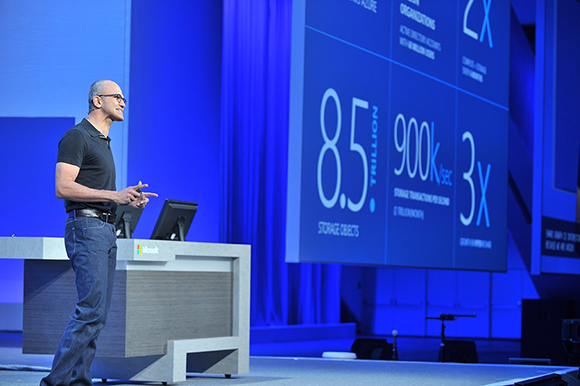
    Microsoft CEO Satya Nadella’s long missive lays out where he’s taking the company.

    It’s a radical shift from the company of the Gates and Ballmer years.

    In order to deliver the experiences our customers need for the mobile-first and cloud-first world, we will modernize our engineering processes to be customer-obsessed, data-driven, speed-oriented and quality-focused. We will be more effective in predicting and understanding what our customers need and more nimble in adjusting to information we get from the market.

    This describes a very different company from five years ago; it implies an end to bureaucracy and management conveniences like stack ranking; if Microsoft is really going to be more nimble, then it means a smaller, more focused management.

    In 1995, Bill Gates turned Microsoft around in a few months when he realised the strategic mistake he’d made in underestimating the impact of the Internet, so the company has adapted quickly to dramatically changed times in the past.

    Whether Microsoft can adapt and maintain its position in a computing world very different to the one it once dominated will be among the great business studies of our time.

    Similar posts:

    • No Related Posts
  • Demoting the newspaper

    Demoting the newspaper

    You know a product has problems when retailers start start moving it out of key retail positions. When the product was the retailers’ core business, you know the entire industry is in serious trouble.

    Mark Fletcher describes in the Newsagency Blog how he’s moved his city’s number two selling paper off the main level of his newspaper display.

    “Sales are not paying for the space,” Mark says bluntly.

    Newsagents relegating newspaper fits nicely into Ross Dawson’s Newspaper Extinction Timeline, in the case of Mark Fletcher’s newsagency Dawson sees the Australian newspaper industry vanishing by 2022.

    For newsagents the signals have been clear for some time that they have to adapt to a society where paper based products – newspapers, stationery and greeting cards – aren’t in demand.

    The process of adapting isn’t easy or smooth – many experiments will fail and even the smartest business people will make expensive mistakes. That’s the nature of evolution.

    Newsagents though are just one example of changing marketplaces, there’s few industries that aren’t being disrupted by the technology and economic changes of our times. All of us are going to have to adapt to a rapidly changing world.


    Similar posts:

    • No Related Posts
  • Living in a changing world

    Living in a changing world

    “We’re looking at a future where every aspect of our lives could be utterly different to how it is now,” declared ABC Radio host Linda Mottram in our semi-regular technology spot on Monday.

    Linda’s concern was based around our talk on 4D printing and the future of design and she’s absolutely right – life is going to be totally different by the end of this century.

    We won’t be the first generation to experience such massive change to society and the economy, our great grandparents at the beginning of the Twentieth were born into a world without electricity, the motor car or antibiotics.

    Those who survived the two world wars and lived to a ripe old age in the 1970s saw life expectancy soar, childhood mortality rates collapse and the western economies shift from being predominately agricultural to mainly industrial and service based.

    From our position, it’s difficult to comprehend just how radically life changed in western countries during the Twentieth Century.

    When we wonder where the jobs of the 21st Century will come from, it’s worth reflecting that many careers we take for granted today didn’t exist a hundred years ago and the same will be true in a hundred years time.

    The technology we’re using may be new, but adapting to massive change isn’t.

    Similar posts:

  • Driving out inefficiencies

    Driving out inefficiencies

    “We’re driving inefficiencies out of every single facet of life,” AT&T CEO Randall L. Stephenson told The World Economic Forum’s New Digital Context panel last month.

    The CEO panel at the Davos forum, which included Yahoo!’s Marissa Mayer, Salesforce’s Mac Benioff, Cisco’s John Chambers and Gavin Patterson of BT discussed how corporations of all sizes are being affected by rapid market changes.

    “All this bandwidth, all these connected devices, are as disruptive as anything this society has ever seen,” Stephenson said.

    “Companies that aren’t moving and driving the new technologies are companies that don’t stay alive.”

    Stephenson’s view was supported by Cisco CEO John Chambers, “if you look at big companies only a third of us will exist in a meaningful way in two decades.”

    Chambers cited Cisco’s experience from the past two decades to illustrate how business is rapidly changing, “my competitors from fifteen, twenty years ago – none of them exist or they’ve exited. From ten to fifteen years ago only one exists, from five to ten years ago only a few.”

    “If you don’t disrupt, you get left behind,” warned Chambers.

    Chambers’ advice to managers is that teams have to be empowered and encouraged to take risks and learn from failures, advice endorsed by Yahoo!’s Marissa Mayer.

    “The best thing you can an executive can do is play defense, not offense. Get out everybody out of the way and set up an evironment where they can really run and make a difference.”

    Yahoo!’s Marissa Mayer endorsed the change, describing a much flatter organization; “we try and run things really flat, really transparent.”

    That flat organisation is really the biggest risk to many executives in staid, safe organisations; it means fewer middle managers as the workplace is increasingly automated.

    As businesses adopt new technologies, the need for Executive Vice Presidents or Group General Managers is eliminated – along with the armies of assistants and underlings required to help these folk in their roles.

    In the past, those layers of management have isolated senior executives from their customers which Salesforce’s Marc Benioff is a luxury companies can’t afford in the current marketplace, “everything is going faster, companies have to change faster.”

    “Today if you’re not listening to your customers more deeply than ever before and not reacting to them more rapidly than every before,then you are probably making a mistake,” warns Benioff.

    Most of those in the room at WEF were the world’s top executives and government officials, how many of them take note of how business is changing will become clear in the very near future.

    There’s also a warning for those government leaders on how employment and government services are going change in the near future which a lesson that needs to be heeded as policies are developed.

    Now’s the time for every manager, business owner or executive to look at the inefficiencies in their workplace and whether it can be eliminated either through technology or business restructuring. It may well save you from being identified as an inefficiency yourself.

    Steam train image courtesy of Gabriel77 through sxc.hu

    Similar posts:
  • A difference in expectations

    A difference in expectations

    Could it be the age group set up for the most disappointment in today’s economy are the baby boomers rather than GenYs?

    The Wait But Why? blog has a provocative post on why Generation Y Yuppies are unhappy. It hasn’t gone down well with some prominent Gen Y writers.

    Part of the reason the article offended Gen Ys like Adam Weinstein is its focus on the younger generation having an entitlement mentality and feeling ‘special’.

    Were I a GenY I’d be pretty irritated at those views, particularly – as Weinstein points out – when younger folk are saddled with much greater debts and far less work security than baby boomers. Interestingly, Weinstein’s rebuttal makes almost the same points the Wait But Why blog from the opposite perspective.

    A mismatch of expectations

    Despite some of the provocative statements, the Wait But Why post makes a very good point about the expectations of different generations and the mismatch between what different age groups expect and the reality they encounter.

    The economic boomers – the group born from 1935 to 1955 – had the good fortune to spend most of their working lives during the post World War II period that saw the Western world experience the greatest economic boom mankind has seen.

    During their working lives, all but the lowest paid economic boomers became healthier, better fed and had more access to creature comforts than even royalty had a generation earlier. The average Westerner today is rich beyond the belief of our great grandparents a hundred years ago.

    As the Wait But Why blog contends, the result is the boomers are the happiest, most fulfilled generation we’ve ever seen.

    In contrast, GenYs are facing a far less fulfilling future in a lower growth economy that is far tougher and a society more focused on ‘user pays’, ‘cost recovery’ and outsourcing labour to the lowest cost provider than the greater good of the community.

    Can boomers continue to be lucky?

    While this is true of both Boomers and GenY, it’s worth questioning whether the Boomers’ happiness of exceeded expectations will continue.

    Today governments are cash strapped, almost pension scheme is underfunded and the demographic time bomb of an aging population has started to be felt across the developed world.

    Worse for the baby boomers is their retirement plans require their assets – primarily their homes, investment properties and small businesses – need to be sold at prices beyond what GenX and GenY buyers can afford.

    A reversion to the mean in asset prices for economic boomers means a lot of them will be going back to work.

    Recently I spoke to one economic boomer who had lost heavily after the global financial crisis. “No worries,” he said. “If need be I’ll get one of my old jobs back, I can still use a set square and drawing board.”

    Sadly, he didn’t understand that being good at using a set square and drawing board in a modern engineering office are as useful as making horseshoes or operating an electric telegraph. Those skills, while noble, are no longer necessary.

    While GenY will get on with adapting to the realities of their economic situation – they have little choice but to do so – the big challenge will be for their parents to deal with the modern economy.

    A new ‘Greatest Generation’?

    Perversely it’s likely the GenYs will turn out more like their grandparents who had to deal with a great depression and a massive World War.

    While hopefully the GenYs won’t have to deal with either of those, they are faced with a much different economy than the one which nurtured their parents.

    So the real ‘happiness deficit’ could turn out among the baby boomers in retirement at the very time in their lives they are least able to deal with it.

    Hopefully the GenY workers will be compassionate on their asset rich but cash poor parents and grandparents.

    Similar posts: