Tag: china

  • Crying over spilt Chinese milk

    Crying over spilt Chinese milk

    East Asian based expats have many conceits – the greatest being that they understand Asia.

    For a high paid executive based in Hong Kong or Singapore sitting in a comfortable air conditioned CausewayBay or Beach Road highrise it’s easy to not to know what you don’t know.

    In Bangkok though the drinkers at Bangkok’s Cheap Charlies Bar are under no illusions about the complexity of Asia as every night brings another surprise.

    During the 1990s it was a regular drinking haunt of those working on the ground in South East Asia – aid workers from Cambodia, oil explorers from Vietnam. gem traders from Laos or builders in Myanmar all swapped stories about their trials and tribulations.

    One of the toughest jobs was setting up a diary industry in tropical Thailand, no trivial task in an environment that isn’t kind to soft, milk producing cattle.

    Through the late twentieth century the Australian government spent millions helping build the Thai industry with the intention of it helping the Aussie industry build markets and expertise.

    Sometime in the late 1990s, the Australian industry decided programs like these were all too hard and not only withdrew from the Thai and Malaysian markets but also let the Chinese opportunity slip through their fingers.

    Today, as Business Spectator reported last week, New Zealand’s Fonterra is not only beating the Aussies in China but also has substantial holdings in Australia as the company’s website describes;

    The company has NZ$11.8 billion in total assets and revenues of NZ$13 billion and employs more than 18,000 people worldwide. In Australia, Fonterra has revenues of $1.9 billion, processes 21 per cent of all Australian milk and employs over 2,000 people. This makes Fonterra very much an Australasian company.

    Fonterra’s story, both in China and Australia, illustrates how something went amiss in Australia’s business sector in the late 1990s.

    The point of Australia’s deregulations and industry consolidations through the 1980s and 90s was to make local businesses and industries more competitive. Instead those Australian conglomerates have been sold to overseas interests as domestic investors find they aren’t interested in investing.

    Instead Australian businesses decided that having being allowed to consolidate they could use their market power to clip the tickets of the industries they controlled rather than innovating or expanding internationally.

    At the same time, Australia’s compulsory savings scheme poured billions into the local share market leaving boards under no pressure to perform better than the index.

    The lazy investing philosophy forced internationally focused businesses to look for overseas investors and has created the steady flow of Australian business, farming and mining assets being sold onto overseas buyers.

    In the meantime, the shock jocks and populists whip up xenophobia rather than holding Australian business community to account for its failure to seek and build new markets.

    This doesn’t mean bad news for young Australians, there are opportunities for smart, innovative and hard working entrepreneurs to challenge the country’s staid duopolies.

    If we choose not to challenge the comfortable duopolies, it may be the next generation of Aussie expats find more opportunities at Cheap Charlies in Bangkok than at home.


    Similar posts:

  • Can Huawei come in from the cold?

    Can Huawei come in from the cold?

    Last Friday the Parliamentary Joint Committee on the National Broadband Committee met in Sydney, I’ll have a story on this in tomorrow’s Business Spectator.

    An interesting exchange during the meeting was  between the committee’s chair Rob Oakeshott and Mike Quigley, the CEO of NBNCo.

    Rob Oakeshott: “You have advice that either as a department or a statutory body that says there are certain companies that should not be involved with the National Broadband Network build? If so, is that advice still in place?”

    Mike Quigley: “Well chair, we work very closely with the appropriate government agencies in this area, obviously there are things we can and things we can’t say, but we have a very close working relationship with those entities and we obviously take their advice on things we should and shouldn’t do.”

    “Their advice is still in place and we’re following it.”

    I’m going to be in Melbourne tomorrow attending the Australian Davos Committee’s China Forum where, among other luminaries, the Prime Minister and various key people in the Australian-Chinese relationship will be talking.

    The company in question is Chinese communications vendor Huawei and their banning from Australian contracts adds an interesting dimension to the discussion on trade relations between the two countries.

    Australia has followed the US lead in blocking the Chinese communication hardware company from key contracts like the NBN on security grounds and it’s hard to see how this doesn’t test the patience of the PRC.

    We’ll see how this issue plays out as it’s one that seems to be largely overlooked when we discuss trade ties and relationships with Chinese companies.

    Similar posts:

  • Why Australia needs foreign ownership

    Why Australia needs foreign ownership

    Such are the vagaries of radio that I’ve been asked to comment on ABC Radio South Australia about foreign ownership based on an article that was picked up by The Drum 14 months ago.

    That article was written shortly after Dick Smith came out grumbling about the prospect of Woolworths selling the electronics store chain named after him to foreign interests.

    My point at the time was that foreign owners would be preferable to some poorly managed, undercapitalised local buyer as the Australian retail industry – even in a declining market like consumer electronics – needs more innovation and original thinking.

    As it turned out, Dick Smith Electronics was sold to Anchorage Capital, a private equity turn around fund with an interesting portfolio of businesses.

    In the meantime, the argument about foreign ownership of property and businesses, particularly farms, has ratcheted up as opportunistic politicians and the shock jock peanut gallery that sets much of Australia’s media agenda have found a cheap, jingoistic issue to score points from.

    So why is foreign ownership of businesses like farms, mines and factories important for Australia?

    A fair price for hard work

    The main reason for supporting foreign buyers for Aussie businesses is it gives entrepreneurs a chance to get a fair price for their hard work.

    A farmer or factory owner who builds their business shouldn’t have to accept a lower price because Australians don’t want to pay for the asset.

    It’s not a matter of being able to pay Australians as have plenty of money to invest – a trillion dollars in superannuation funds and three billion dollars claimed for negative losses in 2009-10 show there’s plenty of money around – it’s just that Aussies don’t want to invest in farming, mining or other productive sectors.

    We’re already seeing this play out in the small business sector as baby boomer proprietors find they aren’t going to sell their ventures for what they need to fund their retirement.

    Access to capital

    Should the protectionists get their way then the businesses and farms will eventually be sold to undercapitalised Australian investors at knock down prices.

    This is the worse possible thing that could happen as not only do the entrepreneurs miss out, but also the factories and farms decline as they are starved of capital investment.

    Cubby Station

    A good example of both the lack of capital affecting investment and finding a fair price for ventures is Queensland’s Cubby Station.

    While I personally think Cubby Station is an example of the economic bastardry and environmental vandalism that are the hallmarks of the droolingly incompetent National Party and its corrupt cronies, the venture itself is a good example of why the agriculture sector needs foreign investment.

    Having been converted from cattle to cotton in the 1970s, Cubbie grew as successive owners acquired water licenses from surrounding properties.

    Eventually the company collapsed under the weight of its debts in 2009 and the property was allowed to run down by the administrators until it was bought by Chinese backed interests at the beginning of 2013.

    At the time of the acquisition, the company’s former chairman told The Australian,  “on reflection, I would go into those things with an even stronger balance sheet — in other words, with less gearing.”

    In other words, the company was under-capitalised.

    Competition concerns

    Another reason for encouraging foreign ownership is that Australia has become the Noah’s Ark of business with duopolies dominating most key sectors.

    Bringing in foreign owners at least offers the prospect of having alternatives to the comfortable two horse races that dominate most industries.

    The property market

    An aspect that has excited the peanut shock jocks has been the prospect of Chinese buyers purchasing all the country’s property.

    For those of us with memories longer than goldfish, today’s Chinese mania is almost identical to the Japanese buying frenzy of the late 1980s.

    Much of what we read about the Chinese buying homes is self serving tosh from property developers and real estate agents and what mania there is will peter out in a similar way to how the Japanese slowly withdrew.

    This isn’t to say there shouldn’t be concerns about foreign ownership – tax avoidance, loss of sovereignty and Australia’s small domestic market are all valid questions that should be raised about overseas buyers, but overall much of the hysteria about foreign ownership is misplaced.

    What Australians should be asking is why the locals aren’t investing in productive industries or buying mining and farming assets.

    The answer almost certainly is that we’d rather stick with the ‘safety’ of the ASX 200 or the residential property market.

    We’ve made our choices and we shouldn’t complain when Johnny Foreigner sees opportunities that beyond negative geared investment units or an tax advantaged superannuation fund.

    Similar posts:

  • They do it different over here

    They do it different over here

    Among expats in Thailand the saying was “the locals can ignore the law, but multinationals can’t.”

    Thailand has some pretty strict laws on employee wages, workplace safety and council permits. Pretty well every business ignores them except the multinationals.

    Generally Thais don’t complain about businesses not complying with the rules and the authorities are reluctant to take action.

    Unless you’re a multinational, in which case the slightest irregularity in pay risks a visit from the police.

    A few days in the Bangkok Immigration Gaol while the misunderstanding is sorted out is a good lesson for any sloppy farang country manager who hasn’t been ticking all the boxes.

    The recent protests in China against Apple and now Microsoft over warranties illustrate a similar situation in the PRC.

    What’s fascinating though is how the complaints against Microsoft and Apple are part of the rising Chinese consumer movement.

    It’s a tough life being a consumer advocate in China, leading protests against well connected local companies or their government cronies could be a career limiting move, or much worse.

    On the other hand it’s safe to criticise an American corporation and its much more likely to get results.

    So managers of foreign companies in China have to be far more responsive to complaints than their local counterparts as Apple and Microsoft have learned.

    For multinationals there is an upside to this, foreign companies tend to get better staff as they don’t mess people around with pay and their products are seen as being better because they do honor warranties.

    It ends up being swings and roundabouts, but it does emphasise the traps for inexperienced expat managers who can unwittingly get themselves in trouble.

    Apple and Microsoft have learned their lesson about customer service in China, you wonder how many others are still to do so.

    Similar posts:

  • is G’day China a good idea?

    is G’day China a good idea?

    Yesterday’s announcement by the Prime Minister’s  of an Australia Week in China may prove far more successful than the G’day USA events the idea is based upon.

    G’day USA has been run for a decade and showcases Australia’s attractions, skills and businesses at events in Los Angeles and New York.

    It’s been moderately successful but an emphasis on movie stars appearing at black tie Hollywood events illustrates Australian governments’ disproportionate focus in throwing money at US movie producers.

    If China Week follows the US example we can expect private, exclusive dinners where Twiggy Forrest, Clive Palmer and the BHP board entertain Chinese plutocrats over bowls of shark fin soup and braised tigers’ testicles.

    Should China Week follow that model then it will probably share G’day USA’s middling successes.

    The opportunity to do it differently though is great as the Chinese-Australian relationship is far younger and hasn’t been locked into Crocodile Dundee type stereotypes on both sides.

    As the Chinese economy matures and evolves, there’s an opportunity for Australian businesses and industries which haven’t been available for exporters to the US.

    Done properly, G’day China could help the profile of Australian businesses in many sectors, particularly in those affected by the great Chinese rebalancing.

    Let’s hope they do it properly.

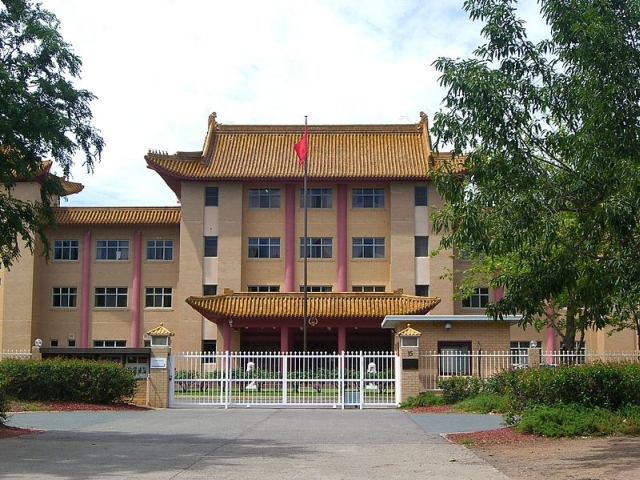
    Image of the Chinese embassy in Canberra, Australia from Alpha on Wikimedia

    Similar posts: