Tag: Cisco

  • Cisco and the connected stadium

    Cisco and the connected stadium

    One of the challenges facing sports administrators and leagues around the world is that the quality of broadcast coverage has become so good it’s become increasingly harder to get fans out to the games.

    Coupled with the constantly improving television coverage, fans are also expecting more as they go to games with their smartphones and tablets. Part of the solution for venue managers is to roll out smart stadium facilities that enhance spectators’ experience at the games.

    Mike Caponigro, Cisco’s head of Global Solutions Marketing for Sports and Entertainment, sees the smart stadium as complementing the ground experience and Cisco are working with over three hundred venues in thirty countries around the world.

    Improving the live experience

    “Live is always going to be best,” states Caponigro. “You can’t replace that tribal passion of the crowd. No matter how excited I get in my living room or with some friends in a pub you’re never going recreate that enthusiasm.”

    However the expectations of sports fans are changing Caponigro points out citing how HD television and the internet is changing the experience for spectators outside the stadium, “fans don’t want to be removed from that action.”

    Cisco started their Connected Stadium program when the Oakland Athletics were looking at moving home stadiums seven years ago. While Oakland decided to remain at their existing stadium the company realised the market for connected stadiums was potentially huge, “it really pushed our thinking on how could we service an industry sector that hadn’t been well served.”

    Accelerating innovation

    “Arguable you’ve seen more innovation in that last seven years in the sports and live entertainment field than in the five decades prior to that,” says Caponigro who attributes the rate of change to consumer adoption of smartphones. “Now we’re working with three hundred properties in thirty countries around the world.”

    “What fans are saying is that in order to continue to go to events there are things that need to be tweaked around the experience,” Caponigro states. “We did a study two or three years ago that found seventy-five percent of fans bring a smartphone to the venue. In the latest studies we’re finding ninety percent.”

    Those fans are expecting a reliable signal to share information and access data. At last year’s Superbowl the crowd consumed 6Tb of data, half of which was outward traffic. “That just reinforces that fans aren’t just consuming services but it’s also become an increasingly social environment.”

    Improving revenues

    One of the areas Caponigro sees as an opportunity for connected stadium administrators is in seat management citing the Golden State Warriors NBA team that have used BlueTooth beacons to drive their seat upgrade application to generate $300,000 in additional revenue.

    Fans have two frustrations with attending live games says Caponigro, is the convenience of getting to and from the game and not getting a good view of the play from their seats.

    The ‘single seat experience’ as Caponigro describes it, uses the stadium’s smart vision TVs and the apps on spectators’ phones to give fans the same access to replays and stats that viewers watching the game on TV or the internet can access.

    Making transport easier

    Getting to and from the game is another advantage the smart stadium technologies offer both spectators and stadium administrators, by giving real time information on parking and public transport status crowds can be better managed and fans can have a smoother experience travelling into and away from the event.

    In the future, Caponigro sees the next wave of innovation integrating back of house services into the connected stadium giving administrators greater understanding of concession sales and crowd movement.

    Another opportunity lies in bringing player biometrics to the spectators, “you might find out if Ronaldo is really as cool as he looks when he takes a penalty” grins Capringo.

    While it’s still early days for the connected stadium, like many Internet of Things applications businesses are exploring the limits. For sports fans, they can expect a richer experience being delivered to their smartphones and seats.

    Similar posts:

    • No Related Posts
  • How to make the IoT pay

    How to make the IoT pay

    How do companies sell the internet of things to consumers? This was the question at the opening panel of the Internet of Things World conference in San Francisco this morning.

    Belkin’s Chief Technology Officer Brian van Harlingen took the lead in the panel stating that the opportunity lies in making sense out of the IoT’s complexity. “With data comes complexity, we have to make it simple for the end user,” said Van Harlingen

    Van Harlingen’s view was backed up by Verizon’s Chief Data Scientist, Ashok Srivastava, who understandably sees the challenge of managing the information generated by masses of devices as being an opportunity for his company and data scientists in general.

    That masses of data is being generated isn’t surprising seeing the other member of the morning’s panel was Jason Johnson, Co-founder and CEO of  smart lock maker August. That the ordinary door lock may be generating masses of data indicates just how much information might be churning around the average smart home in the near future.

    Cut out the complexity

    It may well be that all of this data and complexity isn’t necessary as Joe Dada, the CEO and founder of smarthome company Insteon, point out. “Leave the network as quiet as you can,” is his advice. “People over-estimate the amount of data that needs to be pushed across the network.”

    Dada, a twenty-five year veteran of the smarthome industry, sees the over-complication of the IoT as being a weakness in many of the products and business models being touted today with his company selling their products on being convenient, safe and fun.

    While Dada has a successful business model, many of the other business don’t and exactly how to make money from the IoT wasn’t really answered by the panel.

    Capturing efficiencies

    It may well be that for many the answer lies in making existing products better, in talking to Cisco’s Brad Bechtold who runs the networking giant’s Oil and Gas Industry Transformation division estimates that there could be operational savings of up to 11% for the sector through implementing IoT technologies.

    With estimates of the oil and gas industry’s size being around four trillion dollars a year, that represents an opportunity of over a hundred billion dollars a year in the one sector alone.

    Selling the IoT

    So it may be that the way to sell the Internet of Things into the industrial sector is to point out the operational savings available. Should the promise of substantial cost reductions be realised then it may even trigger a new wave of capital investment as businesses decide it’s easier to upgrade equipment than retrofit it.

    The analytics and management aspect will turn out to be lucrative for many businesses as well, however the key to success is going to be demonstrating how these services add value for customers.

    For the consumer market however the key probably lies in Joe Dada’s advice – keep it easy, convenient, safe and fun.

    Similar posts:

    • No Related Posts
  • Big sports data – how tech is changing the playing field

    Big sports data – how tech is changing the playing field

    “When you’re playing, it’s all about the winning but when you retire you realise there’s a lot more to the game,” says former cricketer Adam Gilchrist.

    Gilchrist was speaking at an event organised by software giant SAP ahead of a Cricket World Cup quarter final at the Melbourne Cricket Ground yesterday.

    SAP were using their sponsorship of the event to demonstrate their big data analytics capabilities and how they are applied to sports and the internet of things.

    Like most industries, the sports world is being radically affected by digitalisation as new technologies change everything from coaching and player welfare through to stadium management and fans’ experience.

    Enhancing the fan experience

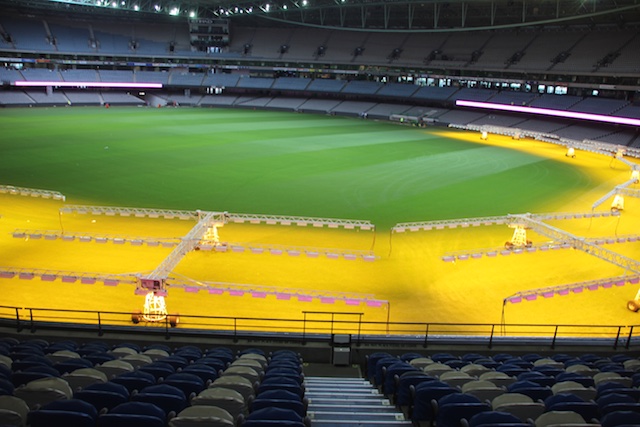
    Two days earlier rival Melbourne stadium Etihad in the city’s Docklands district showed off their new connected ground where spectators will get hi-definition video and internet services through a partnership between Telstra and Cisco.

    While Etihad’s demonstration was specifically about ‘fan experience’, the use of the internet of things and pervasive wireless access in a stadium can range from paperless ticketing to managing the food and drink franchises.

    In the United States, the leader in rolling out connected stadiums, venues are increasingly rolling out beacon technologies allowing spectators to order deliveries to their seats and push special offers during the game.

    While neither of the two major Melbourne stadiums offer beacon services at present, the Cisco devices around the Etihad have the facility to add Bluetooth capabilities when the ground managements decide to roll them out.

    Looking after players

    Probably the greatest impact of technology in sport is with player welfare; while coaches and clubs have been enthusiastic adopters of video and tracking technologies for two decades, the rate of change is accelerating as wearable devices are changing game day tactics and how injuries are managed.

    One of the companies leading this has been Melbourne business Catapult Sports which has been placing tracking devices on Australian Rules football players and other codes for a decade.

    For coaches this data has been a boon as it’s allowed staff to monitor on field performance and tightly manage players’ health and fitness.

    Professional sports in general have been early adopters of new technologies as a small increase in performance can have immediate and lucrative benefits on the field. Over the last thirty years clubs have adopted the latest in video and data technology to help coaches and players.

    As the technology develops this adoption is accelerating, administrators are looking at placing tracking devices within the balls, goals and boundary lines to give even more information about what’s happening on the field.

    Managing the data flow

    The challenge for sports organisations, as with every other industry, is in managing all the data being generated.

    In sports managing that data has a number of unique imperatives; gamblers getting access to sensitive data, broadcast rights holders wanting access to game statistics and stadium managers gathering their own data all raise challenges for administrators.

    There’s also the question of who owns the data; the players themselves have a claim to their own personal performance data and there could potentially be conflicts when a competitor transfers between clubs.

    As the sports industry explores the limits of what they can do with data, the world is changing for players, coaches, administrators and supporters.

    Gilchrist’s observation that there’s a lot more to professional sports than just what happens on the field is going to become even more true as data science assumes an even greater role in the management of teams, clubs and stadiums.

    Paul travelled to Melbourne as a guest of Cisco and SAP.

    Similar posts:

    • No Related Posts
  • Preparing for the mobile data explosion

    Preparing for the mobile data explosion

    Late last month Cisco Systems released its annual Visual Networking Index that tracks the company’s predictions for the growth of global network traffic over the upcoming five years.

    It’s no surprise this year’s report predicts global data traffic will grow at over fifty percent compounded each year with Cisco expecting 24.3 exabytes to be pushed around the world’s networks each month by 2019.

    Most of that network traffic will come from tablet and smartphones with Cisco predicting data use will grow by up to a factor of five on those devices with devices like wearables growing fourfold.

    This growth creates a challenge for telcos as they invest in capacity to deal with the increased traffic and Cisco sees half of all smartphone connections will be handed off to WiFi networks by the decade’s end.

    Summary of Per-Device Usage Growth, MB per Month

    Device Type

    2014

    2019

    Nonsmartphone

    22 MB/month

    105 MB/month

    M2M Module

    70 MB/month

    366 MB/month

    Wearable Device

    141 MB/month

    479 MB/month

    Smartphone

    819 MB/month

    3,981 MB/month

    4G Smartphone

    2,000 MB/month

    5,458 MB/month

    Tablet

    2,076 MB/month

    10,767 MB/month

    4G Tablet

    2,913 MB/month

    12,314 MB/month

    Laptop

    2,641 MB/month

    5,589 MB/month

    Source: Cisco VNI Mobile, 2015

    Handing half the growth in mobile traffic over to Wi-Fi connections, most of which will be connected to fiber or ADSL services will provide challenges for fixed line operators as well who will see the demand for capacity also explode over the rest of the decade.

    Much of this explains the moves by companies like Telstra to roll out public Wi-Fi services to start locking users into their services. It also gives them, and consumers, an opportunity to understand how networks that mix both cellular and Wi-Fi behave.

    Cisco_M2M_connections_to_2019

    Another aspect of the Cisco VNI survey is the Internet of Things which is going to see exponential growth as industrial and household devices start being connected either directly through the telco networks, across unlicensed radio spectrum or over private Wi-Fi systems.

    While Cisco predicts the bulk of that traffic as being generated by smartphones, the company sees connected devices as growing by 45% per year over the next five years with 3.2 billion sensors connected to the internet by the end of the decade.

    Cisco-2015-VNI-M2M-connections

    Notable in the prediction that Low Powered Wide Area (LPWA) networks – non cellular systems mostly operating in the unlicensed spectrum used by Wi-Fi networks – will provide nearly a third of the connections by 2019. At the same time we can expect many M2M deployments to consolidate traffic locally with much of the data processing down locally before the residual information being passed up the network.

    As usual the Cisco VNI report underscores, and possibly understates, the growth in mobile data usage we’re going to see over the rest of the decade. For businesses, it’s time to plan for managing both the flow and application that smart devices are going to generate in our daily operations.

    Similar posts:

    • No Related Posts
  • Skipping the trough of disillusionment

    Skipping the trough of disillusionment

    When consulting group Gartner placed the Internet of Things at the peak of their hype cycle last month it raised concerns that the technologies might be about to take a tumble.

    Speaking to Networked Globe this week in San Jose; Maciej Kranz, VP and GM of Cisco’s technology group described how he believes the IoT’s evolution from the top of the hype cycle to the plateau of acceptance will be quick.

    “We’re happy that Gartner put IoT on top as it means there’s awareness,” said Kranz. “We hope to prove Gartner wrong, that in IoT we don’t go through the classic hype cycle we go from hype into reality.”

    Kranz’s reasoning while the IoT will suffer a short spell, if any at all, in Gartner’s ‘trough of disillusionment’ is because the major industry players are working closely together to build the sector and its standards.

    “Where we think it’s a little bit different from some of the other hype cycles than some of the other hype cycles is that we continue to work very close at the industry,” Kranz explained.

    “Because we’re all working as an industry to make it real it will go through the disillusionment and quickly into a reality.”

    This may well turn out to be true if the big players like Cisco and GE in the industrial space along with companies such as Google and Apple in the consumer sector stay committed to the concept. If the major vendors stay the course, then it’s likely IoT technologies won’t suffer much at all.

    Another aspect in the IoT’s favour is that it isn’t really a specific technology or product at all, instead being more of a concept bought about by various technologies such as home automation, industrial controls and cloud computing all reaching maturity.

    Rather than one separate item on the Gartner hype cycle, the IoT is really made of dozens of different technologies that are mostly on the ‘plateau of acceptance’ themselves.

    Kranz sees Gartner’s listing of the company as being on the top of the hype cycle as being a vindication for how the IoT has been adopted by industry and the community, “it is remarkable how we’ve gone in the last nine months from people saying it’s a vision to n

    Similar posts:

    • No Related Posts