Tag: cloud computing

  • Using Cloud Computing to grow your business

    Using Cloud Computing to grow your business

    Cloud computing tools can help your business grow, improve flexibility and build profits.

    ABC radio commentator and author of eBusiness, Paul Wallbank, looks at how you can use these services to improve your business’ profitability, be more flexible and overcome the problems often found by growing businesses.

    This two hour evening workshop is part of the Bondi Business Enerprise Centre’s social media progam. Seats are $35 and bookings are essentials. Contact the Enterprise Centre to secure your place.

    Address:
    Denison Street
    Bondi Junction, NSW
    2150
    Australia
    Map and Directions

    Date: 20/06/2012

    Start Time: 5:30 PM
    End Time: 7:30 PM

    Price: A $35.00

    Similar posts:

  • FUD on the Desktop

    FUD on the Desktop

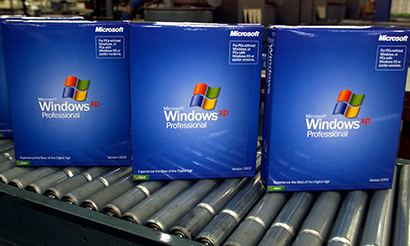
    “User productivity costs jump up a staggering 40 percent“, “return on investment over 130 percent over a three-year period” and an eighty four percent drop in IT support costs are some the latest claims from Microsoft in their campaign to wean users off Windows XP.

    These, undoubtedly true, claims are pretty impressive and compelling for cash strapped IT managers, but do they really matter anymore?

    With the rise of Bring Your Device policies and cloud computing, what operating system employees use is rapidly becoming irrelevant.

    In large organisations that supply workers’ computers, most systems are run on SOEs – Standard Operating Environments – which means users have limited accounts and can’t install rogue software.

    For those organisations wedded to supplying staff with desktop or laptop computers XP is fine and almost all of them are well advanced in their plans to redeploy to Windows 7 or 8 when the XP support period runs out in April 2014.

    We’re seeing fewer organisations locked into the SOE model as the financial sums and business benefits of moving over to an employee Bring Your Own Device – BYOD – model start to look compelling.

    Developing an SOE is a complex, time consuming task for an organisation – the package has to be tested to work on the company’s hardware which might include dozens of different types of printers, laptops and other devices. Then it has to be tested on all the software employees use.

    In a big organisation developing new operating environments is not done lightly. It’s a complex, expensive process.

    With a BYOD policy the company can develop a standard desktop environment that runs on a web browser. Staff can then bring their own device running on Mac OSX, Android, Linux or even Windows XP and, as long as their browser is up to date, they can run on the corporate network.

    The IT department no longer has to care about what the staff member has on their desk and can focus on more important business technology issues – although sadly the password issue doesn’t go away.

    For Microsoft, this evolution in corporate IT is a problem. Increasingly big organisations aren’t placing orders for big fleets of centrally managed desktops. The IT industry has moved to the cloud.

    In a perverse way Microsoft are winning the desktop battle, most of those workers in companies implementing BYOD policies will choose Windows 7 or 8 systems because they are cheap and work well in a business environment. The problem is that’s where the profit no longer lies.

    While we’ll see more FUD – Fear, Uncertainty and Doubt – about cloud computing, BYOD and Windows XP over the next year, the battle has been fought and won.

    Increasingly Microsoft are looking like an exhausted army that has won an irrelevant battle while the real war has moved elsewhere.

    The challenge for Microsoft is to find its way back to relevance in an era where the operating system doesn’t really matter.

    Similar posts:

  • The View From The Cloud

    The View From The Cloud

    I’m presenting View From The Cloud this afternoon where we look at the results of SmartCompany’s technology in business survey.

    The results are interesting, with nearly half the respondents saying they don’t use any cloud services.

    Almost certainly, those respondents are wrong – they don’t realise many of the things they do on the web are cloud based. The 9% who nominated “they don’t know” are closer to the truth.

    Those “unknown unknowns” are the big challenge for business managers and owners – those who think cloud computing isn’t being used in their organisations don’t know what their staff are up to with their laptops and smartphones.

    Of those who are knowingly using cloud computing services, over two-thirds said they did so for the flexibility while just under a half appreciated the cloud services’ ability to grow with their business.

    An encouraging aspect of the survey is how only a quarter of the respondents nominated price as being the reason for adopting cloud services.

    This is an aspect of selling cloud computing services that has worried me for a while, that companies are commoditising their market by giving away free – or insanely – cheap services.

    As always, price doesn’t drive the good customers and this survey illustrates that. Provide a good service at reasonable price points and the customers will come.

    Business respondents also illustrated a mature attitude towards risks with cloud service with 61% concerned about data safety and half of that number worried about access issues.

    An interesting part of the threat response was that 17% had other concerns about cloud technologies – including being tied to one vendor.

    This is an interesting attitude which indicates people don’t understand the degree of vendor lock in that already exists in the computer world and why the majority of businesses are using Windows computers running Microsoft Word. If anything, cloud services are far more open than boxed software.

    Vendor lock in though is a real concern and something that all cloud computing users should check before they, or their business, becomes too dependent on any one software package, consultant or online application.

    Overall, the SmartCompany business technology survey is an interesting snapshot of where business is today with emerging trends and services. Join us at 12.30 to discuss the results.

    Similar posts:

  • Forget Plastics, today it’s Big Data

    Forget Plastics, today it’s Big Data

    “Plastics” was the career advice to uni students in the 1967 movie The Graduate. Today the same advice to a smart young entrepreneur would be “big data”.

    Big data is the current buzzword for the IT industry, we’re seeing start-ups with cool tools popping up and whole new job descriptions to manage it, while big and small businesses ponder how to use another technology in their operations.

    At the end of the month, the third of the City of Sydney’s 2012 Let’s Talk Business series will see SmartCompany’s James Thomson among others discussing how data drives business.

    How we use data in our business is something we’ve had to come to grips with for ages, but many of us haven’t really started to find those nuggets of value in our databases.

    We’ve actually been in the era of big data for decades since computers were introduced in the workplace. One thing that PCs do very well is gather and store information.

    Today computerised point-of-sales systems, database software, loyalty programs and web-tracking tools mean we have a massive amount of data about our clients at our fingertips.

    As computers get more powerful and cloud-based services start making detailed data analysis more available, we’re going to see even more data pouring into our businesses.

    Social media services add to the data deluge as they gather, giving even more intelligence about our markets, individual customers and the performance of our businesses.

    The problem is that many of us are already overwhelmed by what we have. The thought of even more data we can’t use causes many managers and business owners to hide under their desks and weep.

    An article in the MIT’s Technology Review about Peter Fader, co-director of the Wharton Customer Analytics Initiative at the University of Pennsylvania looked at this problem.

    Professor’s Fader’s view is that most businesses have enough data – the problem is managing what we have, along with the risk of trying to extrapolate too much from historical information.

    To deal with this overload we’re seeing companies like Kaggle starting-up to help us mine this data and get useful information about our businesses and customers.

    What these data-mining companies are promising is the ability to see the patterns in what appears to be just a mass of confusing data.

    Already we’re seeing businesses that can connect the dots get a head start on their slower competitors who don’t appreciate the value locked in their databases and CRMs.

    Making sense of the data we’re accumulating is the real challenge. If we’re not paying attention to what we already have then there’s little point in gathering more.

    Tickets for How Your Customer Data Can Drive New Business at the Sydney Town Hall on May 29 are still available.

    Similar posts:

  • Security and cloud computing

    Security and cloud computing

    Last Friday cloud accounting service Saasu ran their Cloud Conference looking at the business benefits of online computing and business automation.

    Among the topics discussed was the security of cloud computing with Stilgherrian giving an excellent overview of the state of information security.

    Stil’s message is clear; online security is everyone’s problem – if the bad guys want to target you for whatever reason they will.

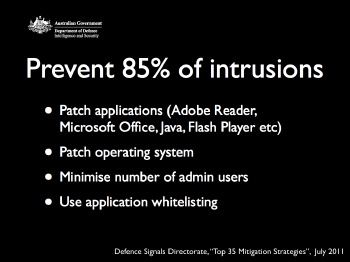
    As a business owner, it’s essential to take basic precautions. This is something I’ve covered before and something Stil raises in his presentation by pointing out that Australia’s Defence Signals Directorate lists 35 mitigation strategies based on the security breaches they examined in 2010.Stilgherrian's recommendations on securing computers

    Of those thirty-five, the top five would prevent 85% of security breaches. The top one – keeping your applications up to date – would avoid almost every PC malware attack along with Apple Mac’s Flashback worm.

    In answering my question about how Saasu and other cloud computing users can protect their system, Stil also raised a good point about using virtual machines for web browsing and even purchasing a computer just for business accounting and banking use so the services can’t be compromised.

    Related to this topic is an ongoing discussion on the Reddit forums between posters claiming to be malware writers and botnet operators.

    While it’s risky to trust everything you read on Reddit, the tips are worthwhile, particularly the advice to “disable addons in your browser and only activate the ones you need.”

    By reducing the number of programs running on your computer or the add ons in your web browser, you lessen the risk of being infected. Again this would have protected the victims of the Flashback worm.

    The security of our systems is our own responsibility, just like our home and office security.

    Cloud computing is no different to other computing – the basics of information security, or #infosec, are the same regardless of whether you’re using software on your computer or the cloud.

    Used responsibly, cloud computing is no less or more secure than any other computer or smartphone use. We shouldn’t underestimate the risks, or get hysterical about the threats.

    Similar posts: