Tag: consumerism

  • Darling Harbour and the peak of consumerism

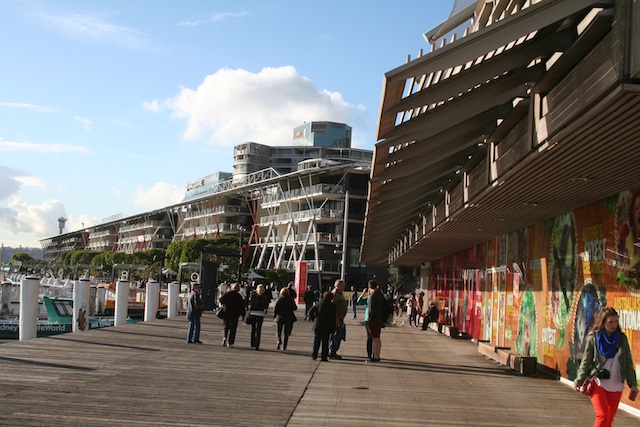
    Darling Harbour and the peak of consumerism

    Sydney’s Darling Harbour was one the centre of the nation’s mercantile economy, from across the country millions of tons of grain, wheat, sugar and other commodities were loaded onto ships and exported to the empire.

    Eventually Darling Harbour fell into disuse, the docks became containerised, bulk goods moved to specifically designed loaders and the new breed of cargo ships were often too big to fit under the Sydney Harbour Bridge.

    What really sealed Darling Harbour’s fate was Australia moved from being a largely export based agricultural export economy to a service based consumerist economy.

    Today Darling Harbour illustrates that change, the docks have become expensive restaurants, hotels and shopping centres. The notorious “hungry mile” of docks is being converted into “Barangaroo” complex of office blocks, apartments and possibly even a casino for “high roller” Chinese gamblers.

    Even the cruise liners are going. The 1980s vision of Darling Harbour as a temple to consumerism and property speculation is complete. In this way, Darling Harbour has become a picture of the Australian economy.

    Just as Australia’s mercantile era peaked just before The Great Depression of the 1930s – the depression of the 1890s was actually far harder on Australia, particularly Melbourne and Victoria – the consumerist era finished with the Global Financial Crisis of 2008.

    It will be interesting to see how Darling Harbour evolves over the next hundred years.

    For a glimpse of the final days of the old Darling Harbour, Island Shunters an ABC documentary from 1977 showed the working lives of railway workers in the goods yards on the Western side of the docks. Today those railyards are the Australian office of Google and Fairfax’s headquarters.

    Similar posts:

  • Knowledge and power

    Knowledge and power

    In the 16th Century English courtier Sir Francis Bacon declared “Knowledge is Power”, something certainly true during the conspiracy prone reign of Elizabeth I.

    Today the data available about ourselves and our communities is exploding along with the computer power to process that information to turn it into knowledge.

    We see that knowledge being used in interesting ways – US shopping chain Target recently described how they used data mining to determine, with 87% accuracy, to figure out if a shopper is pregnant.

    That 87% is important, it says the algorithm isn’t perfect and bombarding a false positive with baby wear advertising could prove embarrassing, or in some families and societies even fatal.

    A good example of data misuse are the two unfortunate Brummies (alright, one’s from Coventry) who were deported from the US for tweeting they were “going to destroy America and dig up Marilyn Monroe

    For the US immigration and homeland security agents, they ready the jokey tweets by the Birmingham bar manager through their own filter and came to the wrong conclusion, although it’s likely their performance indicators rewarded them for doing this.
    This is the Achilles heel in big data – used selectively, information can be used to confirm our own prejudices, ideologies and biases.
    In 2003 we saw this in the run up to the US invasion of Iraq with cherry picking of information used to build the false case that the ruling regime had weapons of mass destruction that could attack Europe in 45 minutes.
    For businesses, we can be sure data showing the CEO is wrong or the big advisory firm has made the wrong recommendations will be overlooked in most cases.

    Despite the Pollyanna view of a world of transparency and openness driven by social media and online publishing tools, the information is asymmetric; governments and big business know more about individuals or those without power than the other way round.

    In a world where politicians, business people and journalists trade on their insider knowledge rather than competing in the open, free market we have to understand that filtering this data is essential to retaining  powers and privileges.

    Usually when the data threatens the existing power structures it is repressed in the same way a dissenting taxpayer, citizen, employee or shareholder is discredited and isolated.

    At present there’s lots of data threatening existing commercial duopolies, political parties and cosy ways of doing business.

    The fact many of those in power don’t want to see what their own systems are telling them is where the real opportunities lie.

    Entrepreneurs, community groups and activists have access to much of this data being ignored by incumbents, it will be interesting to see how it’s used.

    Similar posts: