Tag: copyright

  • Saving the records of our times

    Saving the records of our times

    The World Wide Web describes our times but it’s an incomplete document as sites, pages and posts are lost, deleted or edited. San Francisco’s Internet Archive aims to be the keeper of that history.

    As example of how fragile our online records are is illustrated by  the tale of Kevin Vaughan’s Pulitzer Prize nominated story describing a 1960s community tragedy for the Rocky Mountain News.

    The 34 part piece captivated the newspaper’s readership when it was published in 2007 but two years later, the Rocky Mountain News went broke and the story disappeared along with the rest of the website. The Atlantic Magazine describes Vaughan’s efforts to recover and republish his story.

    Vaughan’s efforts to recover his work are not unique, websites are constantly being shut down, accounts censored and social media posts deleted. In the Coweb, The New Yorker’s Jill LaPore describes how the Ukrainian militia leader responsible for shooting down MH17 promptly deleted the message showing the plane’s remains and how the Internet Archive preserved that damming post.

    Last week in San Francisco the Internet Archive held their Building Libraries Together event where director Brewster Kahle described their efforts to preserve as much of the web as possible for future generations.

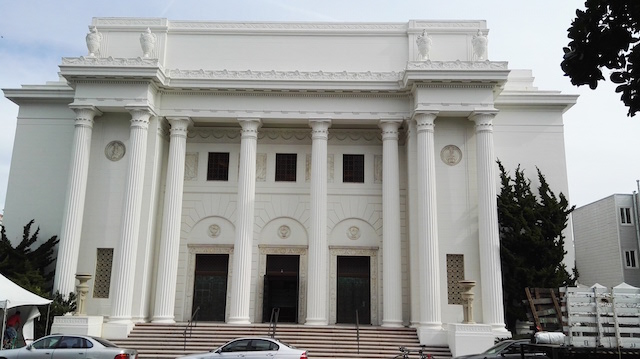
    The Internet Archive itself is in a restored church that seems almost custom built for the organisation. In her New Yorker piece, essential reading for those wanting to understand the project, LaPore describes Kahle’s affection for the building.

    He loves that the church’s cornerstone was laid in 1923: everything published in the United States before that date lies in the public domain. A temple built in copyright’s year zero seemed fated. Kahle hops, just slightly, in his shoes when he gets excited. He says, showing me the church, “It’s Greek!

    For the Building Libraries Together event, the Internet Archive had spread out a series of exhibits on the organisation’s activities that range from trawling the web through to scanning books, digitising movie reels, saving old video games and collecting TV news broadcasts.

    One of the important functions the Archive does is create collections around major events – the capture of the MH17 shoot down was part their Ukrainian War collection – which illustrates the problem of ‘link rot’ as many sites set up around events such as the Occupy movement or the Ferguson protests are now dead or occupied by cybersquatters.

    Running a service like the Internet Archive is labor intensive and in an expensive city like San Francisco where almost all the staff could be paid substantially better working in the tech sector and the pay isn’t exactly stellar.

    Internet_archive_statues

    Kahle jokes “because we can’t pay stock options, those who stay three years here get a statue made of themselves.

    The statues line one side of the old church hall that also doubles as an event space and the server room. At the back of the auditorium are the computers themselves quietly flashing away each time the archive is being read.


    mde
    mde

    For the presentations, Kahle bubbles away with his thoughts on the importance of preserving the Internet and Kalev Hannes Leetaru‘s presentation on data visualisation raised some important topics on copyright and communications which this blog intends to explore deeper in the future.

    The final part of the night’s presentation was an award to the Grateful Dead’s lyricist, John Perry Barlow, for his work in trying to keep intellectual property open and accessible.

    At the end of the night, the crowd left with their gifts and t-shirts and the exhibits had packed up.

    One of the stand out exhibits was the virtual reality stand where an old lady tried an Oculus Rift headset for the first time, “this is wonderful. I just want to reach out and touch everything,” she cried.

    Old Lady on Oculus Rift

    Preserving that wonder and the promised possibilities of our time is possibly the most important thing The Internet Archive can do. In an era where many talk of open information but few genuinely practice it, we run the risk of leaving an information dark ages for future generations.

    How we preserve a record of our times for future generations is a pressing concern. The Internet Archive is one step to solving that problem.


    Similar posts:

    • No Related Posts
  • Links of the day: Connected cars and fast trains

    Links of the day: Connected cars and fast trains

    The Consumer Electronics Show in Las Vegas kicks off today with thousands of product announcements at what is by far the biggest technology convention in the world. No doubt news from the show is going to dominate the tech media for the rest of the week.

    One of the biggest fields for tech vendors at CES will be Internet of Things with connected cars being in the spotlight with both BMW and General Motors leading the way.

    GM unveil their connected car of the future

    For some years GM have offered a connected car service with their OneStar system. At this year’s CES they’re showing how they intend to extend the service with more integrated social and navigation services.

    Driving the crashless car

    While we fixate on the driverless car of the future, the next few years are going to see the technologies be incrementally introduced into our motor vehicles. A good example of this is BMW’s Active Assist that CNET writer Wayne Cunningham claims he could not crash.

    The story points out Active Assist isn’t affordable in today’s cars but undoubtedly much of this technology will be standard in many automobiles by the end of the decade.

    California starts work on its high speed railway

    Cars aren’t the only thing in the news with California turning the first soil in its Los Angeles to San Francisco high speed railway.

    This troubled project has been years in the making and it’s not expected to be completed until the end of the next decade at a cost of over 60 billion dollars. An interesting aspect in the story is how communities in California’s Central Valley region are pinning their hopes of an economic resurgence from the project.


    Google takedown notices explode

    While cars and trains are being reinvented, the entertainment industry is still struggling with its disruption. Torrent freak reports Google is being overwhelmed with movie industry take downs notices.

    As the story suggests, this campaign is hurting Google’s relationship with the movie industry.

    Similar posts:

  • News organisations and social media copyright truths

    News organisations and social media copyright truths

    One of the long running scandals of modern journalism is how media organisations have misused social media.

    Haitian photographer Daniel Moran’s victory over Agence France Press and Getty Images is a reminder to journalists and media organisations that when something is posted to social media it doesn’t mean it’s free to use.

    Since the rise of social media sites it’s become common for journalists to grab images or videos from them to illustrate stories. At best, the media organisations have credited the sites they’ve stolen the content to allay copyright concerns.

    The problem is media companies and journalists don’t have the right to do that; users don’t give away their rights when they post to Twitter or Facebook — they grant a license to the company to use those that content as they wish.

    If a photographer, writer, computer programmer or musician wants to give away their work for free then there’s a range of ways they can do it and many are happy to make their efforts available to the community without charge. It just happens posting to a social media site isn’t one of those ways.

    Hopefully journalists and media organisations will learn a lesson from Daniel Moran’s case, social media doesn’t mean open slather.

    Similar posts:

    • No Related Posts
  • Playing in the big boys’ sandpits

    Playing in the big boys’ sandpits

    The Cool Hunter is a site whose mission is to “select and celebrate what is beautiful and enduring from all that is sought-after in architecture, design, gadgets, lifestyle, urban living, fashion, travel and pop culture.”

    In posting cool stuff they find on the web, Cool Hunter always runs the risk of copyright infringement complaints as people have the unfortunate habit of slapping images up onto the Internet without permission from the rights holders.

    Last August Cool Hunter’s founder Bill Tikos found the site’s Facebook account had been wiped for ‘repeat copyright infringements’ without warning or recourse.

    Anybody following this site won’t be surprised to read this – an exposed nipple can get you thrown off Facebook faster than you can say “New Yorker cartoon” or “it’s only a porcelain doll, for chrissake!” – so one can only imagine the paroxysms of rage that alleged copyright infringement sends Facebook’s puritan bureaucrats into.

    It’s not just nipples at Facebook though, thousands of small traders have seen their accounts arbitrarily suspended on sites like eBay and PayPal.

    Google too are quick to suspend businesses from their local and search services without warning or recourse. Usually business owners only notice they’ve been locked out when they log into their control panels only to find a terse message that their account has been suspended.

    What usually follows is a Kafkaesque tale of trying to understand exactly what they’ve done wrong and how to get their accounts reinstated. In some cases the businesses get cryptic messages saying their accounts are still in breach while others get no response at all. In a few examples, the offending page goes back online only to be shut down again a few days later.

    Rarely does someone in this situation find a calm, helpful voice to explain exactly what they have done wrong and how to fix it.

    This hostile attitude is a result of the “hands off customer service” model of web 2.0 companies and it’s their biggest achilles heel as, paradoxically, customers and users take to social media to complain about bizarre and arbitrary account suspensions.

    For some, like Cool Hunter, it’s a monumental pain and loss of a valuable platform while many of those small eBay and PayPal traders may have thousands of dollars tied up in suspended accounts they can’t access.

    Unfortunately this uncertainty is the cost of doing business on social media sites and it’s one of the reasons why owning your own business website is essential.

    When you choose to use one of these service, understand you’re playing in the big fat kid’s sandpit and you risk him throwing a tantrum and chucking your toys out of the playpen.

    Simply put, don’t base your business on Facebook, don’t keep all your money in PayPal and always have a plan B.

    Similar posts:

  • Television rights and clouds

    Television rights and clouds

    The Australian Federal Court today handed down their appeal decision in the latest twist in the Optus TV Now copyright case where the National Rugby League claimed the telco’s online recording service breaches the sporting body’s copyright.

    Reversing their colleagues earlier decision, the judges found the TV Now service does breach the League’s copyright.

    The Court’s reasoning is because the service plays a part in creating a recording the copies cannot be considered an individual’s personal copy to be watched at a later time – therefore they aren’t protected under the personal use provisions of the Copyright Act.

    It’s going to be interesting to see where the line is drawn that a computer program or cloud service is infringing copyright.

    Could be that copying a video of a football game to Dropbox, Google Drive or Evernote is a copyright breach by those services?

    Perhaps online back up services like Carbonite or iCloud could infringe copyright as they automate the copying process?

    Even if Optus doesn’t appeal the case to the Australian High Court, the decision will almost eventually tested there by someone else.

    Many of the spokespeople – along with and their apologists in the sports and business media – have argued this is about the law falling behind technology.

    The court covered this in paragraphs 18 to 25 of the judgement linked above and the judges are quite clear the law was written to be technology neutral.

    Calls now to “reform” copyright law in light of the TV Now and AFACT – iiNet cases to “bring the law up to technology” are disingenuous.

    While there’s no doubt legislation could be tweaked, there’s the real threat any “reforms” driven by the pleading of the copyright industries and their tame journalist friends will result in more restrictions and damage the take up of modern technologies.

    One can’t blame the rights holders for trying to maximise their income, they have to feed the remorseless hungry beast that is modern professional sport – although one wishes they didn’t keep bleating “think of the children” to justify their actions.

    We’ve previously seen how sports organisations have felt threatened by every new technology and the profits these new tools have delivered them.

    The latest wave of change is no different, although the glory days of sports rights may be another symptom of a changing economy and 1980s thinking.

    Hopefully the sports organisations and rights holders won’t be allowed to kill the potential of the these technologies before new business models are allowed to evolve.

    Similar posts: