Tag: Dutch Disease

  • Australia and the Dutch Disease

    Australia and the Dutch Disease

    This week sees the launch of the annual G’Day USA festival where Australian exporters and various celebrities extol the virues of the country across the United States.

    One of Australia’s success stories of the last decade has been Yellowtail Wines which carved a niche for Australian wines in the US in the same way Jacob’s Creek did a decade earlier in the UK.

    Today the Australian Financial Review reports that Cassella Wines, the maker of Yellowtail, is in breach of its banking covenants due to the high Australian dollar.

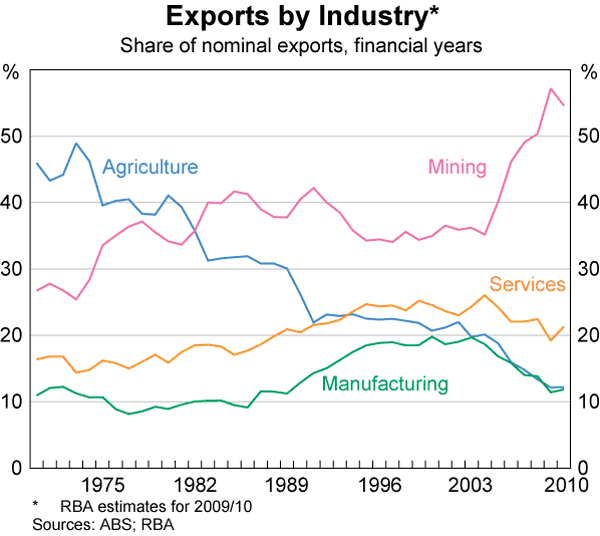
    Cassella Wines is another victim of Australia’s Dutch Disease infection.

    Dutch Disease owes its name to the Netherlands’ gas boom of the 1960s. By the early 1970s the strong Guilder damaged the rest of the Dutch economy which didn’t profit from extracting natural gas.

    Having sleepwalked into the Dutch Disease, it’s fascinating how Australia’s electorate, policy makers and business leaders are in denial about the effects as successful exporters like Cassella Wines struggle with a high dollar and accelerating costs.

    When commodity prices and the dollar turn, and they always do, its going to be tough for the economy to adapt as much of the industry capacity that was competitive at lower rates won’t be available to take advantage of the lower costs and to pick up the slack from a declining mining sector.

    For Australian businesses, the onus is on managers and proprietors to protect their organisations from the short term effects of a high currency and the medium term effect of a falling dollar pushing up the input prices of imports.

    In other words, getting costs down without becoming too reliant on offshored labour or suppliers. The companies that manage this are going to be very strong after the initial adjustment, but it’s a tough management task.

    While that task can, and will be, done by smart and hardworking leaders no-one should expect any recognition of the scale of this task from governments, media or business organisations who seem to be in denial of reality.

    The Dutch and Australian flags image is courtesy of Emilev through SXC

    Similar posts:

  • Australia’s one trick economy

    Australia’s one trick economy

    Earlier this week, Reserve Bank of Australia Governor Glen Stevens gave a speech to the Australian Industry Group on the world’s changing economic currents.

    That presentation has a number of pointers for Australian businesses on how we use technology, our investments and, most importantly, where the Canberra sees our economy going.

    Much of the Governor’s speech discussed how those of us who at the beginning of the century believed Australia’s economy had to diversify into new industry sectors — such as the IT sector — were proved wrong by the Dot Com Bust and the subsequent boom in the resources sector.

    “Australia would probably do best, in its production structure, to stick to its comparative advantages in minerals or agriculture or various services.” Mr Stevens quoted from ten years ago, “but it was hard going trying to make sensible points against the barrage of market and media commentary.”

    Perfect hindsight

    It’s impressive the Governor had this perfect hindsight which can overlook the role of ramping the housing markets by the Rudd and Howard governments to avoid the 2001 and 2008 US recessions along with the sheer good luck of having a resources boom through the last half of the decade.

    During his speech the governor referred to an RBA research paper, Structural Change in the Australian Economy which casts an interesting light on the comparative advantages in those “various services”.

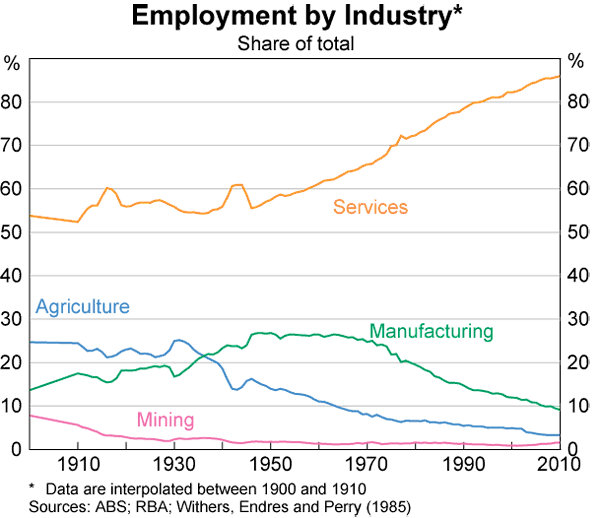
    That paper shows that service sector employment has risen to nearly 85% while its share of GDP has stayed around the same for the last twenty years, which to this non-economist’s mind implies the portion of national wealth is declining for service based workers and businesses.

    Sleepwalking into the dutch disease

    Of course those of us in the service sector could make it up by exporting but here again, service sector exports haven’t done much over the last decade which won’t be helped by the current high Aussie dollar — another aspect of the Dutch Disease we seem to have sleep walked into over the Howard and Rudd years.

    Those same statistics show mining employment has declined over that period as well and if you’re considering sending your kids down the pit, or even packing in your own city job to drive a mining truck, you might want to read the interesting work being done by the University of Sydney’s school of robotics.

    Generously, Governor Stevens didn’t completely write off the role of technology observing that, “in the old versus new economy stakes, it was probably in the use of information technology, rather than in the production of IT goods, that the gains would be greatest.”

    Invest in, but don’t develop, technology

    The Governor’s messages are clear to business people; our businesses have to invest in technology to be more efficient and we need to understand that government policy will be geared around the mining sector.

    Most importantly, we need to understand that on a national level there is no Plan B.

    In the last election it was clear both sides of politics based their policies, such as they were, on the assumption the China boom will last for the foreseeable future. Yesterday’s speech shows Glenn Stevens and the Reserve Bank share that outlook and no other alternative is being planned for.

    That’s fine for Glenn, Julia, Tony and their colleagues as they have safe, indexed pensions when they deign to cease giving us the benefit of their visionary leadership.

    In the business community we don’t have that luxury; a plan B is required just in case things don’t quite work out the way we hope. As the Governor says:

    Succeeding in the future won’t ultimately be a result of forecasting. It will be a result of adapting to the way the world is changing and giving constant attention to the fundamentals of improving productivity. That adaptability is as important as ever, in the uncertain times that we face.

    That’s excellent advice. How adaptable is your business in these uncertain times?

    Similar posts: