
Tag: economy

  • Times get tougher for journalists and the middle class

    Times get tougher for journalists and the middle class

    Journalists have had a tough time over the last twenty years and it’s about to get tougher.

    Last July The Associated Press announced they will automate most of their business reporting. AP’s Business News Managing Editor, Lou Ferrara explained in a company blog how the service will pull information out of company announcements and format them into standard news reports.

    instead of providing 300 stories manually, we can provide up to 4,400 automatically for companies throughout the United States each quarter

    This isn’t the first time robots have replaced journalists, three years ago National Public Radio reported how algorighms were replacing sports reporters.

    Ferrara admits AP has already automated much of its sports reporting;

    Interestingly, we already have been automating a good chunk of AP’s sports agate report for several years. Data comes from STATS, the sports statistics company, and is automated and formatted into our systems for distribution. A majority of our agate is produced this way.

    Reporting sports or financial results makes sense for computer programs; the reciting of facts within a flowing narrative is something basic – Manchester United led Arsenal 2-0  at half time, Exxon Mobil stock was up twenty cents in morning trading and the Japanese Yen was down three points at this afternoon’s close don’t take a super computer to write.

    Cynics would say rewriting press releases, something many journalists are accused of doing, could be better done by a machine and increasingly this is exactly what happens.

    The automation of commodity reporting isn’t just a threat to journeyman journalists though; any job, trade or profession that is based on regurgitating information already stored on a database can be processed the same way.

    For lawyers, accountants and armies of form processing public servants the computers are already threatening jobs – like journalists things are about to get much worse in those fields.

    It could well be that it’s managers who are the most vulnerable of all; when computers can monitor the workplace and prepare executive reports then there’s little reason for many middle management positions.

    This is part of the reason why the middle classes are in trouble and the political forces this unleashes shouldn’t be underestimated.

    Similar posts:

  • Competing in the global tech race

    Competing in the global tech race

    Last week I wrote a piece for Business Spectator on the contrast between countries competing for tech investment and skills.

    Irish Taoiseach Enda Kenny was in Silicon Valley promoting Ireland as an investment and operating location while in London the Queen hosted 350 British tech companies at Buckingham Palace.

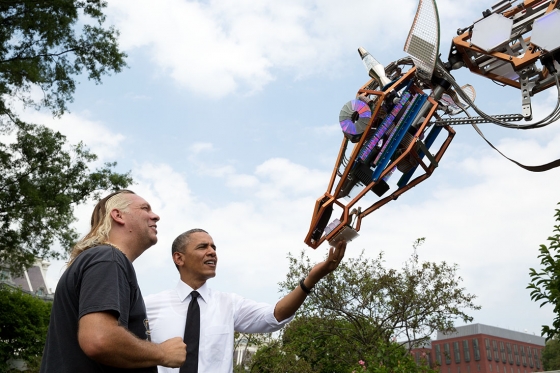
    Earlier this week President Obama hosted the first White House Makers’ Faire with over thirty inventors showing their ideas.

    All of this contrasts with the Australian Prime Minister Tony Abbott’s recent North America where he touted the country was ‘open for business’ by offering mines and toll roads to Canadian pension funds.

    It’s clear some countries’ leaders recognise they live in the Twentieth First Century while others are struggling with Twentieth Century.

    Similar posts:

  • Living in a changing world

    Living in a changing world

    “We’re looking at a future where every aspect of our lives could be utterly different to how it is now,” declared ABC Radio host Linda Mottram in our semi-regular technology spot on Monday.

    Linda’s concern was based around our talk on 4D printing and the future of design and she’s absolutely right – life is going to be totally different by the end of this century.

    We won’t be the first generation to experience such massive change to society and the economy, our great grandparents at the beginning of the Twentieth were born into a world without electricity, the motor car or antibiotics.

    Those who survived the two world wars and lived to a ripe old age in the 1970s saw life expectancy soar, childhood mortality rates collapse and the western economies shift from being predominately agricultural to mainly industrial and service based.

    From our position, it’s difficult to comprehend just how radically life changed in western countries during the Twentieth Century.

    When we wonder where the jobs of the 21st Century will come from, it’s worth reflecting that many careers we take for granted today didn’t exist a hundred years ago and the same will be true in a hundred years time.

    The technology we’re using may be new, but adapting to massive change isn’t.

    Similar posts:

  • What happened to Australia?

    What happened to Australia?

    Today I have a piece up in Technology Spectator on PwC’s Expanding Australia’s Economy report, the headline for which probably guarantees I’ll never get a job in a large Australian corporation again.

    While the headline – which wasn’t mine – is inflammatory, there is an element of truth to it as Australian companies have become far more insular and comfortable in the last twenty years.

    It wasn’t always like that, for a brief period in the late 1980s and early 1990s corporate Australia was prepared to take on the world. But something happened in the mid 1990s.

    John Winston Howard

    One of the key turning points was the election of the Liberal government in 1996, John Howard’s fundamental belief was that things were better in the 1950s and Australia should return to those days. He delivered.

    The Australian people thought his vision was a great idea, having become exhausted by the reform agenda of the 1980s Hawke and Keating Labor governments that had opened and reinvigorated the economy.

    Howard was helped by the Labor Party abandoning its reformist agenda with its successful 1993 campaign against the Liberal’s policy of changing the tax system. As George Megalogenis pointed out in his book The Australian Moment, Paul Keating’s populist victory over John Hewson demolished any appetite for meaningful reform among Australia’s political classes.

    Cosy clubs

    The centerpiece of Keating’s economic reforms was the compulsory retirement savings system; while the idea was good in principle, the practice of private fund managers looking after the savings has meant most of the investment has been concentrated in the top ASX stocks.

    As a consequence, Australia’s top companies were relieved of the chore of answering to stroppy shareholders as their registries were dominated by their friends from Sydney’s Balmoral Beach Club and the hallowed halls of the Melbourne Club.

    Domestic duopolies

    Compounding that problem was another failure of the Hawke-Keating years of allowing domestic monopolies to develop on the basis that Australian companies needed a strong local footing in order to compete in global markets.

    For a while that worked until Australia’s now powerful duopolies decided it was more profitable to exploit their domestic market strength rather than competing as global players. This happened around the time Keating won the 1993 election, by time Howard became PM the practice was well established.

    The combination of tame shareholders and comfortable markets is why Australian corporations haven’t responding to global pressures; they simply don’t have to. Which leads us back to the conclusions of the PwC report.

    Australia needs to lift its game. We are lagging behind our peers globally and are not considered a leader of innovation. The Organisation for Economic Co-operation and Development in its Science, Technology and Industry Outlook 2012 rates Australia as average against its key drivers that measure competency and capacity to innovate. Change is required.

    It’s difficult to see where change is going to come from for Australia while everyone – business leaders, politicians and the population at large – are comfortable. As the long as The Lucky Country stays lucky it can afford not to invest in the 21st Century.

    Similar posts:

  • Leading the disruptive wave

    Leading the disruptive wave

    I’ve a story up on Technology Spectator that pulls together Uber’s fight with taxi regulators around the world with the Australian government’s Commission of Audit.

    While the story is written in an Australian context, the key message about business disruption is universal; as barriers to entry fall, no incumbent can assume they are immune from having their business upended.

    For Australia, this is a particularly important message as the affluent economy is kept afloat by consumer spending underpinned by a favoured and protected housing market.

    The economy though is nowhere near as untouchable as it looks; along with being way over invested in property, Australia’s industries are hopeless uncompetitive and have a cost base similar to Germany’s.

    It’s an entire country ripe for disruption, it will be interesting to see if the Lucky Country’s luck holds in the 21st Century.

    Similar posts: