ABC Radio National’s Background Briefing has a terrific story on the struggles of the Fairfax newspaper empire during the early days of the Internet.
One of the major themes that jumps out is how Fairfax, like many media and retail organisations, squandered the opportunity presented by the tech wreck.
The tech wreck was an opportunity for incumbents to claim their spaces in the online world, instead they saw the failure of many of the dot com boom’s over-hyped online businesses as vindication of their view the Internet was all hype.
As former Sydney Morning Herald editor Peter Fray said “In florid moments you could even think this internet webby thing would go away”.
For Fairfax the profits from the traditional print based business were compelling. According to Greg Hywood the current CEO, for every dollar earned by the company, 70c were profits – a profit margin of 233%.
The Internet threatened those “rivers of gold” and media companies, understandably, did nothing to jeopardise those returns.
Another problem for Fairfax was the massive investment in digital printing presses in the 1990s. These behemoths revolutionised the way newspapers were printed as pages could be laid out on computer screens and sent directly from the newsroom to the press itself which printed out pages in glorious colour rather than with smudgy black and white images.
Moreover these machines were fantastic for printing glossy coloured supplements and the advertising revenue from those high end inserts kept the dollars rolling in.
When the tech wreck happened, the massive investments in printing presses were vindicated as the rivers of gold continued to flow while the smart Internet kids went broke.
Fairfax’s management weren’t alone in this hubris – most media companies around the world made the same missteps while retail companies continued to build stores catering for the last echos of the 20th Century consumer boom.
In 2008, the hubris caught up with the retailers and newspapers. As the great credit boom came to an end, the wheels fell off the established business models and the cost of not experimenting with online models is costing them dearly.
Value still lies in those mastheads though as more people are reading Fairfax’s publications than ever before.
Readers still want to read these publications, one loyal reader is quoted in the story that Sydney Morning Herald should aspire to “being a serious international paper.”
That isn’t going to happen while management is focused on cutting costs to their core business instead of focusing on new revenue streams.
Somebody will find that model, had the incumbent retail and media organisations explored and invested in online businesses a decade ago they may well have found that secret sauce.
Now many of them won’t survive with their horse and buggy ways of doing business.
One of the tough things about long haul, overnight flights is getting a decent night’s sleep. I find this can only be done in a windows seat where you can snuggle against the fuselage and get reasonably comfortable. So it’s a priority to get those windows seats for a big flight.
With the return flight to Sydney from San Francisco it turned out there were no window seats in the basic economy section so a $150 upgrade to United’s Economy Plus section was needed to grab one of those essential windows seats.
Check-in
The United online check in, while clunky, still worked and the upgrade to Economy Plus was a simple online credit card transaction with a straightforward seat allocation, the selection was painless and effective.
At San Francisco airport the check in, albeit three hours early, was friendly and quick with no quirks and thankfully the seat allocation had been kept.
One thing to keep in mind with United’s seat allocations is they reserve the right to change them and even kick you out of Economy Plus, albeit with a refund of the supplement, if the flight is full and the Sydney flights are usually packed.
So it’s a good idea to get the airport and check in early to reduce the chances of losing your seat which is highly likely if there’s been disruptions elsewhere in the United network meaning connecting passengers have missed earlier flights.
Getting through security is the usually fraught hassle however the TSA staff deal with flummoxed tourists and language barriers with a brisk efficiency. Keep your sense of humour and accept that travellers’ dignity was one of the early causalities of the War On Terrorism and the process shouldn’t be traumatic.
Airside
San Francisco’s International Airport is a delight compared to the snarling, customer unfriendly Sydney Airport. While food outlets aren’t cheap, San Francisco’s are decent and there’s plenty of accessible power sockets, working desks and free wi-fi that works.
The gates themselves can be some distance from the facilities so be prepared not to stray too far. The gate lounges themselves are fairly spartan and there’s no reason to wait there until a few minutes before the aircraft starts boarding.
The seats
Sadly I didn’t get the aircraft registration numbers for this flight or the previous inbound trip but it appeared that this plane was newer – say mid-1990s – than the flight into San Francisco which could well have been one of the first 747-400s ever built in the late 1980s.
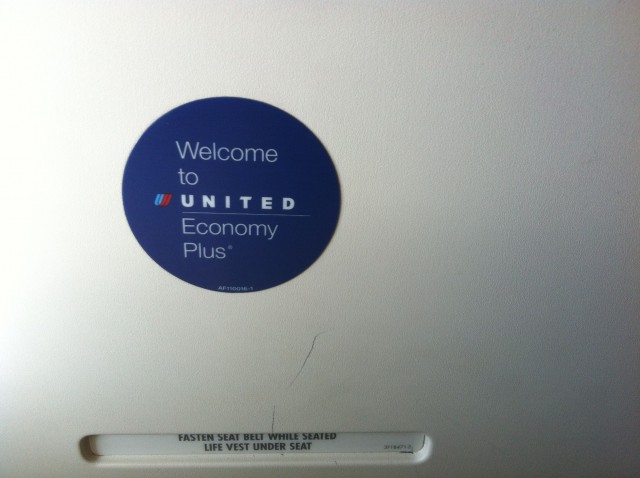
United Airline’s Economy Plus is far more comfortable than standard economy
The Economy Plus seats’ additional 3″ of legroom are definitely worth it. The moment you get in the seat, you know the extra room makes a much more comfortable trip than the cramped 31″ of standard economy class.
One thing to keep in mind is that while Economy Plus adds nothing more in service, being at the front of the economy cabin does mean you get first choice of food, beverages and easy access to the middle toilets which is a slight advantage over those crammed at the back. It’s also a little quieter as the seats are over the wing rather than behind the engines.
Another benefit with the additional pitch is that you don’t get a faceful of headrest when the seat in front of you reclines so it is possible to work on a laptop, read or eat in comfort even when the person ahead of you is still sleeping.
Inflight entertainment
While the system was still the shockingly decrepit 1990s cabin screens, there were for some reason additional choices on the audio channels including a classical music selection which made it far easier to relax than cheesy 1980s love songs or gangsta rap.
Naturally there was no inflight power in the cheap seats so take advantage of the plentiful power sockets at SFO to make sure you’re fully charged before boarding.
Shortly after take off the cabin crew come around with meals. Overall the cabin crew seem tired and beaten, while they aren’t rude or unpleasant one wonders if they have all received too many stern memos from management about being friendly to customers.
Food
An interesting thing about cheap airline food is how they cook and serve it in ways that make it difficult, if not downright dangerous to eat with plastic cutlery.
Careful trying to cut that chicken
In this respect UA 863 didn’t disappoint. The tough, mystery chicken lying under a red sludge masquerading as barbecue sauce was difficult to cut and risked sending one’s drink flying into your neigbour if you weren’t careful. This isn’t helped by the weird ridges United insist on putting underneath their trays.
The bread had a strange chemical taste while the Love and Quiches Double Chocolate Crunch Bar was the highlight of the meal. The red wine was nice as well.
After as good a night’s sleep as one can get in an economy class seat, breakfast was served around two hours before landing in Sydney. Again it was tough to eat.
You’ll need lots of syrup to soften that tough toast
Like the chicken earlier in the flight, the French toast was tough to cut and hard to eat. Fortunately a good soaking in maple syrup makes it almost edible.
The fruit salad was spartan but fine while the cold croissant tasted strange like the roll served the night before. It’s a shame United can’t find one of San Francisco’s excellent bakeries to supply their bread.
Arrival
The plane arrived on-time and without problems with immigration straightforward after dodging the embarrassing and garish duty free ripoff shops.
Customs is the standard mass brawl that’s normal for early morning international arrivals at Sydney when a dozen or so wide bodied jets arrive at the same time from Europe, Asia and the US.
If you have the choice, it may be worthwhile choosing a flight that arrives in Sydney after 8am so you can avoid both the customs hall and traffic peak hours.
Once past customs it’s welcome to the snarling, belligerent and anti-traveller horror that is Sydney Airport. Get out of there as quick as you can by train, taxi, bus or car.
Note if someone is meeting you, the pick up area is on the far side of carparks A and B. It’s not marked for either passengers in the terminals or for those driving into the complex. None of this is an accident and it’s best for both parties to have mobile phones so they can co-ordinate movements.
In many ways the customer hostile attitude of the Sydney Airports Corporation is good news for United Airlines as it makes their tired inflight service feel warm and inviting.
Overall the United Economy Plus option is worth the extra $150 charge to at least get earlier service and more legroom if you have to fly UA. It’s difficult though to recommend United while they fly such awfully old equipment and you should only consider it if the connections or the fare make them the best option.
Craigslist Ad:
We are a small & casual restaurant in downtown Vancouver and we are looking for solo musicians to play in our restaurant to promote their work and sell their CD. This is not a daily job, but only for special events which will eventually turn into a nightly event if we get positive response. More Jazz, Rock, & smooth type music, around the world and mixed cultural music. Are you interested to promote your work? Please reply back ASAP.
A Musician’s Reply:
Happy new year! I am a musician with a big house looking for a restauranteur to come to my house to promote his/her restaurant by making dinner for me and my friends. This is not a daily job, but only for special events which will eventually turn into a nightly event if we get a positive response. More fine dining & exotic meals and mixed Ethnic Fusion cuisine. Are you interested to promote your restaurant? Please reply back ASAP.
The discussion about Amanda Palmer offering unpaid gigs for local musos on her US tour has been heated and the perspectives are interesting.
What’s missed is the difference between artist and workers – the local violin player or trombonist getting up on stage with Amanda Palmer in Poughkeepsie isn’t going onstage to make a buck, it’s because he or she loves playing and is honoured to get an opportunity to perform with a big act.
On the other hand, one of the sites that’s been critical of Palmer advertised for a “insightful, knowledgeable and talented writers to contribute to the ongoing and ever-intriguing discourse on music and film.”
For submitting three 200 word blog posts a day, the lucky writer will receive a grand payment of six dollars. That’s one cent a word. Plus a cut of advertising revenue.
Should anyone be tempted to think that revenue could amount to much, they should keep in mind the web is awash with crap content that’s worth one cent a word; there’s no reason why any half decent writer couldn’t set up their own blog and stick adwords on it for a better return.
A few decades ago when printing was expensive and distribution networks difficult to set up, indy magazines offering little but an outlet to their writers served a purpose.
Today you can setup an outlet in five minutes on Blogger or WordPress and let the web do the distribution for you.
Any business that relies on free or cheap content is doomed – we’re in a world awash with cheap, crappy content and the public don’t see much reason to pay for it.
That there is no market for crap is something our once esteemed newspapers, magazines and TV stations should keep in mind as they sack subeditors, retrench journalists and increasingly source material that was available on Twitter a day earlier.
Ever since the days of Napoleon business people have lusted over the idea of selling into the Chinese market – the idea of a billion people clambering to buy just one widget each brings a gleam to the eyes of even jaded entrepreneurs.
When Deng Xaioping opened the Chinese economy in the mid 1980s Australian brewers, Swiss watchmakers and German motor manufacturers rushed into the country believing that a billion liberated peasants would rush to buy expensive beer and watches.
As it turned out, the real opportunities for foreigners were in the other direction. When China joined the World Trade Organisation in 2001 the boom that had already started in the Special Economic Zones along the southern Chinese coast spread across the Eastern provinces as manufacturing from Hong Kong, Japan and Taiwan to find cheaper labour.
300km South-West of Shanghai the city of Datang became “sock town” where local companies manufactured a third of the world’s sock supply.
Excess capacity is a problem in many industries, particularly motor manufacturing where governments around the world have supported their local producers resulting in a glut of cars and trucks. Socks are no exception to the laws of supply and demand.
The travails of China’s sock industry are a cautionary tale for those who project straight lines for Chinese growth.
Facile assumptions that every man, woman and child on the planet needs to buy two pairs of socks a year, or that China will build millions of steel hungry apartments each year, is not economic analysis and any business built on such shaky beliefs is leaving itself vulnerable when things don’t work out.
The same is true for nations. Hollow assumptions can put an entire economy on shaky ground. Just thinking that every Chinese family needs six pairs of socks doesn’t guarantee economic success.
Throughout the industrial revolution progress and innovation was about creating products that improved people’s lives – whether it was Josiah Wedgwood making affordable crockery, Thomas Edison commercialising the light bulb or Henry Ford making cheap motor cars available to the masses – these innovations changed the way we lived or did business.
In the late Twentieth Century business focused more on creating gadgets and our lives became a race to accumulate more useless tat to store in our big McMansions to store the junk in.
We wore out our credit cards and home equity in “buying stuff we don’t need to impress people we don’t like” throughout the 1990s and early 2000s.
Jeff Bezos is onto this, instead of Amazon offering me-too products that don’t add value, “people don’t want gadgets anymore. They want services that improve over time.”
The word ‘service’ is notable — one of the things Amazon have achieved is changing how customers use books and DVDs from outright purchases that they can trade and sell to licensed products where Amazon and publishers control distribution.
Amazon are consolidating their position as one of the big four Internet empires. How Google, Apple and PayPal respond to Amazon’s suite of services will define much of the online economy.