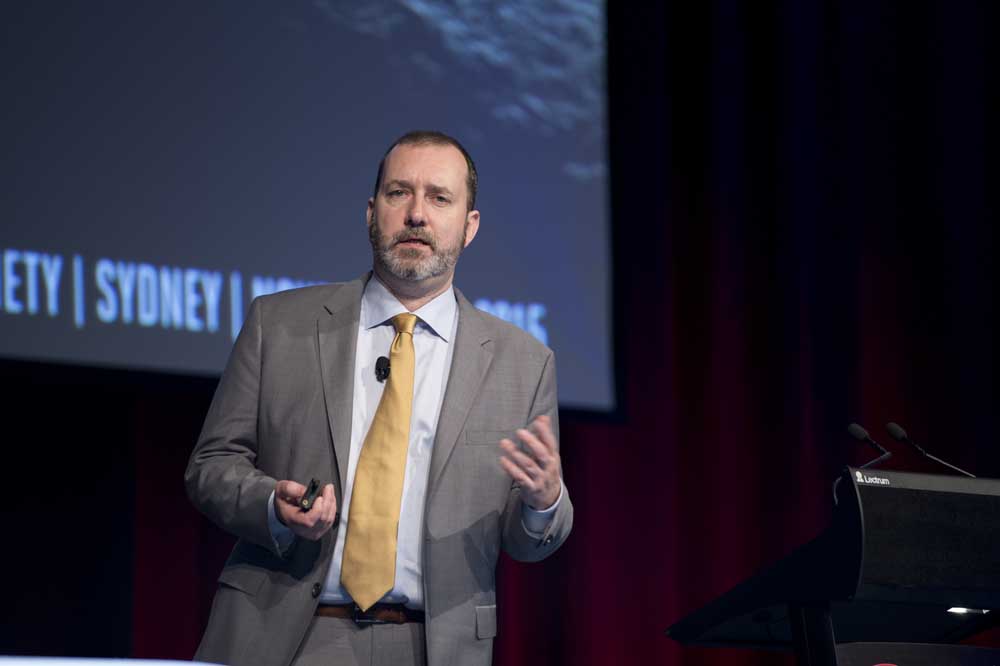
Kevin Ashton is best known for coining the ‘Internet of Things’ term in 1999, however that’s just one part of a varied career that’s included building a number of tech startups, co-founding MIT’s Auto-ID Center and leading some of the early development work in RFID (radio frequency identification) networks, which led to the IoT label being born.
Since exiting his last business Ashton’s focus has been on consulting, mentoring some of the startups he’s invested in and writing with his last book “How To Fly A Horse, the secret history of creation, invention and discovery” released at the beginning of this year.
During his visit to Sydney last week, he spoke to Decoding The New Economy about his startup experiences, the future of work, skills needed for success and why the media is a doing a poor job on reporting technology.
Let’s kick off with your book, what was the motivation behind writing it?
In the late 1990s I started a lab at MIT and most of my talking was about the research we were doing. I’d talk and then they’d hear it. But occasionally someone would say, oh, but you’re leading a very innovative team, and we’re very interested in innovation. Can you talk about innovation and how things get created?
So I started giving talks about my experiences of driving an innovation and trying to be innovative, and so on. And that became more and more popular through the 2000s. Eventually I was giving a talk in Napa Valley, California, and a friend of mine came to watch, and at the end they were like, “Oh my God, that was amazing! You need to write a book.”
I started writing a book of the talk and it did very well. People really liked it. And it was weird because, I guess, you kind of get used to a way of thinking about things, and it seems you forget that to other people it might be insightful.
The book is really my experience and my strong belief that creating is not about magical flashes of inspiration and being a special kind of person, or being a genius, or whatever. It’s got a lot more to do with being willing to just keep going even when it’s not working, even when you can’t see a way forward.
And it’s also not an individual thing. It’s very much about building on the work of other people. Creating itself is very individual, which turned out to be a controversial point as well, that you’re always part of a community of people you know, people you don’t know, people that are still alive, people that died years ago. You’re making these incremental steps, building on the work of others. So that was always my thought, and that’s the book that I wrote. And I’m lucky. People seem to really like it.
What’s your thoughts on the current startup mania?
I think, by and large, big companies suck at doing new things, and the reason is structural. Every big company was a small company at some point. Someone was doing a new thing. And eventually they happened upon something that worked.
The first thing you tried doesn’t work, the second thing you tried doesn’t work, and accidentally you stumble across something that does work and starts making money. Maybe those people move on, maybe they stay, but it’s easy to become addicted to the comfort and safety of the thing that works.
And the money that flows from the thing that works, it’s easy to believe that that thing will continue to work. Or you make a slight change. You only had a red one, and now you’ve got an orange one, and you feel like you’ve been profoundly innovative.
So if you really want to do something new, you probably need to be in a small, passionate group of people. Now it is possible for a big company to take a small, passionate group of people and sort of stick then in an airlock somewhere and leave them alone. Theoretically, that’s possible. It seldom happens, and particularly because most of innovating is failing.
I’ve seen time and again is the people who rise to the top of big companies are often people who are very good at avoiding failure, or the appearance of failure. Very good at taking credit for other people’s success. They’re often from a privileged class. It’s typically white men. The typical CEO is a tallish white man with a full head of hair and a deep voice. I see that all the time. Failing is not good for your career. Ironically, because it is good for creating.
So, I think startups, meaning small companies, small groups of passionate people who are either not scared of failing or don’t have any choice but to keep failing until they succeed because there’s nowhere else to go, are always going to be the engines of innovation and creating.
Now, I will qualify that. There is also a class of privileged white men called venture capitalists who like to make you think that unless they’re allowed to give you some money that you can’t succeed and that you’re not a credible startup unless somebody blessed you with some venture capital or something. And I think, frankly, that’s all bullshit.
The last thing you want to do as an entrepreneur is, and I’ve done it. I’ve started companies without venture capital, and then taken some eventually. My my most successful company never took on any money from anybody else. There was kind of in the middle somewhere.
Not only is venture capital and outside investment not a prerequisite for having a successful startup, it’s really a last resort. Because what comes with that money is loss of control and people who don’t…You know, you start to get some of the problems that come with a big company. Venture capitalists who hear this will just throw up their hands and hate it when they get called out on their shit, but that’s true.
And by the way, a lot of very successful companies that…take Microsoft, or Amazon, or whatever…had a very slight relationship with venture capital. So it’s entirely possible to build a large, successful, high-tech company, without venture money.
The discipline that comes from living hand to mouth and trying to find a customer and trying to make a profit and not wasting your money on bean bags and air hockey or whatever, that’s a good thing. So, I’m all for people of all genders, colors, sexualities, shapes and sizes trying to do something by themselves. I think you can be successful. I don’t think you need anybody’s permission.
Which was your most successful company?
Zensi was a company I started with some academic friends, and it was a very smart way to identify how people were consuming electricity and water. I was very into knowing things relatively. In the case of water, for example, we put a very simple sensor that you could screw under the kitchen sink. It was just a little diaphragm. But every time you use water anywhere in your home, the pressure in your water system changes.
So you turn on the shower upstairs, and throughout your water system, there’s a pressure drop, and then a pressure stabilization as the system gets back to its regular pressure. And what we found was, you could analyze that pressure change and determine someone had just taken a shower, for example.
It’s a very simple sensor connected to the internet, a bunch of algorithms in the cloud. And you could identify leaks, you could tell people where they were wasting water. So, we started that company, basically, with cash of our own and that was in January, February 2009. So that was the depths of the recession. When nobody was starting anything, by the way.
What do they say? They say buy low and sell high. Well, guess what? When you can buy low, nobody’s buying. They’re scared, right?
So we started it 2009, and about 10 months later we had a couple of people trying to acquire it for a lot of money. The best answer you can ever give somebody when they want to acquire your company is, we’re not for sale, because then the price just keeps going up. You have to mean it, right?
Eventually, we got an offer we really couldn’t refuse. At the same time, we were thinking about trying to raise venture money, and so on. It wasn’t like a deliberate strategy to never do it. But the acquisition deal was just so much more valuable. And the beauty of that is, you’re not sharing the money with anybody else.
Today you’re an author and speaker?
Author, speaker. I’ve got some investments in some Austin-based startups. I do a little bit of consulting here and there. So, companies I’m interested in. I have done the MIT thing. And then three startups. And I’m actually enjoying not having a very formal schedule. It gives me a chance to write, which I love. It gives me a chance to come here and do this. I’ve never been very successful in companies that I was not in charge of.
I find that a lot of the kind of mansplaining and bullshit and endless PowerPoint and people wanting to have nothing but meetings and, you know, a lot of posturing and politics and stuff. I mean, like a lot of people who are interested in innovation and passionate about creating new things, I have a very low tolerance for that crap. I’m very bad at it. So, I love my life right now, because I really choose. I’m very much the master of my own destiny, and I don’t have to…I’m not obliged to deal with too many idiots. Which is good for me, because I’m not good at it.
So onto that inevitable question that you’re going to get about the Internet of Things. Do you regret coming up with that tag?
No.
No?
No, I joked one time that I should have called it the internet for things, and people took that a bit too seriously. I mean, I had no idea that it was going to have a life outside of the PowerPoint presentation that I was working on at the time, but it has a poetry to it. It’s specific enough that when people ask what it is, I think you can give a good explanation. It’s general enough that it’s not limiting itself to one application, or something.
The other thing I think is really curious to me is…so the internet of things was something I talked about a lot between ’99 and 2005 or something. And it was reasonably well known in the fairly small community of people who are interested in ubiquitous computing and embedded computing.
And then it took on a life of its own in the late 2000s and sort of the last few years. And I think there’s a couple of reasons why. Right? One is that there are a lot of people graduating right now who are really internet natives.
So the idea of things not being networked, or of things being wirelessly networked, the idea of computers only getting information via keyboard, that’s not a paradigm they’ve ever lived in. And they are…I think I got that slightly wrong, that sentence, so let me rephrase it for you. But there are a group of internet natives graduating right now who have never lived in the paradigm where computers are not connected.
And they’ve never lived in a paradigm where computers don’t gather their own information. So it’s very…the internet of things idea is incredibly natural to them. People who were using computers, let’s say, in the 80s and the early 90s, pre-internet, it can be a little less intuitive. So that’s one thing, but the other thing is, just a complete coincidence, I think, is Twitter. On the internet of things community on Twitter we use the hashtag IOT.
Now, it just so happens, first of all, IoT is very Twitter-friendly because it’s very short. But by calling this thing the internet of things, I inadvertently happened upon a three letter acronym that was distinctive. There aren’t many of those in the world. But there isn’t anything IOT stands for. Now, we never used the term IoT in the early days because it wouldn’t mean anything to anybody, right? But I happened upon this distinctive three-letter acronym, and then Twitter came along. And it made it very easy for all these kids that were kind of internet of things natives to find one another and communicate with one another, and that really helped. That really helped. So there was some coincidence in that realm.
In the presentation that preceded this interview you were quite scathing about some of the more trivial commercial consumer IoT examples.
Oh, stupid. Yeah.
I couldn’t help but think of Marc Benioff a couple of years back, waving his connected toothbrush around at Dreamforce.
People will do everything. If you’ve been in tech for a while, people have been doing that for years. It’s bullshit. I mean, the…So you must live in a super smart home. Not really, no. And they’re like, what have you got?
They think I’m going to have Roombas talking to light bulbs or some bullshit. But the one thing of those consumer products I found useful is my bathroom scale is on WiFi. It’s crazy expensive, but it means that I can never lie to myself about whether or not I’m losing or gaining weight, because it’s like, there’s something on the web, it’s keeping a record. That’s useful. But I think…one of the things that’s kind of curious to me. I talk about it a little bit in my book actually is, there seems to be this obsession with consumer applications in technology.
Which is coupled with a complete lack of curiosity, particularly with respect to you, on the part of journalists and editors and people like that, about how the world actually works. Right. The manufacturing, supply chain, distribution, agriculture, the history of technology. They don’t want to know. It’s like, what is it? And this is a thing. Journalists are the only people who their life is writing about stuff, and then they go out into their kitchen, which is why…they don’t really seem to care about how stuff gets to their kitchen.
It’s like, tell me what it means for my toaster. But there’s so much more to the world than freaking kitchen appliances, you know? And I’m sure there’s something interesting you might to do with a kitchen appliance, but I can’t really think of it. And I don’t see why I have to.
Look at Uber, the interesting thing about it is, people think I’m cheating. I’m like, so, you’ve got GPS, right? Yeah. Well, that’s a sensor. It’s network connected. That’s part of the internet of things. Oh, yeah, okay, like, not really. I’m like, yes, really. That really is. Right? And it’s the same with…so, oh, I’ve got a smart watch now, and I’m measuring how many steps I take, or something. Great. If you’re doing that, that’s internet of things, right?
And on and on it goes. So there’s a real ignorance among a certain class of people, a kind of communicating class, about how the world works, how things are made, how complicated and miraculous that is. And also there’s kind of an anthropomorphic tendency they have that, when you point out that a phone has a camera and a camera is a sensor, that’s kind of confusing, because unless it’s a human-like sense, it kind of doesn’t count, right? Well, we don’t have GPS, but GPS is still location-sensing.
So I think all this is part of paradigm shift, as well. So it’s not that surprising to the internet of things generation, which is really people, for one, like, I don’t know, after 1990 or something. It’s fairly obvious to them, but to older people it’s like, oh, what does the fridge say to the toaster?
I’ve encountered that myself where producers or editors aren’t interested yet the audience enjoys the discussion or topic.
I mean, that’s the thing, and that’s why I made that joke on the stage. It’s like, I don’t actually agree with these filters. My audience isn’t interested in this because I speak to thousands of people a month, and they’re all interested in it.
So supply chain, it’s amazing to me that there’s a couple hundred eight meter high freaking self-driving trucks in the Pilbara but because people don’t care about, well, what is a strip mine, and what the hell are they strip mining?
What is it that Rio Tinto do anyway? It looks kind of dusty, and the things are big and yellow, and not quite black and shiny, or whatever, so we don’t care. That’s amazing technology. And we depend on the minerals those guys are mining, and they can’t necessarily afford to pay 200,000 Australian dollars a year for someone to drive that truck because nobody wants to live there.
I get that a $200,000 a year job is nice, but living in that place probably isn’t, right? So there’s a dehumanizing thing about that kind of work, as well. Mining is horrible. The fewer people that have to do mining…we need mining. The less manual it is, the better. Dangerous, nasty, it’s bad for your health. So that’s really cool, in turn things technology. But you’re right, try pitch it to an editor.
This touches on a constant theme with the IoT and automation. Where do you see the job coming from?
We have to be real careful when we talk about jobs, because there’s a hard piece to this which is on the individual level, it can be quite devastating. Okay? If you made a living as a cab driver, for example, in some license-regulated monopoly city taxi service, Uber is a threat to your livelihood, and there’s no getting away from that. So on the individual level, new technology can be very disruptive, and I don’t want to trivialize that at all.
However, there were people asked that question, they’re generally asking on a macro level. And on a macro level, what we see all the time is that technology tends to humanize the workforce. You are replacing…what technology can do compared to what humans can do is relatively basic. Again, I talk about this in the book. But a thousand years ago or something in the textile industry, there were people whose job was to stomp up and down on wet cloth all the time, right?
To prepare the fibre for weaving, manual weaving, or whatever. And they got replaced by water mills and wind mills. And then you had apprenticeships, right? So people learned to weave as apprentices, and that predates the education system. So, instead of it being enough for you there to stomp up and down in time to some song people were singing, you got trained in a skill. You became more valuable. I think that’s a more fulfilling life.
Then weavers got replaced by automated looms. But that created a volume of sophisticated new textiles that required management jobs, and so people were taught to read. I’m simplifying slightly, but the macro trend is very obvious. As technology replaces menial and manual labor, we need more skilled workers, we need more educated workers, and that’s why we can all read.
Our three times great grandparents or something were probably illiterate. As were all our ancestors before that. Reading is a very recent skill, and now it’s public education, and it’s considered elementary. That’s why it’s called elementary education. It never used to be. So, in terms of where the jobs come from in the internet of things age, I think the internet of things generates efficiencies that allow us to produce more things and allows to give people longer, better lives, and managing that production and that productivity requires skills. It’s really that simple.
I remember trying to explain to some friend’s mother, old mother or something one time, what I did, when I was just in a marketing job at Procter and Gamble. And she was like, oh, so you don’t really do anything. And she was very explicit. But it’s like, no, I don’t really do any…I don’t do any manual labor. I’m a knowledge worker.
I think that comes from something Drucker said in the 1960s. But that’s what happens. And the more we move to a knowledge economy, the less your job is a health risk, and the higher your quality of life, and the higher standard of education your nation is going to want to give you.
I don’t want to be too cynical about it, but countries don’t invest in public education for your sake. A lot of the time, they do it for the sake of the economy. I was just talking to some lady about why Australian school kids need to code. That’s a great question. That’s an important thing. And it’s not coding that matters. It’s advanced mathematics, advanced critical thinking skills.
And by the way, as we end up with a more informed population, a more informed electorate, we end up with a more enlightened society, because it’s harder for some guy on a pulpit or something to talk about brimstone and hire and spew hatred. And that’s another…there’s these huge social trends that we see that come partly from the more educated workforce you need in a more high-tech society. All interconnected.
So what skills do you see being in demand?
I think coding is a little bit…you’ve got to understand, coding is a little bit yesterday’s skill, actually. I did want to say that to the coding lady. But the thing I mentioned to the panelist today, but the thing that’s more important than coding now is data science.
And data science is not coding. Data science is understanding statistics and maths and modeling in a way that means you can write an algorithm which you or somebody else then turns into a piece of computer code.
But basic mathematical equation, that can separate the wheat from the chafe in a big pile of numbers, and identify what’s interesting and what’s not. It’s a little bit like solving a puzzle, and it’s really quite cool. Auto-correct is an example of it, and Netflix recommendation algorithms is an example of it.
It’s a wild and interesting frontier, particularly for mathematically-inclined kids, or puzzle-solving, chess-playing kind of kids. And there’s a huge skills gap. Huge. And these guys are making a fortune coming out of school. They’ve got 20 job offers. And that will be true 10 years from now.
I’m trying to push my kids into doing statistics and data science. It’s a hard sell.
Yeah, I get that it’s not for everybody, but the kind of kid that might get directed toward coding is probably the kind of kid that could also be directed towards data science. And you know, they’re not mutually exclusive, but that’s the bias that I like to lean people towards, because technology is changing very rapidly.
We have to think about what’s going to be needed 5 to 10 years from now and not what’s needed today. You don’t want your 12-year-old to be learning a thing they need to know today, that the workforce needs to know today, that’s not going to be relevant in 10 years from now.