Tag: employment

  • How your next CEO could be a robot

    How your next CEO could be a robot

    “In 30 years, a robot will likely be on the cover of Time Magazine as the best CEO,” Alibaba founder Jack Ma said told a technology conference in Zengzhou, China, last weekend.

    One of the things underestimated about this wave of automation is how AI will be applied to management, Knowledge Management expert Euan Semple makes an important point how being supervised by a bot could be a lot fairer and transparent than human managers.

    In the normal course of work many people don’t see much of their manager. Too often the experience is frustrating and unhelpful. The predictability and transparency of automated systems could potentially be fairer and more effective than an incompetent, prejudiced, or bullying manager.

    The news for those looking at climbing the greasy management pole through getting professional qualifications isn’t good either, reports the BBC.

    For the last fifty years, getting an accounting or law degree, often supplemented by an MBA, was the best path for a management position but shifting work patterns and technology is devaluing those qualifications while it’s appearing there will be less management positions anyway.

    Tomorrow’s workplace is going to look very different to that of the past half century. Those of us currently in the workforce, as well today’s kids, need to be looking closely at the skills they have for a very different world.

    Similar posts:

  • Mining for jobs in an automated future

    Mining for jobs in an automated future

    While politicians clamour to ‘bring jobs home’, automation is increasingly taking those jobs away with the mining industry being the best example.

    In 2015, McKinsey looked at the effects of automation in various US industries and found the production component of mining could lose over 80% of its jobs in coming years.

    In a piece for Diginomica this week, I looked at a case study featuring Western Australia’s Fortescue Metal Group (FMG) from the recent AWS Summit in Sydney.

    Slashing costs

    When Fortescue planned their Solomon groups of iron ore mines in the Pilbara region of North-Western Australia in 2010, they estimated 75 manned trucks would be needed. As it turned out they only needed 49 robotic vehicles.

    The savings, both in capital expenditure and operational costs was substantial and the entire operation saw its costs nearly halved.

    It’s not just trucks becoming autonomous, functions like drilling and explosives laying are also being automated reducing costs and risks even further.

    Dashed hopes

    So mining communities like those in the United States hoping Donald Trump will bring back prosperity or Australians who believe a billion dollar subsidy to an Indian coal mining company will guarantee jobs are doomed to disappointment.

    A modern mine is likely to employ more workers in an office thousands of miles away than on the site itself. Where once the surrounding region would get hundreds of jobs from a large mine, today it’s only going to be a handful.

    It isn’t just the mine workers themselves though, McKinsey’s study also forecast the mining industry’s administrative workforce could see 90% of jobs going while senior management had the potential of being 99% automated.

    Beyond blue collar roles

    That this wave of automation will affect ‘white collar’ jobs as much as trades or unskilled workers isn’t new – this piece in 2015 for The Australian described how many of the ‘knowledge economy’ jobs will soon be done by robots or artificial intelligence.

    Mining is a good indicator of where technology and employment is heading. We, and our political leaders, are going to have to think carefully where the future jobs are coming from as they aren’t going to be found in resurrecting old industries.

    Similar posts:

  • Sustaining the parasite economy

    Sustaining the parasite economy

    Last week I was asked to help a British events manager to help with their research for an Internet of Things conference in Singapore.

    This is the sort of thing I would happily do for free or a cup of coffee if it were a friend or a worthy cause but this was a stranger working for a large multinational corporation who’d found me through a LinkedIn or Google search.

    Knowing that tickets for their European and North American events are around two thousand dollars, I politely asked for a consulting fee.

    What happened next is predictable and I discussed some of the issues on the Australian marketing and media site, Mumbrella.


    In a content and context driven world it’s interesting how the business models of the middlemen increasingly rely on exploiting those delivering the product – be it Uber, Facebook or a big conference organiser.

    How sustainable those models are remains to be seen. It’s hard to see how entire industries can survive on underpaid or unpaid workforces.

    Similar posts:

  • Confessions of a corporate axe man

    Confessions of a corporate axe man

    What does the future of work really look like? Management consultant Rob Gaunt has some bad new for those looking forward to a future of leisure.

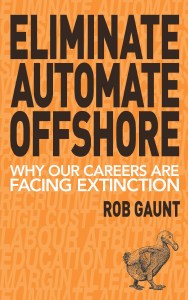
    In his book Eliminate, Automate, Offshore; Gaunt looks at how the modern workplace is changing and the priorities of managements and boards in a competitive, globalised world.

    Gaunt, who describes himself as a ‘corporate axe man’ warns the reader “you may not approve or like what I do, but that doesn’t mean it isn’t going to happen.”

    To start the book, Gaunt gives a potted history of automation in the workforce and how processes can be improved by better management and new technology. He cites his local council garbage collection service which not so long ago would have required eight or nine workers per truck now only needing two.

    This trend is coming to the rest of the workforce, Gaunt warns, adding that many of those jobs that can’t be automated can be outsourced.

    “When I walk into an open plan office, I look and listen to the activity; if the overwhelming noise is of keyboard strokes rather than human voices, it’s a good clue that much of the functions being performed aren’t location dependent.”

    Gaunt goes on to describe how effective outsourcing works with an emphasis on the client having to document their processes before shifting functions or departments to outside contractors as well as the importance of properly scoping and understanding an agreement.

    Towards the end of the book, Gaunt examines what roles are likely to survive in higher cost economies along with the skills today’s children are going to need if they are going to avoid being ‘digital roadkill’ in an automated society.

    Overall the book is a good read to understand the direction of today’s workforce and the factors driving it. It isn’t a pretty tale.

    If anything; Eliminate, Automate, Offshore may be somewhat optimistic about the effects on the skilled trades, professional and managerial sectors as Gaunt probably underestimates how robotics and artificial intelligence are advancing.

    Should you read the book, you may want to give your kids – and their teachers – a good talking too. The axe man is ruthless and he’s coming for many of our jobs.

    Similar posts:

  • Automating out white collar jobs

    Automating out white collar jobs


    The statistics continue to come about the challenging future of work with the Harvard Business Review looking at how artificial intelligence is changing the role of knowledge workers and the World Economic Forum reports how Japan is already well down the track of automating many ‘white collar’ roles.

    A couple of decades or so back, the assumption was ‘knowledge work’ represented the future of employment and the thought of management being replaced by computers or robots was unthinkable.

    That hasn’t proved to be so as the low end jobs, which we thought would be taken up by displaced industrial workers were offshored, subject to a ‘race to the bottom’ in pay rates and, now, are increasingly becoming automated.

    While the robots first came for call centre workers, it’s quite likely the next wave of will affect white colour workers reports Dan Tynan in The Guardian who has an overview of some of the likely fates of various occupations.

    A good example of the shift, are lawyers with Tynan citing the company DoNotPay which uses AI to help customers fight traffic infringements as an example of the legal profession being automated out.

    Bad for young lawyers

    This though isn’t new in the legal profession. Over the past twenty years many roles in fields such as property conveyancing and contract drafting have been offshored, so much so that junior lawyer’s payrates and job prospects have collapsed as entry level jobs have dried up.

    How the legal profession has used automation and offshoring is a good indicator of how these tradition industries are evolving, now a senior lawyer can handle more work and the need for juniors and paralegals is reduced. The work stays with the older worker while younger workers need to look elsewhere.

    While Tynan discounts the effects of automation on the construction and health industries, those sectors are similarly being changed. Robot bricklayers, for example, allow older workers to stay in the industry longer and increase productivity.

    The internet of things and artificial intelligence are similarly taking the load of nurses and doctors while making diagnostics faster and easier with major ramifications of these industries.

    Dirty data

    There are weaknesses in a data driven world and this gives us clues to where the future jobs may lie, the Harvard Business Review optimistically notes many roles can “composed of work that can be codified into standard steps and of decisions based on cleanly formatted data,” however obtaining ‘cleanly formatted data’ is a challenge for many organisations and managing exceptions, or ‘dirty data’ feeds, shouldn’t be underestimated.

    Unexpected consequences exist as well, the media industry being a good example. While the demand for content has exploded, the rise of user generated content on social media and the collapse of advertising models has upended publishing, writing and journalism. While artificial intelligence and animation can replace actors and reporters, it hasn’t done so in a major way yet.

    How industry sectors will be affected by automation is something the US Bureau of Labor Statistics looked at in 2010.

    The roles which the US BLS estimates may be less affected by automation may be more affected than we think – how the retail and media industries changed in the twentieth century is instructive where the models at the beginning of the century were upended but by the end of the millennium employment in those sectors was higher than ever.

    The future of work isn’t obvious and the effects of automation bring a range of unforeseen consequence and opportunities – this is why we can’t rest on our laurels and assume our jobs, trades and professions will be untouched by change.

    Similar posts: