Tag: employment

  • Australia and the Dutch Disease

    Australia and the Dutch Disease

    This week sees the launch of the annual G’Day USA festival where Australian exporters and various celebrities extol the virues of the country across the United States.

    One of Australia’s success stories of the last decade has been Yellowtail Wines which carved a niche for Australian wines in the US in the same way Jacob’s Creek did a decade earlier in the UK.

    Today the Australian Financial Review reports that Cassella Wines, the maker of Yellowtail, is in breach of its banking covenants due to the high Australian dollar.

    Cassella Wines is another victim of Australia’s Dutch Disease infection.

    Dutch Disease owes its name to the Netherlands’ gas boom of the 1960s. By the early 1970s the strong Guilder damaged the rest of the Dutch economy which didn’t profit from extracting natural gas.

    Having sleepwalked into the Dutch Disease, it’s fascinating how Australia’s electorate, policy makers and business leaders are in denial about the effects as successful exporters like Cassella Wines struggle with a high dollar and accelerating costs.

    When commodity prices and the dollar turn, and they always do, its going to be tough for the economy to adapt as much of the industry capacity that was competitive at lower rates won’t be available to take advantage of the lower costs and to pick up the slack from a declining mining sector.

    For Australian businesses, the onus is on managers and proprietors to protect their organisations from the short term effects of a high currency and the medium term effect of a falling dollar pushing up the input prices of imports.

    In other words, getting costs down without becoming too reliant on offshored labour or suppliers. The companies that manage this are going to be very strong after the initial adjustment, but it’s a tough management task.

    While that task can, and will be, done by smart and hardworking leaders no-one should expect any recognition of the scale of this task from governments, media or business organisations who seem to be in denial of reality.

    The Dutch and Australian flags image is courtesy of Emilev through SXC
    Similar posts:

  • Digital hunter gathering

    Digital hunter gathering

    It has come to this – we’ve had the digital natives, the digital immigrants and now we have the digital hunter-gatherers.

    This is the logical end of the ‘sharing economy’ philosophy which sees retweets, mentions and Facebook likes a hard asset.

    Unfortunately having 100,000 Facebook friends giving the thumbs up to your latest retweet of an article of dubious value doesn’t translate into income – most of the digital curators find themselves living a hunter-gatherer lifestyle.

    Life as a hunter gatherer is not pretty or easy – it’s short and brutal. The only certainty as a hunter gatherer is if you don’t find something to eat today, you will starve tomorrow.

    In some ways, it’s fair to say the modern social media expert is not dissimilar to the prehistoric hunter gatherers in that their days are numbered and starvation is a near certainty.

    One conceit of modern times is that life was so much better in the pre-industrial era; that before the industrial revolution people worked less and primitive man lived a noble life unshackled by possessions.

    That’s all nonsense. Mankind shifted to an agricultural and then an industrial society because life is a lot better than fighting sabre toothed tigers for buffalo or trying to live on berries.

    Myths like this are part of masking the steady decline in middle and working class incomes. George Freedman, the CEO of the Stratfor security consultancy, discussed this in his blog post The Crisis of the Middle Class and American Power.

    The rise of the precariat, workers employed on a casual or project based basis, is part of that erosion of incomes. As Freedman says, the “the decline of traditional corporations and the creation of corporate agility that places individual workers at a massive disadvantage”.

    In this respect, today’s digital hunter gatherers are more like the day labourers of a hundred years ago where workers, like my great-grandfathers, would wait at the gates of the factories or docks hoping to be picked for the day’s work.

    One of the truths of today’s workforce is that it’s a harder place than a generation ago and the expectation of naturally rising incomes is gone for the bulk of the population.

    This means we have to re-imagine our own roles in a changed economy. The assumptions of the post-war economy which have sustained us for over fifty years no longer hold.

    Hunter gathering hopefully won’t be option which we end up with.

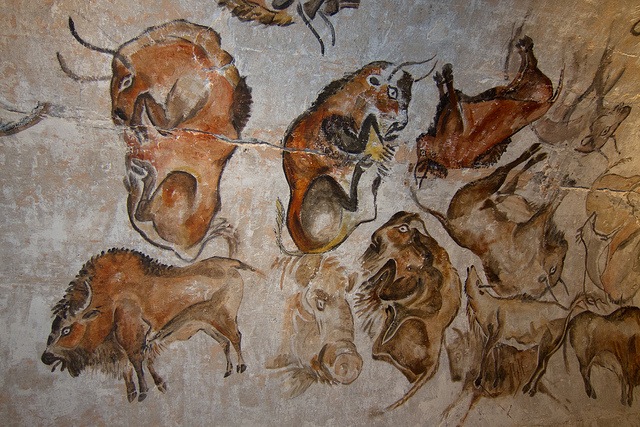
    Reproductions at the Museo del Mamut, Barcelona 2011 from quinet on Flickr

    Similar posts:

  • Pulling up the drawbridge

    Pulling up the drawbridge

    “Online bloggers and tweters are not subject to the financial incentives which affect the print media.”

    While there’s much to disagree with in Lord Justice Leveson’s Australian speeches last week, particularly the bizarre suggestion that bloggers and social media are driving the decline in journalistic standards, he is correct about the economics of online publishing. It’s tough to make a buck on the web.

    It’s so tough, many of the new media startups are founded on not paying for the articles they publish. This model has become so entrenched, that some venture capital investors will only invest in media start ups if they don’t have any reporters or editors.

    Pure platforms

    New media startup Buzzfeed‘s founder, Jonah Peretti, mentioned Silicon Valley’s reluctant to pay writers in a staff email republished by Chris Dixon;

    Tech investors prefer pure platform companies because you can just focus on the tech, have the users produce the content for free, and scale the business globally without having to hire many people.

    This antithesis to paying creatives and content creators is one of the notable aspects of the current Silicon Valley model, who needs editors and writers when a billion people will post to Facebook, Twitter or Instagram?

    Arianna Huffington has been the most successful with this model in the media industry, parlaying a largely unpaid for content business into a fat pay-off.  Chris Anderson described this model best in a description of his website Geek Dad’s economics.

    Reading the comments

    For readers, much of the value in sites like the Huffington Post and Geek Dad lie in the comments stream where readers give their views and experiences and build the communities so many investors and advertisers are looking for.

    This is a point made by Rachel Hills when commenting about Australian website Mamamia’s payment policies;

    When I visit Mamamia. I don’t go to Mamamia for the articles, which usually don’t tell me anything I haven’t already read somewhere else. I go for the comments.

    Rachel concludes with the thought that Mia Freedman’s Mamamia is providing a platform for discussion. This is true, but that’s no different from newspapers, the six o’clock news, current affairs shows or even the weekend’s football match.

    Those football players, newsreaders and journalists are all paid for their work, just like Chris Anderson and Mia Freedman were as magazine editors.

    The hypocrisy of unpaid content

    Which leads us to the core hypocrisy of the unpaid content model; its promoters – people like Mia Freedman, Chris Anderson and Arianna Huffington – have all been well paid in their careers yet now choose to deny the next generation of writers and journalist an income.

    A business adviser once remarked to me that the management of a corporation that were locking in their entitlements while cutting middle management were “pulling up the drawbridge”, that line seems apt as older, affluent journalists demand younger ones work as unpaid contributors or interns.

    The bleat from online publishers is “we can’t afford to pay contributors”, in most other industries being able to pay your workers is a measure of whether your business is solvent. That many new media outlets can’t may mean that the entire industry is insolvent.

    Writers get exposure

    Were the local cafe to say it couldn’t afford to pay its waitstaff, but it was giving them valuable work experience they’d be rightly scorned for exploiting workers. There’s little difference with online publishers.

    It may well be because there is no shortage of manipulative, attention grabbing garbage designed to provoke reactions and increase pageviews, which is the flaw in the “writers get exposure” excuse used by many of these sites.

    As middlemen, publishers have to add value in order to have a role, ‘offering exposure’ to unpaid writers isn’t a reason in itself. This is an industry with shaky foundations and it’s not surprising founders are desperately trying to find greater fools to fund their exits.

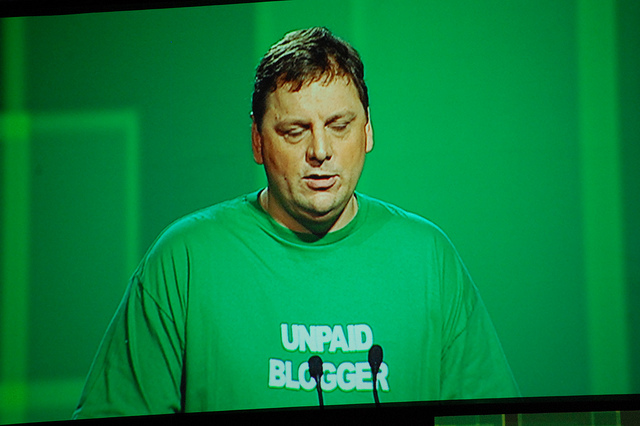
    Image of Michael Arrington from Kevin Krejci on Flickr.

    Similar posts:

  • Newly normal in the English Midlands

    Newly normal in the English Midlands

    On their metal, a story from BBC Radio’s In Business program looked at how the English Midlands is dealing with the toughest economic conditions the beleaguered region has suffered for decades.

    Once the centre of the industrial revolution, The Midlands have had a tough time of the last fifty years as the region caught the brunt of Britain’s de-industrialisation and the loss of thousands of engineering jobs.

    Today, the surviving engineering companies are struggling to find new markets as orders from Europe dry up and many Midlands workers find they are confronting the ‘New Normal’.

    The ‘New Normal’ for British industry is described by Mark Smith, Regional Chairman, Price Waterhouse Coopers Birmingham who points out that UK industries have to sell to the fast growing economies.

    Interestingly this is similar, but very different in practice, to the Australian belief – where the Asian Century report sees Australia continuing being a price-taking quarry for Asia rather than selling much of real value – the Brits see some virtue in adding value to what they sell to Asia’s growing economies.

    The British experience though shows the realities of the ‘New Normal’ for Western economies – the cafe owner featured in story now offers no dish over £3 and the idea of overpriced five quid tapas are long gone. The customers can’t afford it.

    Part of this is because of the casualisation of the workforce as people find salaried jobs are no longer available and become freelancers or self-employed. One could argue this is the prime reason why unemployment hasn’t soared in the UK and US since the global financial crisis.

    That ‘new normal’ features the precariat – the modern army of informal white and blue collar workers who have more in common with their grandparents who worked for day wages at the docks and factories in the 1930s than their parents who had safe, stable jobs through the 1950s and 60s.

    For the precariat, the idea of sick leave, paid holidays or a stable career started to vanish after the 1970s oil shock and accelerated in the 1990s. The new normal is the old normal for them, there just happens to be more of them after the 2008 crash.

    With a workforce increasingly working for casual wages without security of income, the 1980s consumerist business model built around ever increasing consumption starts to look damaged.

    The same too applies to the banking industry which grew fat on providing the credit that unpinned the late 20th Century consumer binge.

    When the 2008 financial crisis signalled the end of the 20th Century credit binge, the banks were caught out. Which is why governments had to step in to help the financial system rebuild its reserves.

    The effects of that reserve building also affected businesses as bank credit dried up. Early in the BBC program Stuart Fell, the Chairman of Birmingham’s Metal Assemblies Ltd described how his bank decided to cut his line of credit from £800,000 to £300,000 which forced the management to find half a million pounds in a hurry.

    That experience has been repeated across the world as banks have used their government support and easy money policies to recapitalise their damaged accounts rather than lend money to entrepreneurial customers to build businesses.

    Businesses are now looking at other sources to find capital from organisations like the Black Country Reinvestment Society which is profiled in the story that raises money from local investors to provide small businesses with working capital.

    Communities helping themselves and each other is the real ‘New Normal’ – waiting for the banks to lend money or hoping that surplus obsessed governments will save businesses or provide adequate safety will only end in disappointment as the real austerity of our era starts to be felt.

    The New Normal is declining income for most people in the Western world and we need to think of how we can help our neighbours as most of us can be sure we’re going to need their help.

    Just as the English Midlands lead the world into the industrial revolution, it may be that the region is giving us a view of what much of the Western world will be like for the next fifty years.

    Similar posts:

  • Are you a worthy customer?

    Are you a worthy customer?

    “Those companies are not going to be winners in the long term. We’re very happy to work with the fastest growing companies in the world; the companies who understand that people are core to who they are,” says Daniel Debow, Vice President of Salesforce’s Work.com at the recent Dreamforce conference.

    Debow was talking about companies that aren’t interested in social software, or those who don’t have the infrastructure or management culture to implement changes which reflect the modern workplace.

    When writing about social and cloud services one thing that jumps out is just how unprepared many businesses, big and small, are for changes that are happening in both the workplace and the market.

    The story of Work.com reflects those changes – the idea behind Rypple and Work.com, which was born out of Salesforce’s 2011 acquisiton of Rypple, is that workplaces are inherently social.

    “We spend as much more time with the people we work than with our families. It matters to us what our workmates think” says Daniel so Work.com gathers the social intelligence within the business to give people real time feedback on their performance.

    The Rypple idea lies in the inadequacy of existing HR software and management practices. Daniel says, “today this model we have it’s totally not reflective of the reality of how people work; people are more connected, they’re collaborative, more realtime.”

    This collaborative and realtime way of doing business challenges the structures in many businesses and the methods of a lot of managers. Many are ill-equipped to deal with a more open and transparent way of managing their teams.

    In fact, software like work.com and its competitor Workday make some of those older style managers redundant, particularly those whose roles involve little more than box ticking and following the strictures of the company’s procedure manual as this can be done better by a computer program.

    The problem for many organisations, both private and public, is they have become more focused on cossetting and protecting the box ticking bureaucrats of middle and upper management rather than delivering service to their customers and supporting their staff responsible for keeping clients happy.

    Something that jumps out when you talk to entrepreneurs like Daniel Debow and others building new social and cloud companies is their lack of interest in selling to those organisations, their view is the old school companies are dinosaurs on the path to extinction.

    Dinosaurs though lasted a lot longer than we often think and the same is true of the current generation of zombie companies being kept alive by government or investors too scared to book the losses which the failure of these enterprises would entail.

    While those dinosaurs are going to be a drag on our economies for the next decade or two, the real opportunities – and rewarding work – is with those businesses who want to change and aren’t run for the administrative convenience of their managers.

    The question for many business owners and managers is whether companies like Rypple or Workday could be bothered selling to you. If you’re not, it’s time to consider your exit strategy – or lobby your local politician for some subsidies.

    Paul travelled to Dreamforce courtesy of Salesforce.com

    Similar posts: