
Tag: entertainment

  • Data and the modern movie producer

    Data and the modern movie producer

    Dealing with the massive wave of data flowing into businesses will be one of the defining management issues of the next decade. One company that is already dealing with this is New Zealand’s Weta Digital.

    Wellington based Weta that’s best known for its work on Lord of the Rings and is part owned by director Peter Jackson employs 1400 staff for its movie special effects work and has won five visual effects Academy Awards over its 23 years of operations.

    Kathy Gruzas, WETA Digital’s CIO, spoke to Decoding the new Economy at the Oracle OpenWorld forum in San Francisco this week about some of the challenges in dealing with the massive amount of data generated by the movie effects industry.

    “We have some very heavy loads.” Kathy states. “We push our systems to the limit.”

    Applying powerful systems

    One challenge is the sheer computing power required, ‘the render frame processes one frame per server until you have four seconds of footage. Sometimes that takes over night or even longer and for that we use a lot of storage,” Kathy says. “The render farm being six thousand servers will write 60 to 100 terabytes of data a day and read a quarter to half a petabyte each day.”

    “We need systems that will be very large to handle the volume of data we generate but also be very quick to handle those read and writes.”

    “One render could use a thousand computers, sometimes more, and all of those will be reading and writing against the same block of storage so we have our own software layer that directs those loads but we try to minimise the load on our storage but we have the worst work load you can imagine with lots of servers, lots of small reads and writes and many of them random and concurrent with pockets of hot files.”

    Despite the automation, the business is still extremely capital intensive. “In visual effects you probably need at least three hundred artists to work on one film, it’s a very labour intensive process to do the artistry and much like a production line.”

    Going mobile

    The nature of modern movie production means the effects teams are now part of the shoot which adds another level of complexity for Weta. “Although we are visual effects which is largely post-production we do go out with crews when they’re shooting the movie so we can do reference photography,” says Kathy.

    “We do 3D scans so if we need to do something digitally and we do motion and facial capture as well,” she says. “There are 240 muscles that we tweak individually to get the expression. That’s a huge amount of data to capture.”

    To do this, Weta created their own ‘road case’ that contains everything they need to grab the shots and store the data they need, “you can’t ask the director retake the shot because we missed something.”

    Into the forest

    “We have to take the case into the forest and into the rain and everywhere. It’s good having that roadcase that has storage, networking and servers in it.” The case, which was self assembled by Weta’s team is “probably the most travelled Oracle system on the planet,” laughs Kathy with “lots of data capture and sub-rendering.”

    Weta’s story illustrates just how managing data is becoming a critical issue for companies. While movie special effects is very much a specialised field that’s far ahead of the curve in its technology use than most businesses, they do show the importance of managing and securing their data.

    For other businesses, lessons from Weta is understanding your company’s – including staff and customers’ – needs then investing in the right tools to deliver is essential.

    One important difference between technology intensive businesses like Weta and most other organisations is the New Zealand company is doing most of its processing and storage in house. Those without the same needs will almost certainly be shifting these tasks onto the cloud.

    Similar posts:

    • No Related Posts
  • Virtual reality hits the market

    Virtual reality hits the market

    After virtual reality viewers being the big item at both the Mobile World Congress in Barcelona and Las Vegas’ Consumer Electronics Show earlier this year, it’s not surprising they are appearing on the market.

    Yesterday both Microsoft’s HoloLens and HTCs Vive were made available to the public. At $3,000 for the Microsoft viewer and $800 for the HTC device, these products won’t get much traction in the mass market.

    For those wanting a cheaper VR device, Google Cardboard has also come onto the market for $15 and while it depends upon a smartphone with the right software and lacks the features of more expensive and sophisticated devices, it is an affordable consumer product.

    Like all early stage technologies, the current crop of VR viewers are expensive and somewhat cumbersome but over the next few years we can expect the price of these devices to collapse and become far more usable.

    We’re in early times for the virtual reality industry. What we’re seeing today is laying the ground for much more exciting things.

    Similar posts:

    • No Related Posts
  • Delivering on the promise of the connected stadium

    Delivering on the promise of the connected stadium

    Once a year I come out of the closet in Sydney and admit I support Carlton in the Australian Football League. This usually ends in humiliation as Carlton hasn’t beaten Sydney in the last twenty years.

    This year’s ritual humiliation coincided with an offer by Telstra to review their smart stadium rollout at the Sydney Cricket Ground’s rebuilt MA Noble stand following a tour of Etihad’s stadium earlier this year.

    Late last month I interviewed Mike Caponigro, Cisco’s head of Global Solutions Marketing for Sports and Entertainment, around how smart stadiums are being rolled out around the world, including the Sydney Cricket Ground.

    Caponigro sees the smart stadium as complementing the ground experience and Cisco are working with over three hundred venues in thirty countries around the world.

    “Live is always going to be best,” states Caponigro. “You can’t replace that tribal passion of the crowd. No matter how excited I get in my living room or with some friends in a pub you’re never going recreate that enthusiasm.”

    However the expectations of sports fans are changing Caponigro points out citing how HD television and the internet is changing the experience for spectators outside the stadium, “fans don’t want to be removed from that action.”

    So how does the connected stadium experience stack up for a punter who’s used to being in the cheap seats and often wonders if buying that ticket along with putting up with the hassles of getting to the ground, being overcharged for bad food and water down beer is worthwhile compared to staying at home and enjoying it on TV?

    A limited App

    Like all the smart stadium rollouts, the SCG’s revolves around the onscreen displays and the spectators’ smartphones. Once downloaded the 35Mb app isn’t spectacular. The sports news focuses on cricket – somewhat irrelevant in a Sydney winter – while the transport map front ends into Google Maps.

    Probably the biggest disappointment with the app is the venue map which is a detailed PDF lacking any interactive capabilities which successfully manages to pack a lot of information, like the location of light towers, without actually telling you anything useful.

    In seat ordering is one of the attractions of the app. Unfortunately we were unable to test it as the collection points are within the members section of the Noble stand which we didn’t have access to.

    The lack of real time information about seating, transport and ground information makes the app at best ornamental, indeed there are opportunities missed in upselling such as offering spectators seat upgrades or merchandising offers.

    In stadium connectivity

    Where the SCG smart stadium shines is in the Wi-Fi connectivity. Mobile connections over 3 and 4G services have always been problematic during match breaks. During the game, the connection was flawless, the only gripe being that the login screen reappeared for a moment everytime the phone was bought out of sleep.

    Again though it’s hard not to think the ground management are missing opportunities with the Wi-Fi as the login screen asked for an email address but didn’t give the option of providing an SCG or Swans membership number rather than just an email address.

    Not so smart screens

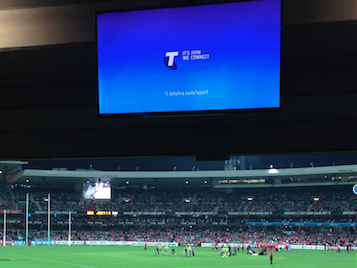
    The biggest boast of smart stadiums are the connected screens, the previous tour of Melbourne’s Etihad Stadium showed what could be done but the SCG game was an opportunity to see the videos in action.

    Smart-stadium-action-shot

    Unfortunately the screens actually detracted from the experience. While the main scoreboards were showing game details and replays the smaller screens were showing the SCG members in ground advertising which added nothing for spectators.

    Even during the match play, the screens carried the Channel Seven television feed with food outlet advertising wrapped around it. Disappointingly the screens didn’t give any updates on the match play, the goal kicked by Swans’ debutante Dan Robinson (who played for my local junior club) didn’t receive a mention at all.

    Overall the spectator experience from the SCG’s smart stadium rollout is underwhelming. This isn’t a result of Telstra and Cisco’s technology but of its implementation with a focus on low value advertising rather than adding value for spectators.

    Leaving money on the table

    The smart screens need to be delivering more relevant information to fans in the stadium while the smartphone app has to be giving dynamic and useful data to help spectators before during and after the game.

    At the moment, it seems there’s a lot of money being left on the table as opportunities beyond pushing advertising onto spectators aren’t being explored.

    smartscreen-connected-stadium

    It’s hard not to think that right now the smart stadium is a solution in search of a problem. Certainly for fans to take anything except the improved Wi-Fi service seriously there ground managements have to offer more than continuous ads for chicken outlets and expensive private schools.

    Then again, maybe I’m just bitter as once again us Carlton fans were humiliated by another hundred point loss. For Blues supporters it was another dismal night at the footy ground.

    Similar posts:

    • No Related Posts