
Tag: Facebook

  • Playing in the big boys’ sandpits

    Playing in the big boys’ sandpits

    The Cool Hunter is a site whose mission is to “select and celebrate what is beautiful and enduring from all that is sought-after in architecture, design, gadgets, lifestyle, urban living, fashion, travel and pop culture.”

    In posting cool stuff they find on the web, Cool Hunter always runs the risk of copyright infringement complaints as people have the unfortunate habit of slapping images up onto the Internet without permission from the rights holders.

    Last August Cool Hunter’s founder Bill Tikos found the site’s Facebook account had been wiped for ‘repeat copyright infringements’ without warning or recourse.

    Anybody following this site won’t be surprised to read this – an exposed nipple can get you thrown off Facebook faster than you can say “New Yorker cartoon” or “it’s only a porcelain doll, for chrissake!” – so one can only imagine the paroxysms of rage that alleged copyright infringement sends Facebook’s puritan bureaucrats into.

    It’s not just nipples at Facebook though, thousands of small traders have seen their accounts arbitrarily suspended on sites like eBay and PayPal.

    Google too are quick to suspend businesses from their local and search services without warning or recourse. Usually business owners only notice they’ve been locked out when they log into their control panels only to find a terse message that their account has been suspended.

    What usually follows is a Kafkaesque tale of trying to understand exactly what they’ve done wrong and how to get their accounts reinstated. In some cases the businesses get cryptic messages saying their accounts are still in breach while others get no response at all. In a few examples, the offending page goes back online only to be shut down again a few days later.

    Rarely does someone in this situation find a calm, helpful voice to explain exactly what they have done wrong and how to fix it.

    This hostile attitude is a result of the “hands off customer service” model of web 2.0 companies and it’s their biggest achilles heel as, paradoxically, customers and users take to social media to complain about bizarre and arbitrary account suspensions.

    For some, like Cool Hunter, it’s a monumental pain and loss of a valuable platform while many of those small eBay and PayPal traders may have thousands of dollars tied up in suspended accounts they can’t access.

    Unfortunately this uncertainty is the cost of doing business on social media sites and it’s one of the reasons why owning your own business website is essential.

    When you choose to use one of these service, understand you’re playing in the big fat kid’s sandpit and you risk him throwing a tantrum and chucking your toys out of the playpen.

    Simply put, don’t base your business on Facebook, don’t keep all your money in PayPal and always have a plan B.

    Similar posts:

  • Salesforce’s place in the web’s walled gardens

    Salesforce’s place in the web’s walled gardens

    “Did he just say we’re at the half-way mark?” Whispered the ashen faced journalist beside me as Mark Benioff’s Dreamforce keynote reached the 90 minute mark.

    Benioff did and the presentation did indeed go three hours because Salesforce.com had a lot to announce with launches of new mobile apps, customer service programs and HR services.

    At the press conference later in the day, Benioff said “we are interested in collaboration and the customer. the reason we’re in marketing is because our customers want us to be in marketing.”

    An interesting part of this is the Facebook relationship, with the Buddy Media acquisition 10% of Facebook’s advertising revenue comes through  Salesforce. This in itself makes Salesforce a key Facebook partner.

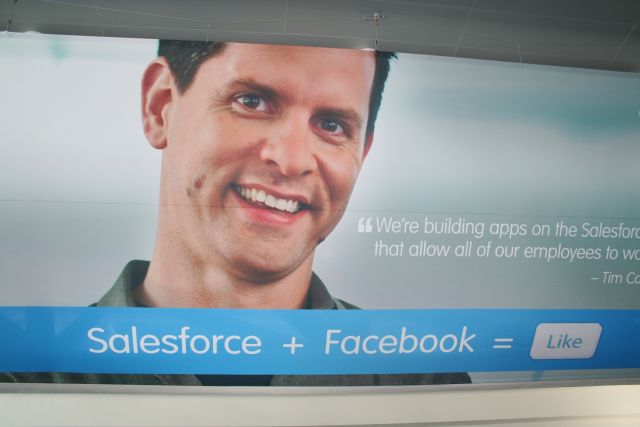
    Facebook’s relationship goes deeper with Salesforce, at the media conference Marc Benioff mentioned that the company’s purchase of Rypple came about because of urging from Tim Capos, Facebook’s CIO.

    That deep relationship was on show in the opening keynote where Facebook were one of the strategic partners showcased by Benioff.

    Of the products showcased, one of the important points that kept being raised was Salesforce’s role as the enterprise social media identity service.

    A partnership between Salesforce and Facebook to provide online identity validation would effectively kill  Eric Schmidt’s aim of Google being the Internet’s identity service although Benioff was at pains in the media conference to emphasise there was room for more than one player.

    Google are also being challenged by Benioff’s announcement of Chatterbox, a secure online file storage and sharing service.

    While the focus with the Chatterbox announcement was on the threat this presents to Dropbox and Box.net, the bigger targets are Google Drive, Apple iCloud and Microsoft’s SkyDrive.

    Salesforce’s move into the various fields of HR, marketing, file storage and collaboration are part of the company staking its own position among the various web empires.

    With a strong enterprise position, it’s quite possible Salesforce could establish itself as the fifth of the Internet’s great empires.

    Every empire needs an army and a particularly strong claim Salesforce would have are the ranks of developers and supporters gathering around the service’s open APIs.

    The move to establish an independent position on the web would also explain Benioff’s commitment to HTML5 as this avoids locking the company into an Apple, Google or Microsoft dominated app environment.

    We’ll see over time how Salesforce establishes their position among the internet empires, right now though their range of services, customer base and partner ecosystem means they are well placed to compete with the big four currently dominating the web.

    Paul travelled to the San Francisco Dreamforce conference courtesy of Salesforce.com

    Similar posts:

  • Facebook’s war on nipples continues

    Facebook’s war on nipples continues

    Mike Stevens, a cartoonist with the New Yorker magazine, found himself the latest victim of Facebook’s War On Nipples when his cartoon depicting Adam and Eve caused the magazine’s Facebook page to be shut down.

    This is the latest shot in Facebook’s War On Nipples. Two years ago a Sydney jeweller found her page shut down for using a naked doll as a model and breast feeding mothers waged a long campaign against the site taking down pictures of babies being fed.

    If you live outside the US, it’s amusing to observe Americans’ bipolar attitude towards women’s breasts — on one hand they are celebrated though Pamela Anderson, breast enhancement and Hooters while the merest flash of nipple sends the nation into purient overdrive.

    So Mark Zuckerberg’s ban on female nipples is understandable in that context as is the reaction to that ban by people who don’t see much wrong with breast feeding mums or harmless cartoons.

    What we should remember though is Facebook have the right to run their site whatever way they like — if Mark Zuckerberg decides he doesn’t like plaid shirts or broccoli he’s within his rights to ban pictures those as well.

    This is the risk if you’re basing marketing strategies around social media services. If you want to play on Facebook, you have to play by Facebook rules.

    So take your nipples elsewhere.

    Similar posts:

  • Nightlife Computers: Sockpuppets, trolls and fakes

    Nightlife Computers: Sockpuppets, trolls and fakes

    Paul Wallbank joined Tony Delroy for the 6 September 2012 ABC Nightlife technology spot to discuss sock puppets, what they mean on review sites and what this means for businesses using social media as a marketing tool.

    If you missed the program, you can listen to the podcast from the Tony Delroy’s Nightlife page.

    This week’s sock puppet scandal puts the light on authors’ book reviews on sites like Amazon while other review services like TripAdvisor, Yelp and Urbanspoon continue to struggle with figuring out which reviews are real.

    Businesses also have to worry about what people are posting in light of the recent Advertising Standards and ACCC rulings making businesses more accountable with what’s posted on Facebook.

    Some of the questions we’ll look at include;

    Join us from 10pm, Australian Eastern Time on Thursday September 5 on your local ABC radio station or listen online through their streaming service at www.abc.net.au/nightlife.

    We’d love to hear your views so join the conversation with your on-air questions, ideas or comments; phone in on the night on 1300 800 222 within Australia or +61 2 8333 1000 from outside Australia.

    You can SMS Nightlife’s talkback on 19922702, or through twitter to @paulwallbank using the #abcnightlife hashtag or visit the Nightlife Facebook page.

    Similar posts:

  • Billion Dollar Babes

    Billion Dollar Babes

    “It changed everything. It changed the game for a lot of us and you know it made a lot of people feel very anxious and sort of compare their own success.”

    Lisa Bettany, the founder of Camera Plus lamented how Facebook’s billion dollar purchase of photo app Instagram purchase changed the start up community on Australian current affairs program Foreign Correspondent.

    In the program  Foreign Correspondent also spoke to Australian and Italian startup founders looking to make it in Silicon Valley. On being asked what they hoped their business was worth they all had the same answer – a billion dollars.

    There’s no doubt Jindou Lee’s Happy Inspector home inspection app or the Timbuktu kids’ story website are great products and should be successful business. But is business success only measured by a billion dollar exit?

    In Garrison Keillor’s Lake Wobegon every child is above average, it seems in Silicon Valley every successful business is worth a billion dollars.

    Every founder in the current app or web 2.0 craze says “it’s not about the money, it’s about changing the world” yet scratch them and they are all on the lookout for the greater fool buying them out for an improbable sum.

    One could say that a billion dollar cheque does change the world of the person cashing the thing although exactly how a iPhone photo app changes the world may escape some of us.

    At the same time the Foreign Correspondent story was being aired the founder of Y Combinator – Silicon Valley’s most successful accelerator ‘s founder – warned the heat is now out of the market after Facebook’s market flop.

    Paul Graham was elaborating on a letter he wrote three months earlier where he said, “If you haven’t raised money yet, lower your expectations for fundraising.”

    If the billion dollar valuations are going out of the startup mentality then it might be better for all of us. It might mean our youngest, best and brightest really are focused more on building things that will change the world rather than buying mega-yachts for themselves and their VC investors.

    Similar posts: