Tag: founders

  • Technology One and cloud computing’s gold rush

    Technology One and cloud computing’s gold rush

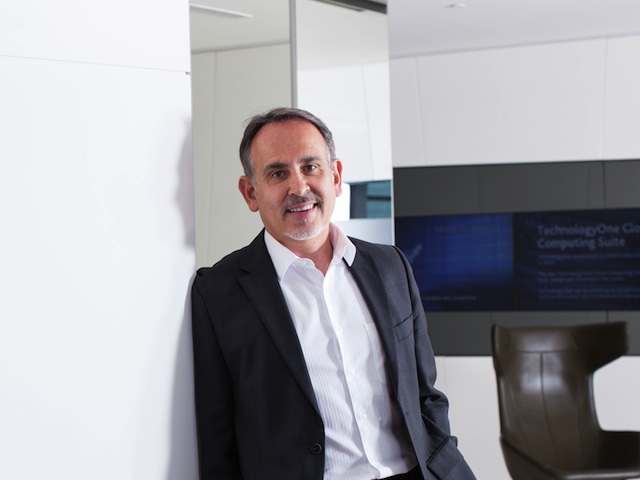
    “Consulting companies are a blight on our industry” declares Adrian DiMarco, CEO of Technology One.

    A quick way to rile DiMarco is by asking him about IT outsourcing as I learned during an interview at Technology One’s annual Evolve conference on the Gold Coast last month.

    The 1600 enterprise clients attending this year’s Evolve conference illustrate Technology One’s growth since it was founded in 1987 out of DiMarco’s frustration with the multinational outsourcing companies.

    “I used to work for multinational technology companies and as a young person I really used to want to work for them, I found it very attractive and I expected they’d be very attractive and cutting edge.”

    The reality DiMarco found was very different; “I worked for them for years and found the opposite, just how bad and inefficient they were.”

    “I really didn’t like what I was working with, the software we were using and stuff and I thought we can do it much better here in Australia. The idea was to build enterprise software.”

    Moving to the cloud

    Having built that enterprise software company DiMarco now sees his Technology One’s future lying in cloud services and empahises the importance of learning from the industry’s leaders.

    “We looked at companies like Google, Salesforce, Facebook and Dropbox. These companies are the undisputed leaders in the cloud.

    “One thing that we noticed was that you can’t get Google, Salesforce, Facebook from a hosted provider; you can’t get it from IBM or Accenture.

    “The leaders in the cloud build it themselves so they are deeply committed to it, they run the software for their customers and they invest millions of dollars each year in making the experience better.”

    “It is clearly what the cloud has always meant to be.”

    DiMarco though sees problems ahead as vendors look to rebrand their products and warns businesses need to be careful about cloud services.

    “It is the next big goldrush in the IT industry. IT companies, particularly service companies have over the last few years seen revenues decline so in order to find new sources of growth they are all targeting the cloud.”

    Accountability and the cloud

    The lesson DiMarco learned in the early days of cloud computing was that accountability is necessary when you’re trusting services to other providers.

    “We had early customers that went to the cloud; we said ‘look, it’s a great idea and we think it’s the future’. They wanted to go with hosting providers and we thought it was a sensible decision and we saw a train smash, it was a train smash of epic proportions”

    “They were running data centres overseas in Europe that had latency issues, performance issues and the customers were paying money after money after money.”

    “The customer was getting a terrible performance and there was no accountability.”

    “We couldn’t fix it because we had lost control over the customers.”

    This lack of accountability is one of the reason why so many IT projects fail DiMarco believes, citing the notorious Queensland Health payroll project.

    “Queensland Health again used this fragmented model; the party that built the software, which is SAP, used a third party which was IBM to implement it which meant no accountablity.

    :That would never have happened If SAP had signed the contract, if SAP had implemented the software, which they won’t do, they would have known the risks that were being taken and they would have stopped that project and fixed it up.??“That’s the difference between our model and the competitors model.”

    “They take no responsibility, they implement these systems, they charge a fee-for-service and they have open ended contracts – that’s how they get to be a billion dollars – and do you know who suffers? It’s the customers.”

    Shifting away from consultants

    DiMarco sees governments moving away from the consultant driven model that’s proved so disappointing for agencies like Queensland Health which creates opportunities for Technology One and other Australian companies.

    “For the last fifteen years we’ve not been able to sell software to the state government. It’s just changing, we’re getting in there now, but it was a terrible problem for us.”

    The shift from big consultants is a view endorsed by Sugar CRM co-founder Clint Oram who described how the software business is changing when he spoke to Decoding the New Economy last week.

    Oram sees the software market challenging established giants like SAP, Oracle and Microsoft; “in the past it was ‘here’s my software, goodbye and good luck. Maybe we’ll see you next year.”

    “If you look at those names, the competitors we see on a day-to-day basis, several of them are very much challenged in making the shift from perpetual software licensing.” Oram says, “it’s been a challenge that I don’t think all of them will work their way through, their business models are too entrenched.”

    “Software companies really have to stay focused on continuous innovation to their customers.”

    DiMarco agrees with this view, citing the constant investment cloud computing companies make in their products as being one of the advantages in the business model.

    Building the Australian software industry

    For Australia to succeed in the software industry, DiMarco believes the nation has to encourage and celebrate the industry’s successes.

    “It’s about getting people to believe in Australian software. I think the Aussie tech industry needs a lot more successes we can point to,” DiMarco observes. “I think that will create enthusiasm, excitement and a hub for the rest of the community to get around.”

    “We gotta get some big scale companies with some high visibility and get them successful.”

    For the future of Technology One, DiMarco sees international expansion as offering the best prospects with the company having recently announced a UK management team as part of its push into the British local government market.

    Hopefully DiMarco’s UK management team won’t have to deal with the local management and IT consultants as they try to sell into British councils.


    Similar posts:

    • No Related Posts
  • Seeing the full picture

    Seeing the full picture

    Being able to make sense of data is one of the challenges of modern business.

    In the case of data visualization service Encompass, the business was founded after its founders were caught out by not knowing all the information behind business deal.

    The latest Decoding The New Economy video is an interview with Roger Carson and Wayne Johnson, the co-founders of Encompass, a cloud based data visualisation company.

    Encompass takes corporate information such as credit information and business registration details and renders it into a form that’s easy to read for salespeople, bankers or anyone doing due diligence on an organisation or individual.

    “A lot of it is about bringing the information together and making it usuable and simple to use,” says Wayne. “If you can’t get that information easily and it takes relationships with lawyers to put it all together or your own legal advisor takes a long time to get this together, it’s costly and you may miss things.

    Wayne and Roger’s path to starting Encompass came from being caught out in a property deal where it turned out some of the business partners wouldn’t have passed close examination.

    “The property venture we went into was not a success,” Roger explains. “If we had known about the people and the properties and the companies involved on the other side of that transaction we probably would not have got involved in it.

    “The genesis of this product really came about because we were involved in a transaction where we didn’t have the full picture, we couldn’t get the full information quickly and we therefore realised there had to be a better way for people to look at commercial transactions and get the full picture.”

    It’s often said that information is power, but the real power lies in being able to understand the data we’re being flooded with. Encompass are a good example of the new breed of business that’s helping others deal with the masses of information we’re all being inundated with.

    Similar posts:

    • No Related Posts
  • Trapped in orbit – the founder’s dilemma

    Trapped in orbit – the founder’s dilemma

    Earlier this week Microsoft co-founder Paul Allen celebrated his Seattle Hawks winning the Super Bowl while his former business partner, Bill Gates, still struggles to escape the clutches of the software giant they founded forty years ago.

    After a long drawn out process, software giant Microsoft has finally chosen its replacement for CEO Steve Ballmer however founder Bill Gates finds himself firmly trapped in the company’s orbit.

    Hoodie wearing Satya Nadella‘s ascension to Microsoft CEO was probably the poorest held secret in the tech industry having been openly reported for several weeks.

    Nadella has a massive task ahead of him as the industry that’s been so lucrative for Microsoft over the past thirty years evolves to deal with the post-PC era.

    Microsoft CEO Satya Nadella
    Microsoft CEO Satya Nadella

    How Nadella manages Microsoft’s transition will define his business career and tenure at the top job, it will also determine the company’s position in a marketplace where PCs running Windows are no longer relevant.

    The biggest news from Microsoft’s announcement though was that Bill Gates will step down as Chairman of the Board and take a new position as ‘founder and technology advisor’.

    Microsoft also announced that Bill Gates, previously Chairman of the Board of Directors, will assume a new role on the Board as Founder and Technology Advisor, and will devote more time to the company, supporting Nadella in shaping technology and product direction. John Thompson, lead independent director for the Board of Directors, will assume the role of Chairman of the Board of Directors and remain an independent director on the Board.

    Despite leaving the CEO role over a decade ago, Gates finds himself back in a hands on role at the company.

    The value of Bill Gates

    It’s questionable what value Gates is going to add in the role of ‘Technology Advisor’ as Microsoft’s markets are very different to those the company was founded in and came to dominate in the 1980s and 90s.

    For Nadella, it’s not exactly a vote of confidence from the board in appointing the company’s founder to hover over his shoulder offering helpful advice.

    On a personal level this must be disappointing for the founder and former CEO as well in that his mind is on far greater topics such as eliminating malaria through the Bill and Melinda Gates Foundation.

    Trapped by Microsoft’s gravity

    Gates’ situation though is a classic example of a business founder who’s never been able to get out of the orbit of their business. Despite their best efforts, they keep being dragged back to give a helping hand.

    At least though Gates has at least been able to step away to some degree, many baby boomers with smaller businesses are going to be locked into their companies as GenX or Y entrepreneurs don’t have the funds to pay what the proprietors need to retire.

    Those boomer entrepreneurs are going to work in their businesses until either they or their venture is put to rest.

    Bill Gates’ dilemma though shows how tough it is for business founders to escape the gravitational pull of their creations, even when it’s as big a business as Microsoft.

    Paul Allen showed how to step away from a business and is enjoying life, Bill Gates’ story though is much more typical for business founders trapped in the enterprises they built.

    Similar posts:

    • No Related Posts
  • Startup economics

    Startup economics

    Business advisor Ivan Plenty’s in-depth study of the viability of failed photo sharing startup Everpix with some useful lessons for business owners in any industry.

    Everpix shut down last November having run out of money despite getting favourable reviews from the tech press and in an unusual move, the founders put the company’s financials up on GitHub.

    As Plenty points out in his analysis of Everpix’s finances, the company was unlikely to ever break even and it’s a lesson to every business owner on the importance of keeping an eye on cashflow and understanding where the venture’s break eve points are.

    One of the key take-aways from Plenty’s analysis was that the base costs of the business were too high and even in the best circumstances it was unlikely that venture would have succeeded.

    A good business plan would have helped the founders understand this problem and it illustrates why rigorously developed cashflow forecast is a great tool for a manager or proprietor.

    The Silicon Valley investment model

    The ultimate objectives of a company’s management are always important when considering the success or failure of a business; what objective is the business working towards?

    In Everpix’s case, it may well have been the Silicon Valley Greater Fool model was a likely end, with good software and a growing customer base the company could have been attractive to a buyer.

    Were that the objective of Everpix’s founders, the company was under-capitalised as management couldn’t afford either the burn out or the PR and marketing team essential for raising the venture’s profile with key investors.

    Under-capitalisation is one of the greatest problems for any new business and its clear that Everpix didn’t have the equity to scale the way it needed.

    Capital on its own though isn’t a panacea, from Ivan Plenty’s analysis the indications are that Everpix’s fate would have been the same, but more drawn out.

    Everpix’s failure and the numbers behind it are a good lesson for anybody thinking about starting a business — numbers matter and businesses live and die by them.

    Similar posts:

  • A swarm of electronic dragonflies

    A swarm of electronic dragonflies

    A Spanish startup shows how the internet of machines is changing the business world having installed their sensors into everything from space ships to koala bears.

    “Libelium comes from Libelula which means dragonfly,” says Alicia Asin, of the sensor company she co-founded with David Gascón. “The company was named after a swarming insect.”

    “We try to solve the problem of dealing with a lot of different sensors and a lot of different protocols and different information systems so we created a hardware platform that sends any information using any communication protocol to any computer system.”

    Bootstrapping a global business

    Particularly impressive about Libelium is the business has grown to a global brand employing 40 people since 2007 when Alicia and David founded their business on their meagre savings.

    “We started with literally wïth nothing, just 3,000 euros which is all you have when you are twenty-four” says Alicia.

    After raising funds through some grants and investors, the company got on with selling their products.

    “We never wanted to be a company where it’s comfortable for three years without making money so we shipped a product in seven months.”

    “We realise now how smart that was.”

    Agriculture and smart cities

    Connected cites and agriculture are the sectors Alicia sees as being the greatest opportunities for the company.

    “I think that cities are very interesting, not because of the technology but what it really means,” says Alicia. “If you are able to have a dashboard of the city’s performance and governments are willing to apply open data then you are really promoting transparency.

    “That’s the best legacy of the Internet of Things.”

    In Agriculture Alicia sees opportunities in high value crops like vineyards, “we can reduce the amount of fertilisers, we can prevent illnesses in vines and you can even design the type of wine as you can control the amount of sugar in the grapes.”

    For Spain, companies like Libelium represent the future of the nation’s industry. “We really need to re-invent the country,” says Alicia.

    “I’m always saying that Spain is becoming the Silicon Valley of Europe when it comes to smart cities. Not only in Barcelona but you also have Santander, you have Malaga, Madrid and Zarazoga.”

    So it may be that along with a swarm of Libelium sensors, Spain also has a swarm of smart cities. It may be enough to re-invent the country along with the agriculture industry and local governments.

    With more bootstrapped startups like Libelium, Spain may even build its own version of Silicon Valley.

    Similar posts:

    • No Related Posts