Tag: future of work

  • Five technologies likely to change business

    Five technologies likely to change business

    What are the technologies that will change business over the coming years? During Gartner’s Business Transformation & Process Management Summit in Sydney on Tuesday, we had the opportunity to talk to Brian Blau, the company’s Vice President of Research, about what he sees as the five technologies that are most likely to change business.

    Brian himself brings a lot of experience with emerging technologies, while he’s currently Gartner’s leading Apple analyst and specialises in consumer and mobile & Wireless technologies he spent the previous twenty years working in the virtual reality field which gives him an informed perspective on the many of the current popular tech buzzwords.

    Talking to Blau in the busy analysts room at the Sydney Hilton, he kept reaching into his bad to show off his collection of the latest gizmos ranging from VR headsets through to smartwatches and fitness trackers, showing his enthusiasm for the field he covers.

    Augmented and Virtual Reality

    “It’s been a long time coming, I had twenty years in AR/VR and I’ve been an analyst for six and I’m glad I have that background,” says Blau.

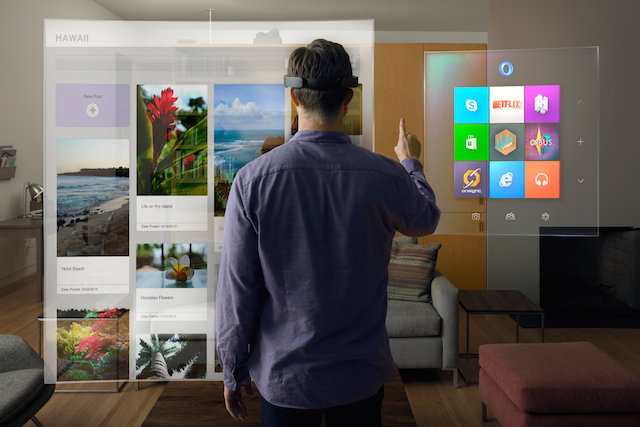
    Blau sees augmented and virtual reality tools altering the workplace dramatically as they change the experience for workers. The industries he sees being affected in the near future are sectors like field service, training and design.

    Wearables

    “Wearables are interesting devices,” Blau says. “You can almost think about them as transitory technologies so today there may be lightweight analytics about what employees do at work or what consumers do in public is kind of a stepping stone. If that device has a screen or some sort of interface on it, it becomes interactive.”

    Blau cautions though that much of the data gathered from consumer wearable devices is far from reliable and while the quality of information improves there is still a way to go until we can depend upon these devices for life or mission critical tasks.

    Virtual Personal Assistants

    “These are combinations of hardware and software – Apple Siri, Microsoft Cortana or Amazon Alexa,” Blau states. “These Virtual Personal Assistants are having a big transformation, today they answer simple questions based on rules but in the future they are going to be hyper-smart.”

    “Facebook, Apple and the rest of them have opened up their platforms to developers, we think this has applicability to all sorts of consumers and in the business domain we’re going to see these devices used in workplaces.”

    Cameras and computer vision devices

    “There are two advances that are happening, there are multi lens camera devices and the algorithms behind them are starting to decode what’s behind the image,” says Blau. “I think this is exciting technology as it’s an input that’s never been digital before.”

    Blau sees the increasing sophistication of cameras and the software processing the images as finding important applications within the workplace, “there’s a lot of tasks around vision that are manually processed at the moment and computer vision is going to automate those.”

    Personal IoT devices

    “These are more about the workforce, the sensors that are in the work environment are those that people could bring to work, it overlaps with wearables.” Blau says, “the next generation of IoT devices are going to be much more personal.”

    “Almost every business I talk to is very interested in virtual reality and wearables,” states Blau. “There is a high amount of interest because there’s a firm belief these devices will change workplace and consumer behaviours.”

    For these devices to be adopted on a large scale, they will have to become more reliable Blau believes with the barriers currently being that most devices and their software are still at Minimum Viable Product stage.

    Tips for the future

    Blau advises businesses looking at these technologies should start with a basic belief that the specific technology will benefit their business, then they have to experiment and identify what the return on investment will be. “My main advice is to experiment with the technology, run a series of pilot programs, make sure you’re diverse in what you are looking and keep an open mind,” he says.

    “The goal with these devices is to change behaviour,” Blau states. “The real challenge will be to get it right over time. You’ll have to reiterate time upon time.”

    With these new technologies entering the business world, companies are going to face changes both within their workforces and in their markets. Being across the potential of these technologies is going to be essential for managers.
    Similar posts:

    • No Related Posts
  • Microsoft and the AI future

    Microsoft and the AI future

    Despite the embarrassment of their foul mouthed racist bot, Microsoft are pressing on with a move into artificial intelligence.

    Ahead of this week’s Launch event in San Francisco, Microsoft’s CEO Satya Nadella laid out his vision for the company’s Artificial Intelligence efforts in describing a range of ‘bots’ that carry out small tasks.

    Bloomberg tagged Nadella’s vision as ‘the spawn of clippy’, referring to the incredibly irritating help assistant Microsoft included with Office 97.

    Tech site The Register parodied Clippy mercilessly in their short lived IT comedy program Salmon Days, as shown in this not safe for work trailer. While The Reg staff were brutal in their language and treatment of Clippy, most Microsoft Office users at the time shared their feelings.

    While Clippy may be making a comeback at Microsoft, albeit in a less irritating form, other companies are moving ahead with AI in the workplace.

    Robot manufacturer Fanuc showed off their self learning machine a few weeks ago which shows just how deeply AI is embedding itself in industry. Already there are many AI apps in software like Facebook’s algorithm and Google’s search functions with the search engine’s engineers acknowledging they aren’t quite sure what the robots are up to.

    For organisations dealing with massive amounts of data, artificial intelligence based programs are going to be essential in dealing with unexpected or fast moving events. Those programs will also affect a lot of occupations we currently think are immune from workplace automation.


    Similar posts:

    • No Related Posts
  • Running a post conventional company

    Running a post conventional company

    One of the most derided organisational theories of recent times has been Holacracy, a system of running organisations without managers.

    The idea behind Holacracy is job descriptions are outdated and unnecessarily limiting. Modern workplaces and roles are far more fluid than the traditional, almost militaristic, structure of the hierarchical organisation chart.

    Creator of Holacracy, Brian Robertson, describes in a Medium post how the anti-management theory came around during the early days of running a tech startup in the early 2000s.

    The impact of our deep dive into agile software development went far beyond just “how we built software”?—?it infused our culture and gave us a foundation of principles and practices for the management of the company as well. Over the next several years, we’d do our best to express this paradigm in everything we did. Agile principles became a guidepost and a measurement for all of our future experimentation, as did the highly overlapping principles of the lean movement.

    Given the tech startup roots of the idea, it’s not surprising Holacracy applies many of the principles that make up the Agile and Lean movements – particularly the hostility to micro-management.

    Moving on from Holacracy

    It’s notable that Robertson posted his background on Holacracy on Medium as the service was one of the more prominent adopters of the organisational theory, however the publishing platform has now dumped the philosophy.

    In his post about why he and his business partner have dumped Holacracy, Medium founder Ev Williams said “the system had begun to exert a small but persistent tax on both our effectiveness” however he still thought the concept has merit and traditional management structures are too slow to deal with the demands of modern business.

    The management model that most companies employ was developed over a century ago. Information flows too quickly?—?and skills are too diverse?—?for it to remain effective in the future.

    Williams’ point is right, the 19th Century military structure of businesses was fine at a time when product cycles could be measured in years if not decades. In today’s world where the life of companies, let alone products, has been drastically compressed a much more flexible and fast moving way of organising businesses is needed.

    Dynamic times

    Along with needing far more flexible and fast moving structures, organisations also have the tools to create them. Again, the days of memos moving through layers of management via manila envelopes are long gone and now we have collaborative, real time communications methods.

    One of the great changes in business over the next decade is going to be the rethinking of how organisations are managed, Holacracy may turn out not to be the answer but it is an early attempt of making sense of a very changed business world.

    Management are the one group that really hasn’t been disrupted over the past thirty years. As strange as it might sound, Holacracy is a taste of the radical changes the executive suite are about to experience.

    Similar posts:

    • No Related Posts
  • What happens when machines start to learn

    What happens when machines start to learn

    Computer programming is one of the jobs of the future. Right?

    Maybe not, as Japanese industrial robot maker Fanuc demonstrates with their latest robot that learns on the job.

    The MIT Technology Review describes how the robot analyses a task and fine tunes its own operations to do the task properly.

    Fanuc’s robot uses a technique known as deep reinforcement learning to train itself, over time, how to learn a new task. It tries picking up objects while capturing video footage of the process. Each time it succeeds or fails, it remembers how the object looked, knowledge that is used to refine a deep learning model, or a large neural network, that controls its action.

    While machines running on deep reinforcement learning won’t completely make programmers totally redundant, it shows basic operations even in those fields are going to be increasingly automated. Just knowing a programming language is not necessarily a passport to future prosperity.

    Another aspect flagged in the MIT article is how robots can learn in parallel, so groups can work together to understand and optimise tasks.

    While Fanuc and the MIT article are discussing small groups of similar computers working together it’s not hard to see this working on a global scale. What happens when your home vacuum cleaner starts talking to a US Air Force autonomous drone remains to be seen.

    Similar posts:

    • No Related Posts
  • How artificial intelligence can outguess people

    How artificial intelligence can outguess people

    It’s hard to spot locations from a photograph and it’s something people can’t do this very well. MIT’s Technology Review reports Google’s researchers have developed a tool that figures out the location of an image with twice the accuracy of humans.

    To illustrate their point Google have their Geoguesser game that allows people to pit their knowledge against the computer.

    While this could be seen as a gimmick, it again shows how computing power is being used in areas that were seen as being immune from technology not so long ago and how artificial intelligence will be applied in various fields.

    For the moment, applying artificial intelligence to seemingly trivial fields like games gives researchers to opportunity to test it before being applied to areas like cancer treatment.

    As artificial intelligence advances, a whole range of existing fields are going to be disrupted – particularly in ‘knowledge industry’ fields like law, consulting and management – while new industries and occupations will arise out of these technologies.

    Similar posts:

    • No Related Posts