Tag: infrastructure

  • Winning the gig

    Winning the gig

    A year back this blog asked if Chattanooga’s experience shows how city infrastructure can drive private sector investment.

    “The Gig”, as Chattanooga’s civic leaders have branded the city’s broadband rollout, came about because the city decided to treat internet services as a utility like water and roads. Vice Motherboard reports how this has reaped dividends for the town.

    As Vice’s Jason Koebler describes, Chattanooga’s unemployment rate has halved since the depth of the Great Recession and in 2014 was listed as having the third highest wage growth among the United States’ mid-sized cities.

    There are downsides though, Koebler warns, and one point is that having good broadband on its own isn’t a sure fire bet.

    “Like the presence of well-paved roads, good internet access doesn’t guarantee that a city will be successful,” he writes. “But the lack of it guarantees that a community will get left behind as the economy increasingly demands that companies compete not just with their neighbors next door, but with the entire world.”

    The advantage Chattanooga had though was its electricity company was owned by the city which meant a major part of the existing infrastructure was already in public hands and made it relatively easier and cheaper to roll out the network.

    What Chattanooga does show is a well planned and structured fibre roll out can be done, it is easy or cheap and takes sensible planning. The latter is something other broadband projects can learn from.

    Similar posts:

  • Australia’s NBN debacle

    Australia’s NBN debacle

    One of the most stunning examples of Australia’s uncompetitive, post-mining boom economy is its National Broadband Network.

    Announced in 2009 to provide high speed data access to the nation to address the effects of thirty years of poor decisions and poorly thought out policies by successive governments, the project was intended to upgrade the telecommunications network and break the near monopoly of the incumbent telco, Telstra.

    Sadly the project quickly foundered as the managers of the company set up to build the network made a series of poor decisions that stemmed from their underestimating of the project’s scope and their arrogant hubris in rejecting the advice of those who did.

    To compound the problem, the project was politicised by the intellectually lazy and opportunistic Liberal opposition who promised they could build it for less by utilising existing telephone and Pay-TV infrastructure. On becoming government, the then communications minister and now Prime Minister changed the scope to do that and promised a quicker and cheaper rollout.

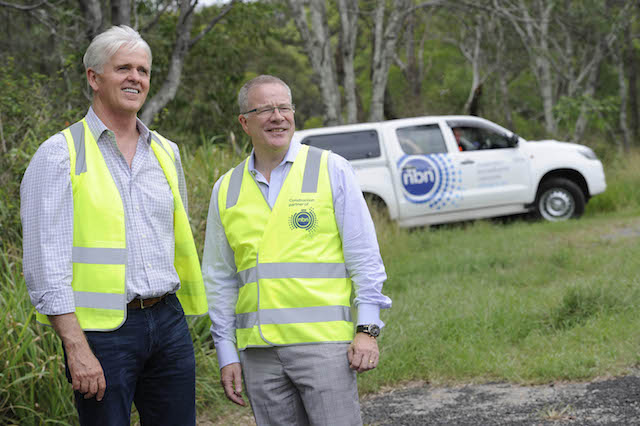
    Last Friday, the folly of the Liberal Party’s plans were shown when the National Broadband Network company, nbn™, issued their updated business plan that detailed a further retreat from both the original project scope and the government’s promises.

    The Melbourne Age’s Lucy Battersby illustrated how completely Malcolm Turnbull and the Liberal Party bungled their costings, showing just how mediocre and dishonest the government and Prime Minister have been in estimating the cost of the project.

    However, NBN Co underestimated the cost of using existing hybrid-fibre coaxial [HFC] cables laid by Telstra and Optus in the 1990s. Last year it calculated an average cost of $1800 per house. But detailed field work discovered the cost was actually $2300.

    In 2013 the Coalition estimated FTTN connections would cost about $900 per premise and this was raised to $1997 in a 2014 strategic review, and raised again in 2015 to about $2300.

    In the real world, being out by nearly 300% would cost an estimator or executive their job and for a small business could well see them being put out of business, but in the carnival of mediocrity that marks modern Australian politics, those responsible for such mistakes only thrive, as do the managers of nbn™ who recently awarded themselves fat bonuses.

    Adding insult to injury for the long suffering Australian taxpayers and broadband users is that the nbn™’s management have revised the scope again to overcome increased costs and now only 21% of consumers will get a fibre connection as opposed to the 40% claimed when the new government changed the scope.

    Those scope changes beg the question why anyone bothered in the first place. Had the network been left with Telstra there’s a reasonable chance 20% of customers would have ended up on fibre by early next decade as the economics of maintaining and installing the technology overtook the older copper system.

    Probably the biggest insult though to Australian customers though are the desperate attempts to make the new network profitable with plans to gouge the nation’s telco users as Fairfax’s Elizabeth Knight reported.

    Data use per user is anticipated to grow at a compound rate of 30 per cent per cent to 2020.

    At first blush these increases in usage might look exaggerated – but wait. Only last year NBN was working off the expectation that this year its existing customers would consume 90 gigabytes per month. But the current rate of consumption is actually 131 gigabytes per month – and rising.

    Thus as the years progress towards 2020, NBN not only gets an increase in customers, it get an increase in revenue per customer .Monthly average revenue per user is forecast to increase from $43 this year to $52 in 2020..


    So Australians will be expected pay more for their substandard connections to help an organisation that has consistently failed to meet its promises and targets. It should also be noted that rising Average Revenue Per User (ARPU) is the opposite of what’s been happening in the real world over the last twenty years as revenues, and profits have fallen.

    To be fair, it’s not just Australia that has struggled with rolling out fibre networks. In the US, Google Fiber is going through blood letting and scope changes as the company struggles to meet targets and keep costs under control. That same experience has been repeated around the world.

    However when it comes to missed targets, broken promises and the sheer scale of money wasted, Australia’s National Broadband Network dwarfs them all.

    Australian taxpayers, voters and telecommunications users should be asking hard questions of their political leaders


    Similar posts:
  • Connecting bridges to the internet of things

    Connecting bridges to the internet of things

    On Networked Globe today I have a description of NICTA’s Sydney Harbour Bridge Monitoring Project where the research agency is rolling out 800 sensors across the structure to reduce maintenance costs.

    The project a good example of how cheap sensors and abundant computing power is changing workplaces, connecting the bridge to the Internet of Things makes it easier for asset managers and engineers to understand what is happening to their structure.

    While the project promises a lot, it’s only a fraction of what’s possible as the sensors are only measuring movements so there’s a lot more they can do.

    The big promise though is for smaller structures than the Sydney Harbour Bridge. Around the world local governments are struggling to maintain their assets, if NICTA can develop a feasible monitoring product then many agencies will be looking at how they can reduce their budgets.

    While we tend to focus on connected kettles and other household devices when we talk about the internet of things, the real benefits and profits lie in the ‘big iron’ industrial and infrastructure applications.

    Similar posts:

  • You can’t get there from here

    You can’t get there from here

    I swore – mainly for my own sanity – that I wouldn’t discuss Australia’s National Broadband Network on this site anymore, today though the topic raised an interesting point about business leadership and project management that can’t be ignored.

    Australian Communications Minister Malcolm Turnbull today released the Broadband Availability and Quality Report (PDF) along with the accompanying My Broadband website that identifies the nation’s telecommunications blackspots.

    Extraordinary failure

    “It is extraordinary that in six years of Labor talking about Australians having inadequate broadband they never bothered to do the work of actually identifying where services were good, bad or indifferent,” said the minister at the announcement.

    Turnbull’s comments are correct, although the criticism is just as valid of previous Liberal and Labor governments who’ve all made incredibly poor decisions in the telecommunications portfolio without considering what was actually happening outside the ministers’ offices.

    A bigger lesson though is that before commissioning a project the size of the NBN – estimates have put its cost anywhere between twenty and eighty billion US dollars – it’s a good idea to know where you are are and where you want to go.

    Big Hairy Audacious Goals

    To put the comments that follow into perspective, I was a supporter of the NBN concept although I thought it was a Big Hairy Audacious Goal.

    In the shadow of the Global Financial Crisis the NBN project ticked all the boxes; it put cash into the economy, it employed an army of workers and upgraded Australia’s telecommunications network that had been neglected by thirty years of incompetent government policies mixed with incumbent telco greed.

    Australia could have afforded ten NBNs during the mining boom of the 2000s; it was an opportunity to rebuild the nation’s ports, roads, railways, schools and tax system that all needed reinvestment and reinvention to meet the needs of the 21st Century.

    Building a middle class welfare nanny state

    Rather than reform the economy or build modern infrastructure, the Howard Liberal government decided to spend the mining boom’s proceeds on building a middle class welfare state.

    Keen students of Australian politics crack a wry smile that the recently elected Abbott Liberal government, of which Turnbull is a member, proposes a paid parental scheme that will complete John Howard’s grand vision of a Middle Class Welfare Nanny State.

    One of the tragedies of the populist and cowardly Gillard and Rudd Labor governments that succeeded Howard was neither had the courage to dismantle the Liberal party’s middle class welfare state.

    At least though both Rudd and Gillard were prepared to make some big infrastructure investments, even if they weren’t fully thought through and chronically underfunded.

    Failing to think through the needs, scope and costs of the project meant the National Broadband Network project quickly collapsed into a managerial mess exacerbated by the dribbling incompetence of the company’s executives, government officials and contractors, which bought us to Turnbull’s announcement today.

    A project in search of a scope

    The project’s failure is a worrying commentary on the abilities of Australia’s management elites in both the private and public sector, however the lesson for the entire world is understanding both where you are and where you want to go to is essential for a project’s success.

    Spending on well planned and necessary infrastructure is good, but to avoid disasters like Australia’s NBN it’s good to start with understanding the problems you want to fix and a project scope that clearly identifies the work that needs to be done.

    Unfortunately too many governments and businesses don’t know where they are or where their plans will take them.

    Similar posts:

  • Taking care of our own

    Taking care of our own

    “The council ought to do something” growled a friend who’d been stuck in a peak hour traffic jam.

    That innocuous comment illustrates the fundamental challenge facing the developed world’s politicians – that we expect our governments to fix every problem we encounter.

    In the case of the local traffic jam, the cars creating gridlock are parents driving their children to two nearby large private schools.

    Despite the problem being caused by the choices of individuals – those decisions to send their kids to those schools and to drive them there – our modern mindset is “the government aught to do something” rather than suggesting people should be making other choices.

    Socialising the costs of our private decisions is one of the core beliefs of the 1980s mindset.

    Eventually though the money had to run out as we started to expect governments to solve every problem.

    We’re seeing the effects of this in the United States where local governments are now having pull up black top roads, close schools and renege on retirement funds as those costs become too great.

    As a society we have to accept there are limits to what governments can do for us.

    Increasingly as the world economy deleverages, tax revenues fall and the truth that a benign government can’t fulfill our every need starts to dawn on the populace, we’ll realise that expecting politicians and public servants to save us is a vain hope as they simply don’t have the resources.

    Bruce Springsteen puts this well in his song “We Take Care Of Our Own.”

    The truth today is the cargo cult mentality of waiting for governments or cashed up foreigners to come and save us is over.

    We’re going to have to rely more on our own businesses, families and communities to support us in times of need.

    The existing institutions of the corporate welfare state are beginning to collapse under the weight of their own contradictions.

    Joe Hockey knows this, but as a paid-up agent of the establishment he doesn’t dare nominate the massive cuts to middle class welfare and big business subsidies that are necessary to reform those institutions.

    Waiting for the council to fix the local roundabout is nice but it doesn’t address the bigger problems.

    It’s up to us to build the new institutions around our local communities and families. This is not a bad thing.

    Similar posts: