Tag: innovation

  • Acknowledging the human costs of disruption

    Acknowledging the human costs of disruption

    As we talk of the dramatic changes facing business and society today it’s worthwhile noting a  much greater displacement happened in the Twentieth Century as electricity, the motor car and communications drove the greatest increase in standards of living that humans have ever seen.

    Our great-great grandparents lived through a period of change far greater than that we will see as their lives and communities were radically transformed.

    Many common jobs in the early 1900s had ceased to exist by the middle of the century as cars replaced horses, mains electricity replaced town gas and refrigeration changed shopping habits. In the second half of the century affordable motor vehicles and television saw our cities reshaped around suburban life, a process now being reversed.

    The structural change to economies saw a shift in population and jobs; a hundred years ago thirty percent of the US labor force was employed in agriculture, today it’s around two percent. Despite the shift, jobs were eventually found for those displaced from farms.

    Shifting from an agricultural economy to an industrial society didn’t come without costs however,  the price paid by the affected communities and individuals was huge as documented by Steinbeck’s Grapes of Wrath and Dorothea Lange’s photos.

    While it’s unlikely we’ll see the deprivation of The Great Depression repeated in a modern welfare state, it’s important to recognise the real human costs of technological change. For politicians and community leaders it could define how history judges them.

    Similar posts:

  • Crowdfunding as product testing

    Crowdfunding as product testing

    A story from the Wall Street Journal describes how Sony have crowfunded their FES watch project, a smartwatch with an electronic paper wrist strap.

    Sony’s decision to crowdfund new projects is fascinating, not least because it gives researchers and entreprenuerial employees the opportunity to commercialise projects at little cost or risk to the company but also as a powerful way to judge the market demand for an idea.

    The FES watch campaign is good example how companies, big and small, can use crowdsourcing and crowdfunding. As we see more creative applications of the two concepts we may well see some radically new management methods and business models arise.

    Similar posts:

  • On being a digital anthropologist — brian solis on technology disrupting buiness

    On being a digital anthropologist — brian solis on technology disrupting buiness

    “Technology is part of the solution, but it’s also part of the problem,” says Brian Solis, the

    Brian Solis describes himself as a digital anthropologist who looks for how businesses are being disrupted. We talk about digital darwinism, how businesses can approach change and the role of individual changemakers within organisations.

    “My primary responsibility is to study disruptive technology and its impacts on business,” says Solis. “I look at emerging technology and try to determine which one is going to become disruptive.”

    To identify what technologies are likely to disrupt businesses it’s necessary to understand the human factors, Solis believes.

    One of the problems Solis sees is the magnitude of change required within organisations and particularly the load this puts on individuals, citing the story of one pharmaceutical worker who tried to change her employer.

    “Her mistake was thinking this was a short race, she thought everyone could see the opportunity inherent in innovation and change when in fact it was a marathon. She burned herself out”

    “What that means is to bring about change you really have to dig yourself in because you’re ready to do your part. You can’t do it alone, you have to do change in small portions and win over the right people.”

    Similar posts:

  • iPhone ME — Apple risks becoming the new Microsoft

    iPhone ME — Apple risks becoming the new Microsoft

    It’s been a tough week for Apple, after the spectacular launch of the iPhone 6 the company has had two humiliating and worrying setbacks that indicate standards may be slipping at the once untouchable giant.

    The iPhone 6 Plus should have been a triumph, and for a while it was, but the news the phones bend and distort has tarnished the product.

    Compounding the bendable phone problem are the claims users are being charged to replace their damaged handsets.

    On its own this problem might have been manageable like the iPhone4’s antenna problems in 2010, however today’s news that the latest iOS8 has had to be withdrawn after user complaints indicates a sloppiness has crept into the company.

    Both problems, or all three problems if it turns out the stories of Genius Bars charging to replace damaged phones, show Apple isn’t paying attention to detail to the degree they’ve become known for.

    The botched iOS8.0.1 rollout is sloppy work while the bendable phone is very much an uncharacteristic lapse in design.

    For a premium brand with a large dose of arrogance, shipping defective products is both an embarrassment and damages the company’s name.

    This inattention to detail is horribly reminiscent of Microsoft’s horror days at the turn of the Century where the company repeatedly rushed incomplete products to market — Windows ME being the most notorious example.

    So maybe we are seeing Apple become the new Microsoft and the iPhone 6 Plus as the Windows ME of our time.

    That doesn’t mean we’ll see the end of Apple, Microsoft is still a huge corporation, but it may be the tech industry’s most iconic business is beginning to lose its edge.

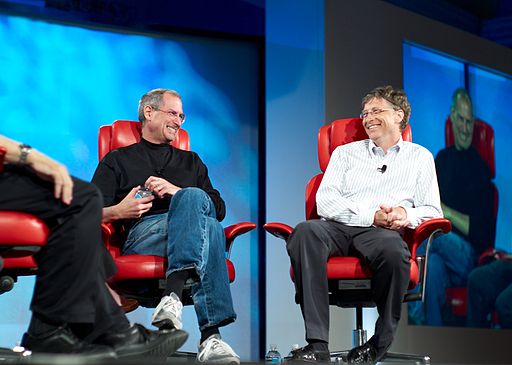
    Image of Steve Jobs and Bill Gates via Wikipedia

    Similar posts:

    • No Related Posts
  • Beating the 1980s business model

    Beating the 1980s business model

    Interviewing Stripe co-founder John Collison in the company’s crowded, noisy lunch room in San Francisco’s Mission District is a good place to appreciate how quickly the online payment service has grown since it was founded three years ago.

    Stripe was founded after twenty-four year old Collison and his brother Patrick encountered problems with online payments in their previous businesses, “we came to Stripe because we had built apps and webservices before and it was phenomenally difficult to take a product you had built and turn it into a business.”

    “At the time you had two options; you could turn your business over to PayPal, which was problematic for a whole bunch of reasons, or you’d build something from scratch.”

    “It was clear to us that neither of the options were very good so we went about building something better.”

    Silicon Valley’s strengths

    Since its establishment Stripe has grown from ten employees to 150, something the founder believes shows the strength of California’s Bay Area over areas like Collison’s native Ireland.

    “One of the things that I like about Silicon Valley is that people here tend to be relatively risk tolerant. Joining an unknown internet payments company three years ago, most people would say ‘you’re out of your mind’. But the psyche around here is that’s a reasonable thing to do.”

    Another aspect that attracts Collison to San Francisco is that most of his employees at Stripe have run their own businesses or startups themselves. Having a workforce of risk tolerant, independent self starters makes it easier to manage a fast growth company.

    Pitching for funding

    The Bay Area’s appetite for risk is reflected in how investors look at businesses; “in the startup world, people like to maximize the opportunity rather than reduce the risk,” observes Collison.

    Collison’s advice for startups seeking funding is to get have users on board that validates the idea, “when we pitched Peter Thiel we had production user for four or five months. What made us think there was something here was that those users were really passionate.”

    The other attraction for Thiel and other members of the ‘PayPal mafia’ – Thiel’s fellow PayPal founders Elon Musk and Max Levchin are also investors in Stripe – was their first hand dealings with the problem of online payments.

    “With the PayPal guys specifically, they really get this. Early on this was what they were trying to do with PayPal – make it easy for people to move money around the world.”

    Entering the era of mobile commerce

    The problem today that Collison sees with PayPal is that it is a product based on a desktop view of online commerce in a time where the industry is moving to mobile.

    “One of the things that has held online commerce back for so long is the purchasing experience has such a high barrier to it.”

    ”We’ve replicated the mail order form on the internet. It feels to me that in five to ten years time we will not be in the same world with people like Google and Facebook improving the identity story. That’s exciting because that helps merchants sell more.”

    “That whole model comes from a desktop era so if your building a lyft or a mobile site it doesn’t make much sense.”

    Beating the 1980s business model

    For the credit card and banking industry, the payments sector is even further behind. Collison believes that until recently the payments industry was based upon a 1980s business model where the costs of inefficiency were pushed onto merchants and small business.

    “All the banks and companies that offered services at the time were operating in the 1980s,” says Collison. “The business model was based on the old way of your customers being people within a fifteen block radius, on the internet your customer base is the whole world.”

    Building new industries

    With Stripe Collison sees an opportunity for new industries to develop out of easier ways of collecting payments, particularly given much of the world’s population in areas like Africa and China doesn’t have credit cards.

    “If we just building a business to take transactions from PayPal and get them onto Stripe, that’s not that interesting. What is interesting is if we can create new types of transactions that would not have existed otherwise.”

    “By providing better infrastructure for anyone to build a global business. That will change the kind of things people will build.”

    Similar posts:

    • No Related Posts