Tag: innovation

  • Standing up to the giants – why the big software companies don’t always win

    Standing up to the giants – why the big software companies don’t always win

    In the latest Networked Globe post I have an interview with QNX founder Dan Dodge on how BlackBerry wants to be at the heart of the Internet of Things.

    One of the things Dodge discusses is how twenty years ago Microsoft told QNX they would be driven out of business by the software giant’s Windows CE operating system.

    As it turned out Microsoft failed dismally.

    QNX’s survival in face of a big competitor is similar to Google’s failed attempts to enter various industries. Everyone assumes Google will succeed against the smaller players because they are rich and smart.

    Often however the rich player doesn’t win because the smaller incumbent is savvy, focused and knows their market well.

    Sometimes bigger is not always better in the software industry.

    Similar posts:

    • No Related Posts
  • The internet of things and empowered customers

    The internet of things and empowered customers

    “The internet of things is about what we own and how we build solutions around that rather than what we buy and companies following us around and guessing about us,” says veteran industry commentator Doc Searls.

    In an interview with Decoding the New Economy, the writer of the Cluetrain Manifesto discusses how he sees the internet of things changing marketing.

    For Searls, the connected shoe is a good example of how individuals can control the data being collected on them and the way businesses can get far more relevant information about how customers are using their products.

    Searls sees that the trend towards companies trying to dominate their fields in the Internet of Things as being doomed.

    “It’s our internet of things, not theirs. Right now the internet of things is being discussed as Apple versus Google versus Facebook.”

    “None of those are going to own the internet of things; the internet of things is a matter of you and your things and me and my things.”

    Empowering customers

    Searls sees the connected shoe as being a good example of how the internet citing his own New Balance shoes as how manufacturers can get richer data on its customers.

    “The interesting thing is there’s much more intelligence a company can get directly from its customers who already own something rather than following us around on the internet.”

    Searls’ view challenges today’s model of advertising based services; it may be this is the reason why companies like Google and Apple are so focused on playing a part in the internet of things.

    Similar posts:
  • Electrocuting elephants – the cost of competing standards

    Electrocuting elephants – the cost of competing standards

    A constant theme when new technologies appear is the inevitable war about standards that often sees bitter arguments over how the new methods should be used.

    Over the centuries we’ve seen fights over railway gauges, video tape formats and even the shape of lighting conductors.

    The struggle over lightning rods between the English and French camps in the eighteenth century was parodied by Jonathan Swift in Gulliver’s Travels where the two tribes fought over which end of a boiled egg should be broken.

    Probably the nastiest dispute in modern times was the battle over DC and AC electricity transmission between Thomas Edison and George Westinghouse, a fight made worse by Edison’s former employee Nikola Tesla taking his patents over to Westinghouse.

    The fight became so fierce that Edison actually electrocuted an elephant to illustrate how dangerous AC electricity would be to householders.


    Tesla and Westinghouse eventually won the argument, but it came at a cost to Topsy the Elephant.

    While we may draw the line at electrocuting elephants in these enlightened days, we aren’t much better at settling standards. That’s why it’s fascinating watching how technologies like the smart car and the connected home will evolve.

    Similar posts:

  • Satya Nadella’s grand vision

    Satya Nadella’s grand vision

    From a PC on every desktop to a services and devices company and now “productivity and platform company for the mobile-first and cloud-first world.”

    Microsoft CEO Satya Nadella’s long missive lays out where he’s taking the company.

    It’s a radical shift from the company of the Gates and Ballmer years.

    In order to deliver the experiences our customers need for the mobile-first and cloud-first world, we will modernize our engineering processes to be customer-obsessed, data-driven, speed-oriented and quality-focused. We will be more effective in predicting and understanding what our customers need and more nimble in adjusting to information we get from the market.

    This describes a very different company from five years ago; it implies an end to bureaucracy and management conveniences like stack ranking; if Microsoft is really going to be more nimble, then it means a smaller, more focused management.

    In 1995, Bill Gates turned Microsoft around in a few months when he realised the strategic mistake he’d made in underestimating the impact of the Internet, so the company has adapted quickly to dramatically changed times in the past.

    Whether Microsoft can adapt and maintain its position in a computing world very different to the one it once dominated will be among the great business studies of our time.

    Similar posts:

    • No Related Posts
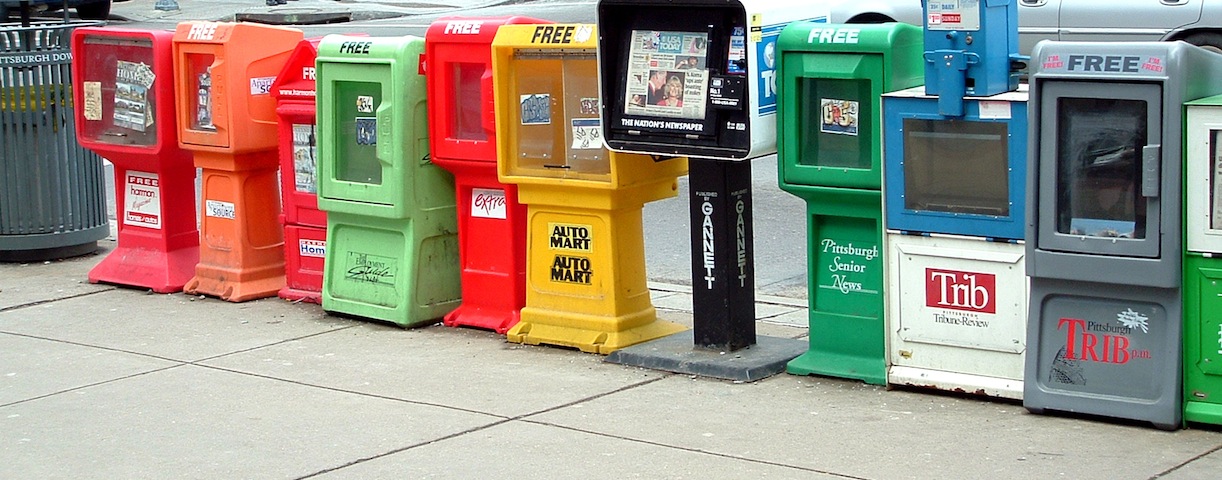
  • Demoting the newspaper

    Demoting the newspaper

    You know a product has problems when retailers start start moving it out of key retail positions. When the product was the retailers’ core business, you know the entire industry is in serious trouble.

    Mark Fletcher describes in the Newsagency Blog how he’s moved his city’s number two selling paper off the main level of his newspaper display.

    “Sales are not paying for the space,” Mark says bluntly.

    Newsagents relegating newspaper fits nicely into Ross Dawson’s Newspaper Extinction Timeline, in the case of Mark Fletcher’s newsagency Dawson sees the Australian newspaper industry vanishing by 2022.

    For newsagents the signals have been clear for some time that they have to adapt to a society where paper based products – newspapers, stationery and greeting cards – aren’t in demand.

    The process of adapting isn’t easy or smooth – many experiments will fail and even the smartest business people will make expensive mistakes. That’s the nature of evolution.

    Newsagents though are just one example of changing marketplaces, there’s few industries that aren’t being disrupted by the technology and economic changes of our times. All of us are going to have to adapt to a rapidly changing world.


    Similar posts:

    • No Related Posts