Tag: innovation

  • It’s only technology

    It’s only technology

    “We treated Bitcoin as a tech story but now it’s become a much more serious economic story,” said a radio show compere earlier today when discussing the digital currency.

    One of the great frustrations of any technologist is the pigeon holing of tech stories – the real news is somewhere else while tech and science stories are treated as oddities, usually falling into a ‘mad professor’, ‘the internet ate my granny’ or ‘look at this cool gadget’ type pieces.

    Defining the world we live in

    In reality, technology defines the world in which we live. It’s tech that means you have running water in the morning, food in the supermarket and the electricity or gas to cook it with.

    Many of us work in jobs that were unknown a hundred years ago and even in long established roles like farming technology has changed the workplace unrecognisably.

    Even if you’re a blacksmith, coach carriage driver or papyrus paper maker untouched by the last century’s developments, all of those roles came about because of earlier advances in technology.

    The modern hubris

    Right now we seem to be falling for the hubris that we are exceptional – the first generation ever to have our lives changed by technology.

    If technological change is the measure of a great generation then that title belongs to our great grandparents.

    Those born at the beginning of last century in what we now call the developed world saw the rollout of mains electricity, telephones, the motor car, penicillin and the end of childhood mortality.

    For those born in the 1890s who survived childhood, then two world wars, the Spanish Flu outbreak and the Great Depression, many lived to see a man walk on the moon. Something beyond imagination at the time of their birth.

    It’s something we need to keep in perspective when we talk about today’s technological advances.

    Which brings us back to ‘it’s only a tech story’ – it may well be that technology and science are discounted today because we now take the complex systems that underpin our comfortable first world lifestyles for granted.

    In which case we should be paying more attention to those tech stories, as they are showing where future prosperity will come from.


    Similar posts:

  • Where will the jobs come from in the internet of things?

    Where will the jobs come from in the internet of things?

    One of the common worries about the internet of things and the automation of business processes is that many jobs are going to be lost as a consequence.

    This is a fair concern however we need to keep in perspective just how radically employment has changed in the last century.

    Concerns about technology displacing occupations is nothing new; in the eighteenth century the Luddite movement was a reaction to skilled workers being displaced by new innovations.

    In an interview with GE’s Chief Economist Marco Annunziata, published in Business Spectator, we covered this topic and Marco had a valid point that the bulk of the Western world’s workforce was employed in agriculture a hundred years ago.

    Today it’s less than two percent in most developed country as agriculture became heavily automated, yet most of those workers who would once have worked in the fields have productive jobs. “As an economist I look at this over a long term perspective and I’ve heard this concern about technology displacing jobs over and over again.”

    Annunziata sees new roles being created, among them what he calls ‘mechanical-digital engineers’ who understand both how the actual machines work as well as the data and the software used to run and monitor them.

    This isn’t to say there won’t be massive disruption – John Steinbeck’s Grapes of Wrath described the massive dislocation that happened in the United States with the first wave of agricultural mechanisation in the 1920s and the decline in rural communities is due directly to modern farms not needing the large workforces that sustained many country towns.

    We can’t see where the jobs of the future will be and just roles like as Search Engine Optimisation and ecommerce experts where unheard of twenty years ago, our kids will be working in occupations we haven’t contemplated.

    It’s up to us to give our kids the skills and flexibility of thinking that will let them find opportunities in a very different workplace.

    Similar posts:

  • Is NFC ready for prime time

    Is NFC ready for prime time

    One of ‘coming real soon’ technologies of our times is Near Field Communications (NFC), a short range radio service connecting suitably equipped electronic devices.

    NFC has been tipped to arrive ‘real soon now’ for several years as mobile phone companies, banks and telcos fight to control the payments system.

    The service hasn’t taken off for a number of reasons; it’s clunky to use, the technology itself isn’t consistently applied and many smartphones don’t have the feature, the most notable being the iPhone.

    Most of the applications cited for NFC are contactless payment services where a customer can wave a phone to pay for things, a good example is this parking meter in San Francisco.

    NFC-parking-meter-detail

    On the other side of the Pacific, Google are running a campaign in Australia encouraging commuters to try the NFC features that are built into most Android phones.

    IMG_4447

    Unfortunately the technology doesn’t work, as the comments to this blog post indicate. The users’ problems illustrate why NFC is struggling; it’s clunky, unreliable and customers don’t understand it.

    It’s notable the Google campaign includes a QR code, another technology that’s been pending for nearly a decade.

    Both are doomed though while customers struggle to use them.

    We may well see both QR codes and NFC succeed eventually, but right now they are the classic case of a technological solution searching for a problem to solve.

    Similar posts:

    • No Related Posts
  • The end of HTML 5?

    The end of HTML 5?

    One of the big debates in web design since the rise of smartphone apps has been the question of ‘going native’ or following web standards.

    In an ideal world, all apps would follow the HTML web standards so designers would only have to create one app that would run on any device — a smartphone, tablet or PC — regardless of what type of software it was running.

    However the HTML 5 standard has proved problematic as developers have found applications written in the language are slow with limited features, so the attraction of writing ‘native’ apps that are designed for each system remains strong as users get a faster, better experience.

    The problem with that approach is that it results in having to design for different operating systems and various devices which is costly and adds complexity.

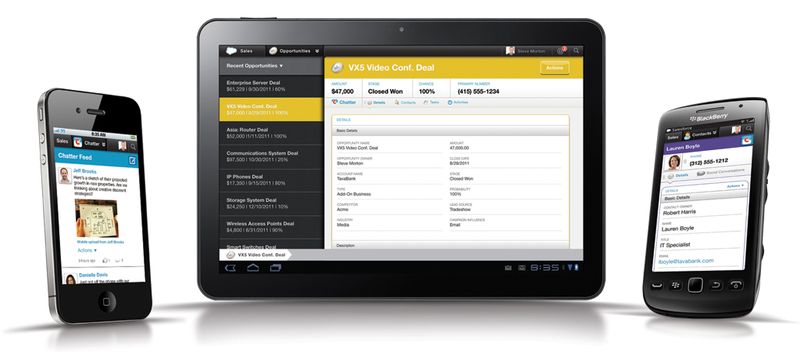
    For the last two years at Dreamforce, Salesforce CEO Marc Benioff has trumpeted the advantages of the company’s HTML5 Touch product.

    This year Benioff unveiled the company’s Salesforce One product — a suite of Application Program Interfaces (APIs) that simplifies building smartphone and web apps. At the media conference after the launch, Benioff even went as far to describe the once lauded Touch product as a “mistake”.

    So Salesforce has abandoned HTML5, which is a blow for standard applications.

    If others follow Salesforce, and it appears that is the trend, then we’ll increasingly see the smartphone industry dominated by iOS and Android as most companies lack the resources or commitment to develop for more than two platforms and their form factors.

    Open standards have been one of the driving factors of the web’s success, it would be a shame if we saw the mobile market split into two warring camps reminiscent of the VHS and Beta video tape days.

    Similar posts:

    • No Related Posts
  • Google, Facebook and the Silicon Valley paradox

    Google, Facebook and the Silicon Valley paradox

    One of the great advertising campaigns of the 1980s featured entrepreneur and Remington Shaver CEO Victor Kiam telling the world “I liked the product so much I bought the company”.

    The modern equivalent of Victor Kiam’s slogan is “eating your own dogfood” where businesses use their own products in day to day operations. It’s a great way of discovering weaknesses in your offerings.

    One of the paradoxes of modern tech companies is how they don’t always eat their own dogfood when it comes to their business philosphies – they expect their customers to take risks and do things they deem unacceptable in their own businesses and social lives.

    The best example of this are the social media services where founders and senior executives take great pains to hide their personal information, a phenomenon well illustrated by Mark Zuckerberg buying his neighbours’ houses to guarantee his privacy.

    Just as noteworthy  are the policies of Google’s IT department, for past five years most tech evangelists – including myself – have been expounding the benefits of business trends like cloud computing and Bring Your Own Device (BYOD) policies.

    Now it turns out that Google doesn’t trust BYOD, Windows computers or the Cloud, as the company’s Chief Information Officer, Ben Fried tells All Things D of his reasoning of banning file storage service Dropbox;

    The important thing to understand about Dropbox,” Fried said, “is that when your users use it in a corporate context, your corporate data is being held in someone else’s data center.”

    This is exactly the objection made by IT departments around the world about using Google’s services. It certainly doesn’t help those Google resellers trying to sell cloud based applications.

    Fried’s view of BYOD also echoes that of many conservative IT managers;

    “We still want to buy you a corporate laptop, get the benefits of our corporate discounts, and so on. But even more importantly: Control,” Fried said. “We make sure we know how secure that machine is that we know and control, when it was patched, who else is using that computer, things like that that’s really important to us. I don’t believe in BYOD when it comes to the laptop yet.”

    Despite these restrictions on Google’s users, Fried doesn’t see himself or his department as being controlling types.

    “But the important part,” Fried said, “is that we view our role as empowerment, and not standard-setting or constraining or dictating or something like that. We define our role as an IT department in helping people get their work done better than they could without us. Empowerment means allowing people to develop the ways in which they can work best.”

    Fine words indeed when you don’t let people use their own equipment or ask for a business case before you can use Microsoft Office or Apple iWork.

    That Google doesn’t give its staff access to many cloud services while Facebook’s managers restrict their information on social media shows the paradox of Silicon Valley – they want us to use the products they won’t use themselves.

    Back in the 1980s, Victor Kiam liked what he saw so much that he bought the company. You’d have to wonder if Victor would buy Google or Facebook today.

    Similar posts:

    • No Related Posts