What happens when a vehicle manufacturer locks down their products’ software? John Deere’s customers are finding out as American farmers turn to Ukrainian software vendors for software to maintain their tractors.
John Deere’s behaviour is extreme as almost every component of a modern tractor has a software component which leaves farmers at the mercy of the company’s dealers and authorised mechanics.
So understandably the farmers are finding ways to hack their equipment to reduce downtime and costs, something permitted in the US after an exemption to the Digital Millennium Copyright Act (DCMA) was granted to vehicle software.
Vendor control over connected vehicles is a bigger problem for consumers than just maintaining the software, as the information collected from these devices becomes more valuable who controls that data becomes more important.
With global supply chains, increased regulatory requirements and demanding markets, the agricultural industries are probably leading the world in applying the Internet of Things and Big Data, so the challenges faced by farmers are things which will affect us all.
As everything from toasters to motor cars become connected and dependent upon code, the conflict between proprietary software, open markets and user rights is going to grow.
Consumers and the free market can only do so much to control the flows of data and who owns them. It’s hard to see how governments can’t become involved in how information is owned, traded and stored.
In the tropical north of Australia, one university is looking at using the Internet of Things to expand the reach of its research and open new opportunities for the local economy.
On Monday James Cook University opened Australia’s first university IoT lab in Australia.
Based at the Cairns campus in Far North Queensland, the lab is part of the university’s new Internet of Things engineering degree and is supported by Chinese telco vendor Huawei.
The university, which also has campuses in Townsville and Singapore, boasts expertise in areas such as marine sciences, tropical ecology and tropical medicine, all of which are relevant to the IoT and made more relevant by Cairns being the main service centre for much of Australia’s remote Top End and the Torres Strait.
Part of a central mission
“The Internet of Things is based on something that is central to our mission in the Tropics: building greater connectivity between people, place and technology,” said the university’s Vice Chancellor Professor Sandra Harding.
JCU’s IoT degree, the first of its kind in Australia, combines the study of electronic engineering with internet technologies, wireless communications, sensor device, industrial design and cloud computing.
Currently the IoT faculty has 57 first year students, which the university hopes to grow to over 200. The head of the IoT faculty, Professor Wei Xiang, explained why the university decided to offer this course.
Economic drivers
“Primarily it’s driven by the economy, Australia is transitioning from a mining boom to a knowledge and innovation driven economy. So in the middle of 2015, JCU decided to offer an engineering degree in Cairns.”
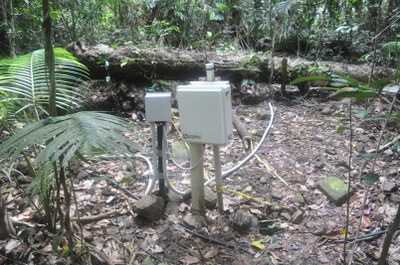
“The IoT places nicely into traditional strengths at JCU in fields like marine science, marine biology and remote medicine, for example we can use the IoT for reef condition monitoring and our Daintree Rainforest project.”
An electronics Engineer himself, Professor Xiang sees the IoT as the future of industry and leapt at the chance to lead a course when the opportunity arose.
“In the middle of 2015 I thought, ‘this is what I want to do as this is where the future is.’”
Smartcity opportunities
Along with the remote health, marine science and agricultural aspects the City of Cairns itself offers smartcity opportunities. As a moderate sized town of 142,000 relatively isolated from the rest of Australia, Cairns has large tourist traffic coupled with weather extremes – the city gets nearly two meters (80 inches) of rain every summer. Making it a good test bed for new city technologies.
“Cairns Regional Council is very interested in smartcities, I’ve been working very closely with the city council and its innovation team,” says Professor Xiang. “We are also rolling out our smart campus.”
Part of the smart campus initiative is the university installing a NarrowBand-IoT base station provided by its program supporter, Chinese telecoms giant Huawei.
Huawei’s NB-IoT base station
Along with supporting the IoT lab, Huawei also plans to offer JCU IoT students the opportunity to travel to Huawei’s global headquarters in China and its Australian headquarters in Sydney as part of its Seeds for the Future program.
“It gives our students and staff an experimental platform that conforms to the latest IoT international standard,” Professor Xiang said. “It means that as we design devices and sensor networks we can test and configure them using that standard.”
The university’s Vice Chancellor, Sandra Harding shares Professor Xiang’s enthusiasm. “From designing smarter cities, to growing precision agricultural systems, monitoring natural environments in real-time, and creating clever health solutions that work in remote communities,” she says. “We don’t want to be just a part of that future, we want to lead it.”
Paul travelled to James Cook University’s Cairns campus as a guest of Huawei.
Tracking environmental changes across the oceans a huge undertaking. To deal with the scale of the task Australian researchers have started equipping seals marine animals with a maritime equivalent of a fitbit to monitor the effects of our changing planet.
One of the interesting case studies that came across my desk in recent weeks was the IMOS animal tracking program. The Integrated Marine Observing System is a consortium of research institutions lead by the University of Tasmania that collects data for the Australian marine and climate science community and its international collaborators.
The data is collected from ten different technology platforms including floats, ships, autonomous vehicles such as gliders and deep ocean probes, and by fitting tracking devices onto animals.
Along with sharks and fish, seals are one of the animals IMOS use to track water conditions, one of the benefits of using seals is they can transmit data to a satellite when they return to the surface to breath and they never get stuck under ice.
The tags themselves are made by a Scottish company and are designed to gather information on the depth, temperature, salinity of the seas the animals travel in. They are also useful for tracking the behaviour of the animals.
Along with research into conditions across the vast Southern Ocean, IMOS is also being used to monitor the effects of port development in the mining regions of Western Australia and other areas where environments are undergoing dramatic change.
Once the data is collected it’s open to use by the research community in their understanding the effects of a warming planet, that open data and the cloud storage it is based upon are critical to the program’s success as there’s little point in collecting the data.
We have the devices to collect a tremendous amount of data on our environment, whether it’s our personal fitbits, financial records or information on agriculture or wild animals. The challenge though is to use that data effectively.
In the case of a changing environment, understanding what is happening and the effects could be a matter of our survival. While the idea of a fitbit for seals seems cute, the data they collect could prove critical.
Smartphones being the centre of Xiaomi’s product offerings seems to be the common factor in the expanded range of devices, with the company hoping their ecosystem will be a compelling point of difference in a crowded market.
The idea the smartphone will be the centre of people’s connected lifestyles isn’t new but Xiaomi’s bet on low margin home appliances to drive smartphone sales and subscriptions to cloud services seems a brave move.
It may work however, the business models of tomorrow look improbable today.
Who is responsible for the effect of renegade computer programs is going to become a serious legal topic as an increasing number of things become ‘intelligent” and connected to the internet.
Britain’s Financial Conduct Authority (FCA) is one of the first regulators to start looking at how companies’ algorithms. In their just released rules for wholesale traders, the FCA sets out the responsibilities for companies and their managers.
“We are determined to embed a culture of personal responsibility within the banking sector,” says the FCA’s Acting Chief Executive Tracey McDermott. “Clear individual accountability should focus minds, drive up standards, and make firms easier to run and to supervise. And if things go wrong, it will allow senior managers to be held to account for misconduct that falls within their area of responsibility.”
The definition of ‘misconduct’ when an algorithm goes awry will undoubtedly prove contentious, as will the idea of ‘personal responsibility’ in the banking sector.
While it’s too tempting to be dismissive of such move in the financial services industry, the FCA’s regulations are a pointer of what most industries are going to face over the next ten years as the more devices make decisions for themselves or communicate with other equipment over the Internet of Things.
In many areas the question of who is responsible for a rogue computer program will be left to the uncertainties of the legal system with no doubt many surprises, injustices, inconsistencies and unintended consequences so the earlier regulators develop a framework for dealing with mishaps the better.
Should the IoT start delivering on its promise of a connected world a poorly designed algorithm in even what should be relatively trivial devices or services may have the potential to cause massive disruption and damage. It’s hard not to imagine many other regulators in other industries are looking at how to attribute responsibilities, if not minimise risk, in a smart connected world.