
Tag: investment

  • Silicon Valley and the virtues of going private

    Silicon Valley and the virtues of going private

    Last week there were a pair of interesting stories about the tech industry’s investment models.

    The biggest story was the rumours that PC manufacturer Dell may go back to being a private company and the other was Survey Monkey’s raising of $800 million through debt and private capital.

    Not your usual VC play

    Polling company Survey Monkey’s capital raising is notable because it’s very different to the standard VC equity models used by Silicon Valley companies of this size.

    Adding to the unusual nature of Survey Monkey’s behaviour is the declaration that they have no intention of becoming a public company. By ruling out an obvious way for investors to cash out of the business, they are making a clear statement that those putting money into the venture are doing so for the long term.

    That Survey Monkey is also taking on debt indicates management believe they are going to have the cash flow to service payments. Not playing to the Greater Fool business model makes the online polling company very different to most of its contemporaries in Silicon Valley.

    Dell going private

    Survey Monkey’s $800 million is dwarfed by Dell’s market cap of 22 billion dollars so the talk of the PC manufacturer buying out its stock market shareholders and becoming a private company is big news indeed.

    The New York Times Dealbook has a close look at the of the idea of taking Dell private and comes to the conclusion it’s not likely to happen.

    While there are challenges, there is merit to the idea. Richard Branson delisted Virgin from the London Stock Market in 1988 after becoming frustrated with the short term objectives of his shareholders and there’s a possibility of Michael Dell may feel the same way.

    For Dell, the challenge lies in moving away from the commodity PC sector. The Dell Hell debacle showed the company’s management has struggled with the realities of the low margin computer market and things aren’t getting better.

    Dell themselves are steadily moving away from PCs with bigger investments in services and other computer hardware sectors.

    Project Ophelia, a USB stick sized computer running Google’s Android operating system was one of Dell’s announcements at the Consumer Electronics Show and could mark where the company is going in the post-PC environment.

    Given portable and desktop PCs represent over half of Dell’s income moving away from those markets is going to be a major change in direction for the company.

    A change is though what the company needs with revenues down 11% on last year which saw profits nearly halved.

    Whether going private or staying public will allow Dell to recover its profitability remains to been seen, but management could probably do without the distraction of answering to stock markets while dealing with a complex, challenging task.

    Both Dell and Survey Monkey are showing that there isn’t one path to raising funds for technology companies, in fact there’s plenty of businesses raising money privately without the razzamatazz of high profile venture capital investments.

    It may well be though that we’re seeing private companies coming back into fashion as individual investors see the advantages in businesses with good cash flows rather then the hyped loss leaders which have dominated Silicon Valley’s headlines.

    Image of Wall Street courtesy of Linder6580 on SXC.HU
     

    Similar posts:

  • Towards the post car society

    Towards the post car society

    We don’t often think about it, but the design or our cities reflect the technologies of the day. Right now the way we live is built around the motor vehicle, but are we moving into a new era?

    After a visit to Ford Australia’s Centre of Excellence For Design and Engineering, Neerav Bhatt has some thoughts on the role of the motor car in an era where people don’t have to travel to their workplaces.

    One of Neerav’s points is that car use is falling among younger workers, a trend that’s happening across the western world.

    Much of this is put down to the generations of Millennials and Gen-Ys being more interested in technology purchases rather than cars along with changing work patterns.

    A more fundamental reason could be that we’re reaching the end of the motor car era.

    If there is one technology that represents the Twentieth Century it is the motor car; the automobile has shaped our cities, our lifestyles and our culture.

    However we are now in the Twenty-First Century.

    The three eras of motoring

    Roughly speaking, we could break the Twentieth Century’s love affair with the motor car into three phases; development, consolidation and dependency.

    In the first period, the automotive industry was developing with thousands of manufacturers experimenting with the technology and production methods. At the same time governments were beginning to build road networks and communities were demanding improved links.

    By the beginning of World War II, the motor car was an important part of life but ownership was largely restricted to affluent households and business.

    Following World War II governments made huge investments in road networks and automobiles became cheaper to own.

    This gave a generation a new taste of freedom as you could go anywhere with a tank of gas. It also changed the layout of our suburbs as people could now travel further to work, allowing them to move into bigger houses on the fringe of town.

    As government investment was focused on road building, passenger train and tram networks were starved of capital with many cities abandoning their transit systems altogether.

    Suburbs built in the early to mid Twentieth Century had evolved around trams and the legacy of that can still be seen today. However customers no longer wanted to fight for parking spots on crowded streets designed for horse drawn carriages and trams.

    Responding to this developers started building supermarkets and shopping malls which became popular largely because they offered easier parking. Cheaper goods made available by improved logistics systems – another effect of the motor car – was the other main reason.

    The beginning of dependency

    With the advent of the 1970s oil shock, the role of the motor car turned from being a tool of liberation into one of dependency. The suburbs of the 1960s and 70s had been built around the assumption of universal car ownership and cheap fuel. When fuel ceased being cheap, then households budgets were affected.

    Not coincidentally after the oil shock the reversal of ‘white flight’ – the movement of the middle classes to outer suburbs – started with the gentrification of inner suburbs that had been abandoned by the working class.

    Through the 1970s and 80s the cost of owning a motor car became more expensive as governments stopped externalising the costs of maintaining roads and saw car use and petrol taxes as a revenue source.

    At the same time the obvious effects of saturating society motor cars became obvious as roads increasingly became choked and planners began to realise that building more roads only attracted more traffic.

    Times of decline

    By the turn of the Twenty-first Century technology had also started to move away from centralised offices and factories. Today technologies like the internet and increasingly 3D printing mean that workers don’t have to commute vast distances. Automation also means many levels of management are no longer necessary.

    Changing work patterns is also affecting incomes, with car ownership being expensive many employees – particularly young workers – don’t want to buy automobiles.

    This all means that the era of the motor car is coming to an end, it’s not going to vanish quickly but the decline has started.

    For business, this means the post World War II assumptions that saw the rise of the supermarket, shopping mall and big box discount store are no longer valid.

    Some managers, most notably those of doomed department stores, won’t learn these lessons and will pass into history like the stagecoach companies.

    Just as the end of the horse and carriage era saw the demise of buggy whip makers and blacksmiths, the rise of the motor car saw an unprecedented rise in wealth, employment and productivity. Not only were the lost jobs created elsewhere, but many more were created.

    While the motor car isn’t going to disappear overnight, the decline has started and our society is adapting. For business and government leaders, the task is to understand those changes and adapt.

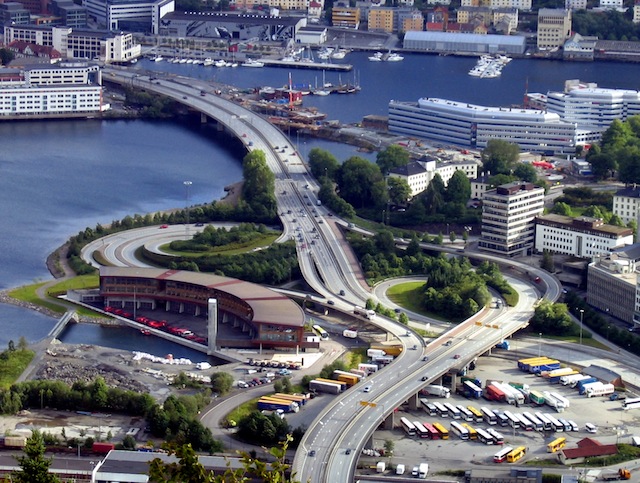
    Image courtesy of a Norwegian motorway by Ayla87 through SXC

    Similar posts:

  • Australia and the Dutch Disease

    Australia and the Dutch Disease

    This week sees the launch of the annual G’Day USA festival where Australian exporters and various celebrities extol the virues of the country across the United States.

    One of Australia’s success stories of the last decade has been Yellowtail Wines which carved a niche for Australian wines in the US in the same way Jacob’s Creek did a decade earlier in the UK.

    Today the Australian Financial Review reports that Cassella Wines, the maker of Yellowtail, is in breach of its banking covenants due to the high Australian dollar.

    Cassella Wines is another victim of Australia’s Dutch Disease infection.

    Dutch Disease owes its name to the Netherlands’ gas boom of the 1960s. By the early 1970s the strong Guilder damaged the rest of the Dutch economy which didn’t profit from extracting natural gas.

    Having sleepwalked into the Dutch Disease, it’s fascinating how Australia’s electorate, policy makers and business leaders are in denial about the effects as successful exporters like Cassella Wines struggle with a high dollar and accelerating costs.

    When commodity prices and the dollar turn, and they always do, its going to be tough for the economy to adapt as much of the industry capacity that was competitive at lower rates won’t be available to take advantage of the lower costs and to pick up the slack from a declining mining sector.

    For Australian businesses, the onus is on managers and proprietors to protect their organisations from the short term effects of a high currency and the medium term effect of a falling dollar pushing up the input prices of imports.

    In other words, getting costs down without becoming too reliant on offshored labour or suppliers. The companies that manage this are going to be very strong after the initial adjustment, but it’s a tough management task.

    While that task can, and will be, done by smart and hardworking leaders no-one should expect any recognition of the scale of this task from governments, media or business organisations who seem to be in denial of reality.

    The Dutch and Australian flags image is courtesy of Emilev through SXC

    Similar posts:

  • Reskilling the workforce

    Reskilling the workforce

    One of the core objectives 1980s management philosophy is to shift costs and risks onto others. Staff training is one area that caught the brunt of the drive to slash expenses for short term gain, as a consequence we have a skills crisis with offers opportunities for savvy entrerpreneurs.

    In Why Good People Can’t Get Jobs: Chasing After the ‘Purple Squirrel Wharton management professor Peter Cappelli discusses his recent book that looks at this problem.

    Cappelli’s argument is that companies aren’t offering enough for the skills they desire, they often ask too much of candidates and they won’t train staff.

    In Cappelli’s book, he claims that staff training has plummeted;

    One of your chapters in the book is called “A Training Gap, Not a Skills Gap.” You have some figures showing that in 1979, young workers received an average of two and a half weeks of training per year. By 1991, only 17% of young employees reported getting any training during the previous year, and by last year, only 21% said they received training during the previous five years.

    The predictable consequence of neglecting training for the last thirty years is we now face skills shortages and those responsible – the managers and business owners who refuse to train workers – are now demanding governments do something about it.

    In many ways today’s skills shortages epitomise the short termism of 1980s thinking and how we now find society, and business, is struggling with the long term effects and costs.

    Wherever there’s a problem there is opportunity and there’s a breed of businesses, training companies and workers who will be taking advantage of the failures of the previous generation of managers.

    For those stuck in the 1980s mindset that training, like most staff expenses, is a cost and not an investment they are going to struggle in a world where adding value is more profitable than being the lowest cost provider.


    The photo THE BEAD MAKER — Apprentice Watches the Master — A Rosary Shop in Old Meiji-Era Japan was posted to Flickr by Okinawa Soba.

    Similar posts:

  • Australia’s high cost quandary

    Australia’s high cost quandary

    “Around the world our towncars are usually 30% more expensive than taxis, in Sydney it’s 20% as the cabs are pretty expensive,” said Travis Kalanick on launching the Sydney version of Uber’s hire care booking service.

    It’s not just hire cars which are expensive in Sydney – the soaring cost of living in Australia is bourne out by Expatistan, a web site that crowdsources the cost of living in various cities.

    Expatisan’s comparisons find Sydney up with Tokyo and London as the most expensive towns on earth.

    That conclusion means Australian businesses, governments and policy makers have some important decisions ahead of them.

    Cholesterol in the veins

    High property prices have been the norm for two decades in Australia, the middle class welfare state that both political parties support gives tax and social security concessions to property owners while the banking system requires most business lending to be secured by property.

    As a consequence, generations of Australians see property as the only path to financial success. If Bill Gates, or any of today’s entrepreneurial wizz-kids, had been born in Australia, they’d be encouraged to get a safe job and buy property than to take the risk of starting a new business.

    The property obsession has another perverse effect in that it creates a short term outlook for Aussie business owners who have to consider getting,  and paying off, a mortgage quickly to secure their financial foundations.

    A few weeks ago a business owner was profiled in the Sydney Morning Herald, which some call the Sydney Morning Property Spruiker, who paid 1.1 million Aussie dollars (a million US) for a property in Redfern – which is Sydney’s Bronx.

    That poor guy not only has a fat mortgage to pay off, but he has to pass those costs onto his customers. Just to pay the bank is a fat chunk out of his business before he pays his staff, landlord and the various other expenses before he can take his profits.

    Having to pay the bank for living costs is the main reason why Aussie businesses don’t invest in capital equipment, which in turn makes  them less competitive than overseas competitors.

    One of the myths in Australian business is that competitiveness is solely due to labor costs, what the ideologues preaching this miss is that even if Aussie workers were paid a bowl of rice a day, Chinese and Mexican factories would still be more productive due to the investment in modern equipment.

    For the sake the argument, we won’t even discuss German, Japanese or Swiss manufacturers who are still competitive despite Australian level cost structures.

    This last point is what’s missed in much of the discussion about Australia’s economic future – apologists for Reserve Bank governor Glenn Stevens and the self congratulatory Canberra monoculture say that the high Aussie dollar is here to stay and mining will be driving the economy.

    Should the mining sector stall, which currently seems to be the case, then housing development will pick up the slack according to the policy-makers’ groupthink.

    That housing development is going to come at a high price, with Australian land and homes already among the world’s highest. Given Australia’s private sector debt is among the highest in the world already, it’s hard to see where the money will come from to fuel further property speculation.

    Right now Australia has a serious problem in determining what the future will be for the country.

    If the future is a high cost economy underpinned by massive property property prices, then the future has to lie in high value added sectors.

    The question is ‘what sectors’? Australian business, governments and society in general seem to think that property speculation is the future.

    Property speculation turned out not to be the future for Spain and it looks like China’s speculative boom is meeting its obvious end.

    Australians are going to have to hope that it really is different down under and that young people and immigrants are prepared to spend huge amounts of money to keep the economy afloat.

    If the policy makers are wrong, then the worry is that there is no Plan B.

    Similar posts: