Tag: legal

  • The saddest sign you’ll ever see

    The saddest sign you’ll ever see

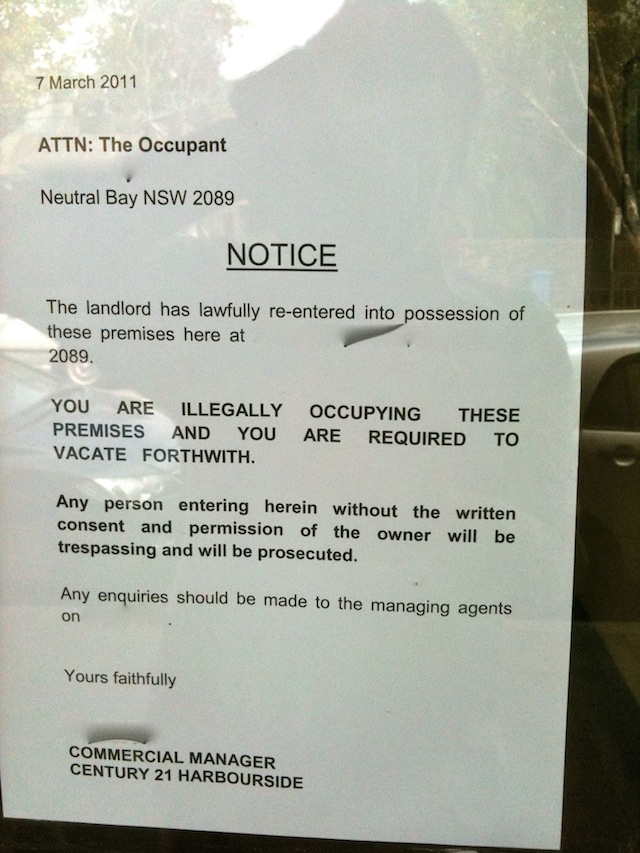
    The sign on an abandoned business announcing “Landlord taken possession” usually hides a pile of pain and distress.

    It’s not cheap or easy for a landlord to take possession of a business premises and for most to do so it’s usually the end of long period of unpaid bills and broken promises.

    Behind that sign is usually months, if not years, of stress and despair as a business owner has held onto a failing enterprise, bluffing their landlord, their suppliers, their staff, their own families and often themselves.

    Almost every one of those signs has a story of failed relationships, destroyed friendships and ruined marriages.

    Often they didn’t understand the cost of doing business and in many cases because they hadn’t consulted a bookkeeper or accountant earlier they didn’t understand their venture was always loss making despite what appeared to be a healthy cashflow.

    When the truth about the businesses becomes obvious, life for the honest owner of a failing enterprise tries to bluff themselves and those around them that things will be okay, that the dream is still alive.

    This is what worries me about many of the businesses that participate in group buying deals, they are desperate to keep their business afloat and believe the cashflow or publicity will save their failing venture. Even worse, many don’t understand how that “50% off” deal will affect their ability to pay staff and the landlord.

    Even where the failed proprietor has been one the “two percenters” – the 2% of our society that runs their affairs with no regard for the pain and suffering of those they hurt – many people, particularly the smaller suppliers and low paid workers, have taken a hit as bills went unpaid and promises were not kept.

    Most business owners though believe in their idea or vision and work long and hard in an attempt to achieve it. The majority of those who end up with the landlord taking possession are often those who ignored the signs and believed things would come good next season, next month or next week.

    I’m always saddened when I see a “landlord taken possession” sign like the one near me in the window of what was an Italian restaurant until recently. What’s the saddest business sign you see?

    Similar posts:

  • Other peoples’ platforms

    Other peoples’ platforms

    “We have successfully established an online business, but we have run into problems with Ebay (indefinite suspension – unfairly I might add)” wrote Ralph*, an old client.

    “We are pretty desperate, as this is now our sole business and we are now without an income.”

    The Privately Owned Web

    Ralph’s problem is typical of thousands of businesses that rely on one Internet service. Some months back we looked at “Nipplegate”, the story of a Sydney jeweller who had her Facebook page closed down because of her anatomically correct dolls.

    All of these services are privately owned with their own terms and conditions along with their own corporate objectives. If you choose to use their product, you have to follow their rules – just like a shopping mall management can order you off their premises because they don’t like the colour of your socks.

    The most glaring example of this is Wikileaks where Amazon, Paypal, Mastercard and Visa all threw the whistleblower site off their services for allegedly breaching their terms of services in various obscure ways.

    The Terms of Service Trap

    A business’ Terms of Service usually feature clauses wide enough to catch even the most honest and diligent business, this is by design as it gives management the excuse to throw anyone who makes their lives difficult, which is exactly what has happened with Wikileaks.

    While Ralph’s problem is nothing like the scale of Julian Assange’s, all of these stories illustrate the dangers of relying on one service for your livelihood. Should that service change the way it operates, then any business that relies on that could be broke in hours, as many businesses that rely on Google search results have found.

    Most of the Internet is not a public space, almost all of it is privately run along similar lines to that shopping mall or a walled estate.

    Ralph and Julian Assange have shown us the limitations and risks of the privately operated web. As citizens and business owners we have to understand these corporations’ objectives are not always the same as ours and make judgements on how we live with the risk of finding ourselves in breach of a Term of Service in our business or personal lives.

    We’re still in relatively early days of the net and all of us are still learning. One lesson is clear though, we can’t allow our livelihoods to be held hostage by a small number of big technology companies. Make sure you have alternatives to your online channels.

    *Ralph is not his real name

    Similar posts:

  • The downside of social media marketing

    The downside of social media marketing

    Until last Sunday, Facebook was working well for jeweller Victoria Buckley; the page for her store in Sydney’s upmarket Strand Arcade was generating sales and had a rapidly growing fan base from around the world.

    One of the key parts of her marketing campaigns are porcelain dolls made by the Canadian designer Marina Bychkova. Her classic doll Ophelia features in the window displays, on posters in the store and on the shop’s Facebook page.

    Ophelia is a little bit different to most dolls in that she’s naked and anatomically correct — she has nipples.

    Last weekend Victoria received six warnings from Facebook about “inappropriate content” on her page. There was no indication of which images or text broke the rules or what would happen to her page if she took no action.

    “The frustrating thing is I can’t pinpoint which images” says Victoria, who goes on to point out that over the year she’s used Ophelia in her marketing, including two large banners in the busy shopping precinct, she’s received no complaints.

    “It’s all a bit arbitrary”, says Victoria “it only takes one anonymous person to click on the flag content button and there’s a problem”. Earlier this year her Flickr account was set to restricted because of Ophelia’s nudity.

    To avoid problems, Victoria has blacked out any potentially inappropriate parts of Ophelia on the store’s Facebook profile and started a “Save Ophelia- exquisite doll censored by Facebook” group until she can resolve the issue.

    But here lies another problem; she can’t find a way to contact Facebook. “It’s become an increasingly important part of the business” Victoria says of the Facebook page and “I just don’t know what’s going to happen to the site”.

    Right now Victoria has no idea what is going to happen to her business’s profile. As she can’t talk to Facebook, she’s uncertain of the page’s future.

    This uncertainty illustrates an overlooked issue with social media sites. All these services are proprietary, run by private organizations to their own rules and business objectives.

    In many ways, they are like private mall owners. They are perfectly entitled to dictate what merchants and customers can do on their premises. If you don’t like it, you have no recourse but to take your business elsewhere.

    As consequence these sites have a great deal of control over your online business, a lesson that’s been hard learned by many eBay and PayPal dependent Internet retailers.

    A good example of what can go wrong are the Geocities websites. Ten years ago Geocities was a popular free hosting site used by many micro businesses and hobbyists. Just over a year ago the now parent company Yahoo! shut them down and all the data on them has been lost.

    By relying another company’s Internet platform, you are effectively making them a partner in your business. That’s great while things go well, but you have to remember their business objectives and moral values are different to yours.

    This is why a business website is essential; your traffic and all your intellectual property is too important to sit on another businesses’ website with all the risks that go along with that.

    The lesson is that while using Facebook, Twitter and other Internet services are an important part of the business marketing mix, your business needs the security of its own website and all your marketing channels, both online and offline, should point to it.

    Fortunately Victoria’s across that, she’s pointing her Facebook fans to her website telling them, “You can join my independent mailing list at this link, in case they get really stupid and close this group.”

    Similar posts: