Tag: manufacturing

  • Finding a role for Hong Kong in the China story

    Finding a role for Hong Kong in the China story

    The Chinese government’s declaration of a Shanghai Free Trade Zone recently made headlines with speculation the region might be exempt from the nation’s internet blocks.

    For Hong Kong, the Chinese government’s move is another blow to the territory’s already declining position as the main gateway to the People’s Republic.

    As part of the Decoding The New Economy series of interviews, I spoke to Brian Wong of Hong Kong’s Seacliffe Partners about the challenges facing the territory and the role the former British colony will play over the next few decades.

    “Hong Kong, I think, is the perfect bridge between East and West, ” says Brian. “But I think Hong Kong has been in search since the change over in 1997 as to where it really wants to focus itself.

    The territory is squeezed between Singapore that has established itself Asia’s leading financial hub and now is positioning itself as a creative centre and Shanghai which has become the new ‘Gateway to China’ with its domestic financial centre and deep water port.

    Despite the challenges facing the Territory, Brian sees opportunities in the city’s cultural and business environments.

    “One of the great things about Hong Kong still is its international community and its accessibility for creative types,” Brian says. “I think Hong Kong is starting to recognise this advantage.”

    “You have a large base of Chinese based manufacturers looking to beyond just low cost OEM manufacturing, what they need is creative design and innovation. If Hong Kong can be one of the big suppliers of that then they have a really good opportunity.”

    One area Brian sees Hong Kong has an advantage is in its developing a hardware hackers culture that fits in with the massive manufacturing hubs surrounding the territory along the southern Chinese coast.

    “I went to a talk where there was a fellow from Mountain View, California who does a lot of product invention,” Brian tells. “He’s set up a lab in Hong Kong to do product innovation because although he recognises China has a low cost manufacturing base, he doesn’t want to live in Shenzhen.”

    The challenge for Hong Kong is to encourage a more entrepreneurial mindset, Brian believes. He also sees Hong Kong having an opportunity in being a conduit for the Chinese diaspora looking at investing into the PRC.

    Probably the biggest advantage Brian sees Hong Kong having are in its mature legal and capital markets that Shanghai and other Chinese centres lack – “these are world class,” he asserts.

    Ultimately though it may be that Shanghai, Beijing, Taipei or Singapore aren’t threats to Hong Kong at all as each city becomes the centre of certain aspects of a diverse Chinese and East Asian economy.

    “I think much like in the United States there is not just one financial centre – you’ve got Chicago, New York and you’ve got different roles for different cities, LA for media and San Francisco as the gateway into the United States.”

    “There’s room for more than just one. The question is what does Hong Kong want to be and how does it want to be most valuable to the China story.”
    Similar posts:

  • Rebuilding American Manufacturing

    Rebuilding American Manufacturing

    US manufacturing is undergoing a resurgence, just without the jobs reports the New York Times in its story on the textile mills of South Carolina.

    The decline and recovery of US manufacturing is a story of our times – the industrialisation of Asia, trade treaties such as NAFTA and China’s joining the World Trade Organisation all saw Western producers move their operations overseas.

    A weakness with that business model are the extended global supply chains as goods spend months on ships following long manufacturing and design lead times, the exact opposite of what modern consumers are looking for.

    Coupled with domestic manufacturers’ increased investment in automated systems which makes labour costs a smaller factor and the sums start adding up for making things in the United States.

    Unfortunately for the workforce, those automated plants don’t require anywhere near the staff older factories employed and the skills required in today’s mills are substantially different from those needed in those of earlier times.

    Most industries are encountering the same change and new technologies make the modern factory very different to that of a few decades ago.

    The jobs aren’t going to come back in the numbers that were once employed, as the New York Times story illustrates with the decline in the working population.

    US-employment-changes-by-industry

    Despite the recovery in US manufacturing, today’s industry is very different to what it was last century, something that’s missed by those advocating a return 1950s style government policies to protect jobs in sectors like car manufacturing.

    Even if they are successful in rejuvenating local car factories, cotton mills or coal mines, the days of these plants employing tens of thousands of grateful cloth capped workers are over.

    Those politicians whose ideology is based on the old model, or businesspeople who want to work in the old ways, are going to find the modern economy very difficult and challenging.

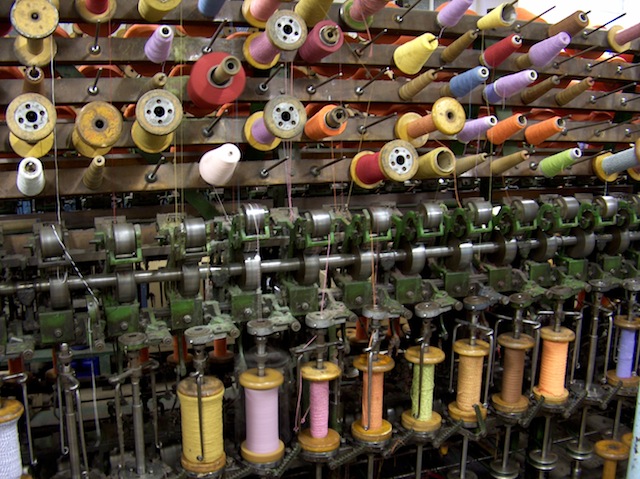
    Image of cotton threads on a weaving machine through jbeeby on sxc.hu

    Similar posts:

  • Open source manufacturing

    Open source manufacturing

    Chinese business website Caixin Online has a great video on China’s Open Source Hardware Movement, this is an area that promises to change the manufacturing industry.

    Open Source is the philosophy of sharing intellectual property and allowing anyone to improve the idea on the proviso they share their changes with the rest of the world.

    The hope is that open sourced products end up being more reliable than proprietary designs due to scrutiny from hundreds, or thousands, of reviewers.

    Until recently, open source has been largely restricted to the software world but now it’s moving into broader Engineering and manufacturing circles.

    As the Caixin video shows, the open source hardware movement is introducing geeks to a tool which many thought was dead – the soldering iron.

    I noticed this a week or so ago when I walked into a co-working space and found the lady I was meeting hunched over a soldering iron putting together a part for a quadcopter.

    Right now soldering parts to build quadcopters or game controllers is just the beginning, the really interesting things start when open source meets 3D printing – then we’ll see some real game changing things happen.

    Soldering iron picture courtesy of Bomazi through Wikimedia Commons.

    Similar posts:

  • Was the netbook the Trabant or Model T of the computer world?

    Was the netbook the Trabant or Model T of the computer world?

    Taiwanese technology website Digitimes reports Asustek have shipped their last eeePC netbooks, bringing to an end a product that promised to change the computing world when they were first released in 2007.

    At the time the eeePC netbook picked up on a number of trends – cheap hardware, the maturity of the open source Linux operating system, affordable wireless access and, most importantly, the accessibility of cloud computing services.

    There’d been a pent up demand for usable portable computers for years but Microsoft and their hardware partners consistently released clunky, overpriced tablet computers that simply didn’t deliver on their promises.

    For users wanting a cheap, fairly robust portable computer then netbooks were a good choice, at the price you could even risk having one eaten by lions.

    into the lions den with an Asus eeePC netbook

    Unfortunately for netbook a few things went against the idea.

    Customers don’t like Linux

    An early blow to the eeePC was that retail users don’t like Linux. Most computer users are happy with Windows and MacOS and weaning them off what they know is a very hard sell.

    Sadly on this topic I have first hand knowledge having suffered the pain of co-founding a business in the mid 2000s that tried to sell Linux to small businesses.

    Asustek discovered this when they found customers preferred the more expensive Windows XP version over the original Linux equipped devices.

    Unfortunately Microsoft’s licenses damaged the economics of the netbook and held the manufacturers hostage to Microsoft who, at the time, wasn’t particularly inclined to encourage customers to use cloud services.

    Manufacturer resistance

    Microsoft weren’t the only supplier unhappy with netbooks. Harry McCracken at Time Tech describes how chip supplier Intel worked against the products.

    For manufacturers, the netbooks were bad news as they crushed margins in an industry already struggling with tiny profits. However all of them couldn’t ignore the sales volumes and released their own netbooks which cannabilised their own low end laptop and desktop ranges.

    In turn this irritated the army of PC resellers who found their commissions and margins were falling due to the lower ticket prices of netbooks.

    The rise of the tablet

    The one computer manufacturer who stayed aloof from the rush into low margin netbooks was Apple who had no reason to rush down the commodity computing rabbit hole. It was Steve Jobs who launched the product that made netbooks irrelevant.

    “Netbooks aren’t better at anything… they are just cheaper, they are just cheap laptops” Jobs said at the iPad launch in January 2010.

    Immediately the iPad redefined the computer market; those who’d been waiting a decade for a decent tablet computer scooped the devices up.

    Executives who wouldn’t have dreamt of replacing their Blackberries with an iPhone, let alone using an Apple computer proudly showed off their shiny iPads.

    The arrival of the iPad in boardrooms and executive suites also had the side effect of kick starting the Bring Your Own Device movement as CIOs and IT managers found that their policy of Just Say No was a career limiting move when the Managing Director wanted to connect her iPad to the corporate network.

    Rebuilding PC margins

    Around the time of the iPad’s released the major PC manufacturers declared a detente over netbooks and joined Intel in developing the Ultrabook specification.

    Intel designed the Ultrabook portable computer specification

    The aim of the Ultrabook was to de-commodify the PC laptop market by offering higher quality machines with better margins.

    While the Ultrabook has worked to a point, competition from tablet computers and the demands of consumers who’ve been trained to look for sub $500 portables means the more expensive systems are gradually coming down to the netbook’s price points.

    Today’s Ultrabook will be next month’s netbook.

    For the PC manufacturers, the lesson is that computers have been a commodity item for nearly a decade and only savvy marketing and product development – both of which have been Apple’s strengths – is the only way for long term success in the marketplace.

    Those US based manufacturers who haven’t figured this out are only go to find that Chinese manufacturers – led by companies like Taiwan’s Asustek – will increasingly take the bottom end of the market from them.

    The car industry is a good comparison to personal computers in commoditisation – with the passing of the netbook, the question is whether we’ll remember the eeePC  as a Trabant, Model T Ford or a Volkswagen Beatle.

    Similar posts:

  • Bringing manufacturing home

    Bringing manufacturing home

    In the 1980s General Electric, like most US companies, sent most of its appliance manufacturing offshore.

    Now its coming home.

    The Atlantic Magazine looks at how General Electric is resuscitating manufacturing at Kentucky’s Appliance Park as management finds US workers are more skilled and productive than their equivalents in Mexico or China.

    An important part of the article is how critcal supply chains are; manufacturing hubs rely upon having a community of skilled service providers and suppliers around the factories while being close to customers improves and simplifies logistics.

    In the latter case, it now take hours or days to deliver products to customers’ stores or warehouses rather than the five weeks it takes from China.

    The cost of those goods is lower too, the Kansas made GeoSpring heater sells for $1299 while the Chinese product sells for $1599.

    What is most notable though is how designers and managers now have a better understanding of the manufacturing process; where under the oustourced model the difficulties in assembly were none of their business, now they are far more deeper and directly involved.

    This really goes to the core of what an organisation does – in the 1980s it was fashionable to talk of the “virtual corportation” where everything the business did was outsourced except for the managers who were employed solely to pocket their bonuses.

    In the 1990s and early 2000s that “virtual corporation” became a reality as manufacturing and customer support were offshored and logistics was outsourced.

    One of the best examples was customer support where looking after the needs of those who buy the company’s products were secondary to the need to cut costs.

    This focus on cost cutting over customer service hurt Dell badly in the 2000s and it continues to hurt many organisations – particularly telcos and banks – today.

    The weakness in the “virtual corporation” model was the company ended up adding little more value than the brand name and eventually those offshored manufacturers and call centres took control of the business’ goodwill and intellectual property.

    Eventually the hidden costs of offshoring became too obvious for even the most craven, KPI driven manager to ignore and suddenly manufacturing in the Western world became competitive again.

    Sadly, the fixation on dirt cheap labour has damaged many industries beyond the point where they can be salvaged with too many skilled workers lost and the ecosystem of capable suppliers destroyed. These are costs where tomorrow’s managers will rue the short sighted actions of yesterday’s corporate leaders.

    Similar posts: