Tag: media

  • Freebies and rorts

    Freebies and rorts

    Something went badly wrong in Samsung’s PR department last month as their strategy of engaging bloggers turned into a series of embarrassing arguments over control.

    First, a pair of Indian bloggers found themselves stranded at Berlin’s IFA 2012 fair after arguing with Samsung then French blogger France Quiqueré told of her similar encounter with Samsung’s control freakery at the London Olympics.

    Both encounters raise the issue of what is expected when a journalist or blogger is given a free trip to a conference or event.

    Freebies are always a difficult issue, the blogger or journalist is always going to be in a conflicted position and the organisation paying the bills has an interest in what they report.

    In an ideal world, we’d all follow Sarah Lacy’s example where no-one accepts freebies. The problem with that is that most media companies, let alone bloggers, don’t have the funds to attend high priced conferences in their own cities and going to one half way across the world is out of the question if someone else doesn’t pay.

    Sarah’s journalist model works fine when you have a well funded operation like Pando Daily’s VC investors or someone prepared to work for nothing – the digital sharecropper model.

    With the collapse of newspaper revenues, most media companies long ago gave up their ethical objections to accepting paid trips to conferences – in sections like travel, tech and motoring the freebie has been well established for decades.

    Basically, if event organisers didn’t pay the bills for journalists and bloggers their conferences or product launches won’t get much media attention because most of the reporters simply couldn’t afford to attend.

    This is simple economics and where disclosure comes in. If a blogger or reporter has been given free travel or accommodation so they could attend an event then readers should be told.

    What really matters in all of this are the audience and the reporter’s ethical compass. If the readers or viewers can trust and value what reporters produce and in turn the reporters are comfortable within their own moral boundaries then everyone is a winner.

    The danger is getting the balance wrong. If readers lose trust, PR people start taking liberties (as Samsung tried to do) or bloggers and journalists are uncomfortable with what they do then it’s time to stop doing it.

    One quick way to destroy credibility is for PR managers to expect those blogger to act like performing monkeys in return for ‘winning’ a competition or believing that ferrying a journalist to an event will guarantee fawning coverage.

    Any decent journalist or blogger who respects themselves and their audiences won’t do that, if only because it will damage their brand or career prospects. This is the lesson Samsung have learned.

    For the record, I do accept freebies and disclose them at the bottom of any related blog posts. If an investor would like to bankroll a down under Pando Daily, you know where to contact me.

    Similar posts:

  • Mosquitoes of the Internet

    Mosquitoes of the Internet

    Sydney Morning Herald urban affairs columinst Elizabeth Farrelly recently fell foul of one the big fish that inhabits the shallow, stagnant intellectual pond that passes for Australia’s right wing intelligentsia.

    As a result, Elizabeth found her personal blog infested with insulting comments from the Big Fish’s Internet followers.

    What focused their ire was Elizabeth complaining about a delivery truck parked across a bike lane. A bit like this genius.

    The funny thing with the righteous defence of the poor truck driver’s rights to privacy and blocking cycleways is where it the driveways to the gated communities for self-righteous and entitled self retirees that these commenters inhabit were blocked in a same way many of them would be reaching for the blood pressure pills.

    One of the great things about the Internet is that it allows all of us to have our say without going through the gatekeepers of the newspaper letters editor or talkback radio producer.

    The down side with this is that it gives everyone a voice, including the selfish and stupid – the useful idiots so adored by history’s demagogues.

    Luckily today’s Australian demagogues aren’t too scary and the armies of useful idiots they can summon are more likely to rattle their zimmer frames than throwing Molotov cocktails or burning the shops of religious minorities.

    Most of these people posting anonymous, spiteful and nasty comments are really just cowards. In previous times their ranting and bullying would be confined to their family or the local pub but today they have a global stage to spout their spite.

    These people are the irritating mosquitoes of the web and they are the cost of having a free and vibrant online society.

    It’s difficult to have a system where only nice people with reasonable views that we agree with can post online. All we can do is ignore the noisy idiot element as the irritations they are.

    This is a problem too for businesses as these ratbags can post silly and offensive comments not just on your website but also on Facebook pages, web forums and other online channels.

    Recently we’ve had a lot of talk about Internet trolls, notable in the discussion is how the mainstream media has missed the point of trolling – it’s about getting a reaction from the target. In that respect The Big Fish and his army of eager web monkeys have succeeded.

    The good thing for Elizabeth is her page views will have gone through the roof. That’s the good side of having the web’s lunatic fringe descend upon your site.

    Similar posts:

  • Driving agendas

    Driving agendas

    A feature of the new question and answer service Branch are “featured questions” highlighting popular or interesting conversations on the service.

    One of those early featured conversations was a question from investor Michael Arrington, “when is it good for founders to leak stuff to the press?”

    Strategic leaks have become the staple of most news services, time poor journalists are desperate for scoops and clicks which gives an opportunity for companies and governments to feed information that suits their agenda of the moment.

    As the answers in the thread indicate, this style of reportage is very common in the Silicon Valley tech press. The greater fool business model of many web start ups require they get lots of media coverage in order to attract buyers.

    That media coverage includes ‘leaking’ stories that one big company – a Google, Microsoft or Facebook – is interested in the business. This always creates credulous headlines on the tech media sites and one of these leaks prompted Arrington’s question.

    Strategic leaking isn’t just a tech media phenomenon. Australian politics was paralysed at the beginning of the year when numerous stories that “un-named Labor Party sources” were plotting against the Prime Minister dominated the headlines for weeks. All of these were pointless leaks from various minor politicians try to push their agendas. Often to their long term detriment.

    In the sports world the agendas often revolve around contract negotiations – remember this next time you read that a star player may be going to another team, almost certainly that story has been planted by that player’s agent in an attempt to increase his client’s value.

    The same thing happens in the business, property and the vacuous entertainment, travel and dining pages.

    Agenda driven journalism fails the reader and the writer, it also damages the publication as once readers start asking what the motivation is for a story, then the credibility of that outlet is failing.

    Increasingly this is happening to all the mainstream publications.

    Resisting the push to agenda driven journalism is tough as editorial resources are stripped from media organisations and as journalists come under more pressure to write stories that drive traffic.

    One of the great assets of big media is trust in the masthead. A hundred years ago people took what was written in their city’s newspapers as truth, a few decades ago it was what was on the evening news. If Walter Cronkite or your city’s news anchor said it was true, then that was good enough for most people.

    In the race for clicks, that trust has been abused and lost by all but the most dedicated fans. It’s probably the greatest loss of all for the established media giants.

    For readers, the web and social media is their friend. They can check with their peers to see if a story stands up and if it doesn’t they can spread this across their networks.

    Agenda driven journalism fuelled by pointless leaks helps no-one in the long term and it will probably kill many established mastheads. It’s another opportunity for smart entrepreneurs to disrupt a market that’s failing.

    Similar posts:

  • Good critic, bad artist?

    Good critic, bad artist?

    With the passing of art critic Robert Hughes I’m re-reading a passage of his autobiography, Things I Didn’t Know.

    In Hughes’ passage describing his leaving Australia he talks of attempts at painting and makes an observation about art criticism that is true of every field.

    “You do not have to be a good painter to be a good art critic,” he said. “But there is, to me, something a little suspect about an art critic who has never painted and who cannot claim to grasp even the rudiments of intelligent drawing.”

    The same could be said of any critic – knowing the technicalities, skills, difficulties and effort enables a critic to make informed judgement. That isn’t to say they are superior at their trade than those they criticise.

    It’s been said that we are all two bad decisions from ruining our lives or careers. That’s true in the artistic or professional fields – many managers, entrepreneurs, politicians, artists or just men going through middle aged crises have come unstuck from making the wrong choice at the wrong time.

    It’s why we always have to view the stories of great success with caution, as the winners’ tales are tinged with survivor bias and for every winner there a field of skilled, hard working people who didn’t succeed.

    In some fields, like arts and sport, the winners have to have skills before they will even get a chance of winning. Although there are many who could have be successful but weren’t because they never had an opportunity to pick up a paintbrush, guitar or ball at a key moment in their lives.

    That isn’t quite so true in more subjective fields like business, politics or journalism. In those callings it is possible for a suburban apparatchik, dour accountant or talentless hack to rise because of their mentors, rat cunning or just pure dumb luck.

    One of a critic’s roles is to call out those talentless but lucky hacks and in doing so they do society a great favour.

    In a world where spin and PR often trump good policy or ethical behaviour, we have to pay attention to the informed critics who help us filter out the misinformation and lies that is part of our information diet.

    Similar posts:

  • Saving Fairfax

    Saving Fairfax

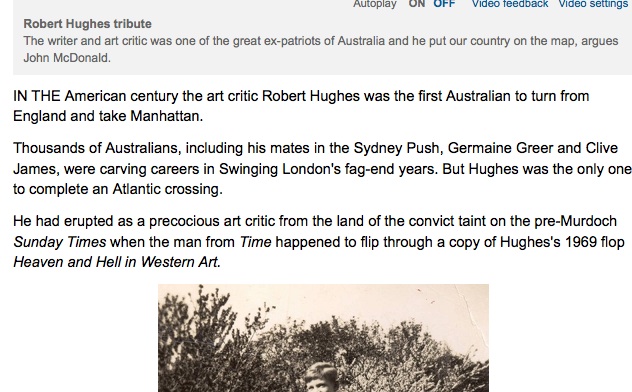
    The writer and art critic was one of the great ex-patriots of Australia and he put our country on the map.”

    One typo illustrates all that is wrong with Australia’s two oldest newspapers, The Age and The Sydney Morning, who are both part of the Fairfax stable.

    It’s particularly disappointing that one of the leading newspapers in the city of Hughes’ birth could have such a dumb typo, but adding to the insult is the paper’s underwhelming and disappointing coverage as compared to the New York Times, the paper of his adopted home town.

    Hughes was one of many in his generation left Australia because of the lack of opportunity. Fellow expatriate (note the spelling) Clive James said he could have never have developed his writing skills without the sharp editing his copy was subjected to at London’s newspapers. That is as true today as it was in 1960.

    Poor editing lies at the core of Fairfax’s problems, not just in silly typos but also with inappropriate stories like leading with a shop assistant’s Facebook profile or the hysterical regurgitation of spin doctor’s talking points.

    This isn’t to pick on Roy Masters and Asher Moses, both are capable of great work — Asher’s Digital Dreamers series profiling Australian technology expatriates (that word again) was excellent work and when Roy doesn’t get sucked into the petty ego wars that dominate Sydney’s Rugby League community his sports writing can match the world’s best.

    Both Roy and Asher, along with every other journalist at Fairfax, are let down by poor editors who don’t have the balls to tell them when work isn’t up to standard, let alone pick up dumb typos.

    If Fairfax is to survive, it requires strong and good editors that are prepared to hold their writers accountable and back them when the going gets tough. Right now Fairfax lacks those leaders.

    That lack of leadership extends throughout the organisation’s management and board. Fairfax’s management lacks people committed to delivering a great product or capable of grappling with the challenges of making online journalism pay.

    Making online journalism pay is more than just having one-way Twitter accounts, plastering your site with ads or irritating your users with auto playing video clips. Web strategist Jim Stewart dissects how these tactics aren’t working for Fairfax.

    Whoever figures out how to make money from online journalism will be the Randolph Hearst of the 21st Century, currently it’s safe to say there are no budding Hearsts or Murdochs among the comfortable ranks of Fairfax’s management.

    Similar posts: