Tag: media

  • Irrelevance and the media

    Irrelevance and the media

    It’s a shame we weren’t around when dinosaurs became extinct. Then again, maybe we are.

    News Limited business commentator Terry McCrann writes about the “Bleakest of views from the shopfronts” in his Sunday column describing the problems of retail.

    All of the problems Terry cited are from big retailers – Woolworths, Dick Smith, Harvey Norman and JB HiFi. To make it clear he was talking about corporate issues there’s even a reference to General Motors.

    Nowhere does Terry talk about smaller businesses or those challenging the big guys, folk like Ruslan Kogan or the Catch of the Day team. It’s all about the big end of town.

    Terry’s article illustrates the problem of relying on incumbent mainstream media commentary; that it is Big Media talking about Big Business and Big Government.

    “Small”, “ordinary” or “average” has no place in their conversation, if you can call the pronouncement of mainstream media commentators a conversation at all.

    We can understand this – for a journalist, it’s good for the ego and career to look like a “heavy hitter” in big business. For the politician, small business and community groups can’t pay the speaking and consulting fees paid by corporations to supplement their meagre retirement benefits.

    Increasingly what happens in the corporate board rooms or the once smoke filled rooms of political caucuses is out of touch with the real world.

    This has become particularly acute since the responses to the 2008 crash proved to the management classes that their bonuses and perks will be protected by government bailouts regardless of how many billions of shareholder wealth they manage to destroy.

    In the United States we see this in political controversies being focused on contraception – an issue settled forty years ago – while the country faces fundamental challenges to its economic base and the basic welfare of its citizens and industries.

    While in Australia the media ‘insiders’ rabbit on about pointless internal party politics and soothing articles on how everything else is fine, we just need to be more optimistic. Yet the real questions about how we take advantage of the country’s greatest export boom, position the economy for the next 50 years and the nation’s dependence on the Chinese economy are being ignored.

    Terry McCrann’s story is emblematic of just how out of touch Big Media, and their friends in Big Business and Big Government, are with the real world.

    All we can do is let them get on with it and not take them too seriously.

    Similar posts:

  • Is Twitter’s censorship a good thing?

    Is Twitter’s censorship a good thing?

    Since Twitter announced they were going to start blocking messages on a country by country basis if required by the laws of that land they have received a lot of criticism.

    Most of this criticism of Twitter revolves around the belief that every message should only edited or deleted by the person who posted the tweet.

    Anything else a breach of free speech and a threat to the underlying principles of the internet.

    That utopian view of the Internet doesn’t translate into real life; the online world is as subject to laws as any other part of life and social media companies have to comply with the same laws as newspaper organisations or fast food chains.

    Regardless of what you think of those laws – and in many countries they certainly are unreasonable and oppressive – they do matter.

    Were Twitter not to comply then the entire service would be at least blocked in those countries and, should an action be enforced in a US court, then the tweet removed anyway for every user around the world.

    By introducing country specific blocking, the service can let the rest of the world see a tweet that would otherwise be lost and in countries with restrictive or authoritarian laws, local people can still use the service.

    A particularly clever way of dealing with removal requests is to note that the specific message has been blocked in a country. This adds a level of transparency and accountability to the actions of courts and governments that want to close the service.

    We can see that being particularly effective in jurisdictions like the UK where British judges have been quick to apply “superinjunctions” preventing the merest mention of something by anybody.

    Should Britain’s overeager judges start demanding Twitter block tweets, those in the UK will quickly realise something is amiss. The effect will probably be to increase the interest in the blocked tweets that can be seen anywhere around the world.

    Despite the utopian view that transparency and openess will solve the world’s problems, we don’t live in that world right now and people can – rightly or wrongly – ask that false, defamatory and damaging posts on the Internet can be removed.

    Interestingly Google this morning announced they will be introducing a similar system to deal with country specific problems on their blogger platform.

    Twitter’s handled this in the best way possible, in many ways this could be a step forward for social media and the Internet in general.

    Similar posts:

  • Exposure exposed

    Exposure exposed

    A few years back a client of mine was delighted to receive a phone call from a television producer offering exposure for his business on a national TV program.

    The offer was Jeff, who is a builder, would donate his company’s work to a television home improvement show and in return Jeff’s business would get a mention in the credits as well as some coverage in the program.

    Jeff agreed, had new t-shirts for his labourers printed and they did three days work helping celebrity gardeners refurbish a backyard.

    The guys had a ball, the labourers chatted up the presenter and the pretty production assistants and for a day or so Jeff felt like he was in Hollywood.

    A few weeks later the show went to air – there were a couple of glimpses of Jeff’s guys doing stuff and if you were quick with the freeze button you could pick out part of Jeff’s business name and phone number.

    When the show finished, Jeff’s business appeared for a split second which was difficult to read if you were lightning fast with the remote control. Not a great return for several thousand dollars of labour and materials.

    That was an expensive lesson for Jeff.

    Recently I heard of a business that was asked to contribute some of products to a newspaper – they wanted an ongoing commitment that would cost the business quite a bit of money.

    For the newspaper this is a great deal – they tie in a promotion for their readers that costs them nothing. The business is left out of pocket with little upside except for some “exposure” of dubious value.

    We see this repeated every day by dozens of businesses being seduced into offering fat discounts for group buying sites. The salesman’s spiel is that a prominent offer will get exposure on their email that goes out to thousands of people.

    Most of these promises are nonsense; giving away your time or work for free is the most expensive thing a business can do and if it’s going to work it has to be part of a strategic plan.

    It’s been said all publicity is good publicity, but that’s not really true if there’s no return on a substantial effort.

    Blindly giving things away in the hope of getting some free publicity isn’t a good business practice and those who urge you to do so aren’t acting your best interests as Jeff learned.

    Similar posts:

  • Book review: The Information Diet

    Book review: The Information Diet

    We all know a diet of fast food can cause obesity, but can consuming junk information damage our mental fitness and critical faculties?

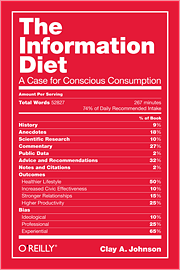
    In The Information Diet, Clay A. Johnson builds the case for being more selective in what we read, watch and listen to. In it, Clay describes how we have reached the stage of intellectual obesity, what constitutes a poor diet and suggests strategies to improve the quality of the information we consume.

    The Information Diet is based upon a simple premise, that just as balanced food diet is important for physical health so too is a diverse intake of news and information necessary for a healthy understanding of the world.

    Clay A. Johnson came to this view after seeing a protestor holding up a placard reading “Keep your government hands off my Medicare.” Could an unbalanced information diet cause a kind of intellectual obesity that warps otherwise intelligent peoples’ perspectives?

    The analogy is well explored by Clay as he looks at how we can go about creating a form of “infoveganism” that favours selecting information that comes as close from the source as possible

    Just as fast food replaces fibre and nutrients with fat, sugars and salt to appeal to our tastes, media organisations process information to appeal to our own perceived biases and beliefs.

    Clay doesn’t just accuse the right wing of politics in this – he is as scathing of those who consider the DailyKos, Huffington Post or Keith Olbermann as their primary sources as those who do likewise with Fox News or Bill O’Reilly.

    The rise of opinion driven media – something that pre-dates the web – has been because the industrial production of processed information is quicker and more profitable that the higher cost, slower alternatives; which is the same reason for the rise of the fast food industry.

    For society, this has meant our political discourse has become flabbier as voters base decisions and opinions upon information that has had the facts and reality processed out of it in an attempt to attract eyeballs and paying advertisers.

    In many ways, Clay has identified the fundamental problem facing mass media today; as the advertising driven model requires viewers’ and readers’ attention, producers and editors are forced to become more sensationalist and selective. This in turn is damaging the credibility of these outlets.

    Unspoken in Clay’s book is the challenge for traditional media –their processing of information has long since stopped adding value and now strips out the useful data, at best dumbing down the news into a “he said, she said” argument and at worse deliberately distorting events to attract an audience.

    While traditional media is suffering from its own “filter failure”, the new media information empires of Google, Facebook, Apple and Amazon are developing even stronger feedback loops as our own friends on social media filter the news rather than a newsroom editor or producer.

    As our primary sources of information have become more filtered and processed, societal and political structures have themselves become flabby and obese. Clay describes how the skills required to be elected in such a system almost certainly exclude those best suited to lead a diverse democracy and economy.

    Clay’s strategies for improving the quality of the information we consume are basic, obvious and clever. The book is a valuable look at how we can equip ourselves to deal with the flood of data we call have to deal with every day.

    Probably the most important message from The Information Diet is that we need to identify our biases, challenge our beliefs and look outside the boxes we’ve chosen for ourselves. Doing that will help us deal with the opportunities of the 21st Century.

    Clay A. Johnson’s The Information Diet is published by O’Reilly. A complimentary copy was provided as part of the publisher’s blogger review program.

    Similar posts:

  • Successful Sources Will Not Be Paid

    Successful Sources Will Not Be Paid

    The whole world wants a freebie, and many of us are giving our ideas, intellectual capital and service away to online magazines in the hope of getting a link or a little bit of publicity.

    Bringing the idea undone is the unfortunate reality that web is awash with free pointless material that adds little value. Your contribution, however valuable, gets lost in the static of PR driven articles and SEO optimised fluff.

    This is why Google are trying to tie social recommendations into their search results, although it’s hard to see how your cousin’s LOLCat posts are going to add any more value than the generic garbage served from services like eHow.

    Yet every day there’s more callouts for  free content – desperate journalists and publishers beg for our ideas or labor in return for some ‘exposure’.

    And that ‘exposure’ floats away into the ocean of noise and irrelevance filled with the rest of the ‘free’ content.

    Giving stuff away for free isn’t working well anymore and for those of us who are trying to build a business around that model, we’re struggling to get found or heard in the morass.

    Along with the wasted time, the danger is we start giving away our best, most valuable work in order to get attention and then we have nothing left to sell.

    Consumers are waking up to this and beginning to focus about what they read online. We should too.

    Similar posts: