Tag: politics

  • The battle between the old and the new

    The battle between the old and the new

    “We will build an America where ‘hope’ is a new job with a paycheck, not a faded word on an old bumper sticker” – Mitt Romney, US Republican Presidential candidate

    “What immediate measures can be taken to protect jobs?”French President Nicolas Sarkozy

    “We want to be countries that made cars” – Kim Carr, Australian Minister for Manufacturing

    Around the world the forces of protectionism are stirring to shield fading industries, businesses and fortunes from economic reality.

    The most immediate target in this battle are the new industries that threaten the old.

    It’s no coincidence US lawmakers want to introduce laws that will cripple the Internet in order to favour music distributors, that the US and New Zealand governments work together to shut down a cloud sharing service or that failing Australian retailers call on their government to change tax rules in order to prop up their fading sales.

    The old industries appear to have the advantage; they are rich, they have political power and – most importantly for politicians – they employ lots of voters.

    We shouldn’t under estimate just how far the managers and owners of the challenged industries will go to protect their failing business models, unwanted product lines and outdated work methods, which isn’t surprising as their wealth and status is built upon them.

    Eventually they will lose, just as the luddites fighting the loom mills and the lords fighting the railway lines did.

    The question for society and individuals is do we want to be part of yesterday’s fading industries or part of tomorrow’s economy.

    We need to let our political leaders know where we’d our societies to go before they make the wrong choices.

    Similar posts:

  • Book review: The Information Diet

    Book review: The Information Diet

    We all know a diet of fast food can cause obesity, but can consuming junk information damage our mental fitness and critical faculties?

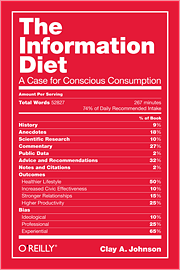
    In The Information Diet, Clay A. Johnson builds the case for being more selective in what we read, watch and listen to. In it, Clay describes how we have reached the stage of intellectual obesity, what constitutes a poor diet and suggests strategies to improve the quality of the information we consume.

    The Information Diet is based upon a simple premise, that just as balanced food diet is important for physical health so too is a diverse intake of news and information necessary for a healthy understanding of the world.

    Clay A. Johnson came to this view after seeing a protestor holding up a placard reading “Keep your government hands off my Medicare.” Could an unbalanced information diet cause a kind of intellectual obesity that warps otherwise intelligent peoples’ perspectives?

    The analogy is well explored by Clay as he looks at how we can go about creating a form of “infoveganism” that favours selecting information that comes as close from the source as possible

    Just as fast food replaces fibre and nutrients with fat, sugars and salt to appeal to our tastes, media organisations process information to appeal to our own perceived biases and beliefs.

    Clay doesn’t just accuse the right wing of politics in this – he is as scathing of those who consider the DailyKos, Huffington Post or Keith Olbermann as their primary sources as those who do likewise with Fox News or Bill O’Reilly.

    The rise of opinion driven media – something that pre-dates the web – has been because the industrial production of processed information is quicker and more profitable that the higher cost, slower alternatives; which is the same reason for the rise of the fast food industry.

    For society, this has meant our political discourse has become flabbier as voters base decisions and opinions upon information that has had the facts and reality processed out of it in an attempt to attract eyeballs and paying advertisers.

    In many ways, Clay has identified the fundamental problem facing mass media today; as the advertising driven model requires viewers’ and readers’ attention, producers and editors are forced to become more sensationalist and selective. This in turn is damaging the credibility of these outlets.

    Unspoken in Clay’s book is the challenge for traditional media –their processing of information has long since stopped adding value and now strips out the useful data, at best dumbing down the news into a “he said, she said” argument and at worse deliberately distorting events to attract an audience.

    While traditional media is suffering from its own “filter failure”, the new media information empires of Google, Facebook, Apple and Amazon are developing even stronger feedback loops as our own friends on social media filter the news rather than a newsroom editor or producer.

    As our primary sources of information have become more filtered and processed, societal and political structures have themselves become flabby and obese. Clay describes how the skills required to be elected in such a system almost certainly exclude those best suited to lead a diverse democracy and economy.

    Clay’s strategies for improving the quality of the information we consume are basic, obvious and clever. The book is a valuable look at how we can equip ourselves to deal with the flood of data we call have to deal with every day.

    Probably the most important message from The Information Diet is that we need to identify our biases, challenge our beliefs and look outside the boxes we’ve chosen for ourselves. Doing that will help us deal with the opportunities of the 21st Century.

    Clay A. Johnson’s The Information Diet is published by O’Reilly. A complimentary copy was provided as part of the publisher’s blogger review program.

    Similar posts:

  • What businesses should learn from Wikileaks

    What businesses should learn from Wikileaks

    The Wikileaks Cablegate affair has been entertaining us now for two weeks as we see diplomats and politicians around the world squirming with embarrassment as we learn what US diplomats really think about the foreign powers they deal with.

    Both the leak of the cables and the treatment of Wikileaks and its founder, Julian Assange, by various Internet companies raises some important questions about the Internet, cloud computing and office security in the digital era.

    Security

    It’s believed the source of the leaked cables is Private First Class Bradley Manning, who is alleged to be responsible for leaking the Iraq tapes released by Wikileaks earlier this year.

    The lesson is don’t give junior staff unrestricted access to your data, access to important information such as bank account details, staff salaries and other matters best kept confidential needs to be protected.

    You can stop data leaving the building by locking USB ports, CDs and DVDs through either software or hardware settings on your computers and you should ask your IT support about this, keep in mind that locking down systems may affect some of your staff’s productivity.

    Locking the physical means though doesn’t stop the possibility of data being sent across the Internet and access logs may only tell you this has happened after the fact. So it’s important to review your organisation’s acceptable use policy. Check with your lawyers and HR specialists that your staff are aware of the consequences of accessing company data without permission.

    Incidentally, the idea that Pfc Manning was just one US Army staffer of thousands who were able to access these cables raises the suspicion that the information Wikileaks is now releasing was long ago delivered to the desks of interested parties in London, Moscow, Tel Aviv, Beijing and cave hideouts in remote mountain ranges.

    Don’t rely on one platform

    Wikileaks found itself hounded from various web hosting and payment providers. As we’ve discussed previously, relying on other people’s services to deliver your product raises a number of risks. Make sure you have alternatives should one of your service providers fail and never allow an external supplier to become your single point of failure.

    Concerns about the cloud

    This column has been an unabashed fan of cloud computing, but the Wikileaks saga shows the cloud is not necessarily secure or trustworthy. Not only is there the risk of a PFC Manning working at the data center compromising your passwords or data, but the arbitrary shutdown of Wikileaks’ services is a stark lesson of relying on another company’s Terms of Service.

    Within most terms of service are clauses that allow the provider to shut down your service if you are accused of breaking the law or straying outside of the providers’ definition of acceptable use. As we saw with Amazon’s treatment of Wikileaks, you can be cut off at any time and without notice.

    Amazon’s shutting down of Wikileaks is a pivotal point in the development of cloud services. Trust is essential to moving your operations to the cloud, and Amazon’s actions shown much of that trust may be misplaced.

    Should you be considering moving to the cloud, you’ll need to ensure your data and services are being backed up locally and not held hostage to the arbitrary actions of your business partner.

    Don’t put your misgivings in writing

    So your business partner is a control freak? Great but don’t put it in writing.

    Be careful of gossip and big noting

    One interesting aspect of Wikileaks to date is how senior politicians like gossip and showing how worldly they are to US diplomats.

    That’s great, but it probably isn’t a good idea to tell your best friend they should consider beating up your most important customer. As mentioned earlier, this little gem was probably on polished desks of the Chinese Politburo long before the cables found their way to Wikileaks.

    Resist the temptation to gossip, remember your grandmother’s line about not saying anything if you can’t say something nice.

    Ultimately what Wikileaks shows us is all digital communications are capable of being copied and endlessly distributed. In a digital economy, the assumption has to be that everything you do is likely to become public and you should carry out your business conduct as if you will be exposed on Wikileaks or the six o’clock news.

    Wikileaks is a lesson on transparency, we are entering an era of accountability and the easiest way to deal with this is to be more honest and open. That’s the big lesson for us in our business and home lives.

    Similar posts:

  • The end of the troll

    The end of the troll

    Australian union leader Paul Howes today claimed in Sydney’s Daily Telegraph that New Media is denigrating politicians. His point being anonymous users on newspaper websites (such as the one he writes for) and online services like Twitter encourage abuse and slander which is degenerating politics and media discussion.

    The rough and tumble of the Internet was raised during the Canberra Media140 conference last September where conversation turned around Liberal politician Joe Hockey’s comment that anonymous, banal tweets was causing him to lose faith in online services like Twitter.

    Media140 provided more discussion about anonymity when The Australian decided to out the anonymous blogger Grogs Gamut, aka Greg Jericho. Greg wasn’t being abusive however his commentary had clearly found its way under the skin of some members of the Canberra political classes.

    But does anonymity matter?  We are kidding ourselves if we believe we are truly anonymous on the Internet. Few of us have the skills or diligence to fully hide our tracks from people we offend or upset.

    Anonymity also discredits much of a person’s statements – as both Paul and Joe have pointed out, if you aren’t prepared to put your name to your views then there is a good argument that your opinions are really worthless.

    However that argument ignores the power imbalance between the ordinary citizen who may find their career at risk by stating their views, as Greg Jericho found, and politicians and those working for political parties or allied organisations, like Joe and Paul who are protected by powerful and often tribally loyal party structures, PR machines and compliant journalists.

    Probably the part that’s most disingenuous though about Paul Howes’ article is that anonymous Internet commenters are dragging politicians down. Sadly our politicians did that job themselves long before social media or web2.0 based websites came on the scene.

    Today’s politicians are only reaping what they have sown themselves. Paul and Joe’s mentors – people like Graham Richardson, John Howard and Bob Carr – went out of their way to pander to and encourage the shrill, anonymous harridans of talkback radio.

    Unfortunately for today’s politicians, the Internet doesn’t have the same gatekeepers in the form of friendly announcers, producers and editors to save them from the public’s genuine, unfiltered opinions.

    The fact many of those anonymous comments – whether online or in more traditional media channels – may be true is another thing to consider; that people genuinely believe these politicians are doing the wrong thing. Rightly or wrongly, is that the fault of the Internet, or the fault of those politicians and their advisors who claim to have wonderful communication skills?

    Internet anonymity is not perfect, and often not right, but the privilege of being able to make an anonymous statement is a fundamental part of a working democracy.

    It’s not surprising our current generation of spin-doctored, on-message politicians feel threatened by a medium they struggle to understand or control, but that isn’t the fault of the anonymous online troll who could turn out to be what ultimately saves our democracy.

    Similar posts:

  • How broadband won the Australian election

    How broadband won the Australian election

    In a dour and negative Australian election campaign, the National Broadband Network was the one issue separated the look alike policies of the two major parties. In the end, it decided the election.

    Privately developed communications networks are rare in the nation’s history for a combination of factors including Australia’s population distribution and commercial appetites for investment risk.

    Australian governments have always been critical to the development of regional communications, from the establishment of state operated railway networks, through the post office owned telegraph and telephone networks and eventually the road system.

    So the National Broadband Network is typical of Australian communications development where the government provides the infrastructure framework and the private sector grows around it.

    There’s no doubt regional communities understood the importance of being connected to the global economy, successive Federal governments have struggled with a patchwork of government programs such as the Universal Service Obligation and Broadband Connect in an effort to guarantee some level of service for all Australian communities.

    The NBN itself was conceived in the realisation that any solution that relied wholly on private funding was not going to deliver a national solution. This was view that regional organisations such as Digital Tasmania had held all along when agitating for their communities not being left behind.

    And Tasmania was were the vote mattered, the coalition failed to win any Tasmanian seats where three would have been won had the state followed the rest of the nation. Those three seats; Bass, Franklin and Braddon would have been enough to give the Liberal and National Parties power.

    Had the coalition focussed on the legitimate criticisms of the NBN such as the government’s failure to quantify the $43 billion price tag or NBNCo’s failure to produce a business plan then they may well have won the election.

    As the country Independents stated, the NBN was one of the key considerations in their decision to support the Labor government, so not getting their NBN policy right cost the coalition government in two ways.

    Now the NBN is going ahead we need to focus on what it can deliver, along with a sensible discussion on the right mix of fibre and wireless infrastructure, the proportion of private and public investment and exactly how much the project is going to cost.

    Now is the time to get on with building what will be the 21st Century equivalent of the roads and railways of the 20th and 19th Centuries.

    Similar posts: