Tag: politics

  • Economics for the ordinary person

    Economics for the ordinary person

    “95% of economics is common sense” says economist Ha-Joon Chang in his book The Little Blue Book — Five Things They Don’t Tell You About Economics.

    In a presentation at this year’s RSA conference Chang explains some of the underlying themes of his book, particularly the point that the various schools of economics theory are based on their own sets of cultural assumptions and that every group struggles to explain the world, especially when asked to fit Singapore into their models.

    Chang’s five points are a call for the average person to understand economics and be prepared to challenge the orthodoxies being trundled out by business and political leaders.

    You should be willing to challenge professional economists (and, yes, that includes me). They do not have a monopoly over the truth, even when it comes to economic matters.

    As economists have been allowed to become the high priests of modern society — or possibly the court jesters of the corporatist world — it may well be time to challenge them.

    Similar posts:

  • Technology’s Ayn Rand fallacy

    Technology’s Ayn Rand fallacy

    Adam Curtis in his wonderful BBC series All Watched Over By Machines of Loving Grace discusses how Ayn Rand influenced many in the tech industry.

    Having been accused of being a ‘techno-utopist’ Curtis’ story is a good reminder of the limits of technology and how the future doesn’t usually turn out how we imagine.

    The Ayn Rand influence is worth reflecting on as Rand’s libertarian outloook is shared by many in the technology industry – from the lowest PC technician to the highest flying software mogul.

    Rand’s beliefs are best portrayed in her own words, in a 1958 interview with Mike Wallace she tells of how she believes in “challenging the moral code of altruism.”

    In Rand’s world view it was the duty of each man to achieve their own happiness, self sacrifice and caring for other is weakness.

    That technologists should have those views is curious in that the entire computer industry, the internet and Silicon Valley itself is the result of massive US government spending during World War II and the Cold War.

    An more delicious irony is the centre of Silicon Valley, Stanford University, is itself the result of a bequest by railroad tycoon and former Californian governor Leland Stanford.

    So self-sacrifice, altruism and government spending forms the basis of the entire modern tech industry – something that computer industry’s libertarians ignore, if they are conscious of history at all.

    An even bigger contradiction is the belief that the internet dismantles government and corporate power – one of the lessons of Edward Snowden’s revelations is how comprehensively intelligence agencies monitor online communications.

    When the history of Silicon Valley and the 21st Century tech boom is written, one of the compelling themes will be the contrast between the industry’s beliefs and reality.

    The final chapters of that history will describe how that contrast between reality and beliefs is resolved.

    Similar posts:

    • No Related Posts
  • Building smart cities

    Building smart cities

    What will the connected cities of the 21st Century look like and how will they provide service for even their most disadvantaged residents?

    The latest Decoding the New Economy Video features an interview with Antoni Vives, Deputy Mayor of Barcelona, about his community’s journey to become a smart city.

    What’s striking about talking with Antoni is how passionate he is about Barcelona’s future and the importance of the city building new industries around the digital economy.

    Particularly notable is the administration’s vision for the city which combines Barcelona’s traditional industries, such as the port, with future technologies.

    “Barcelona has to become a city of culture, creativity, knowledge but mainly fairness and well being,” says Antoni when asked on where he sees his city as being in ten years time. “I would love to see my city as a place where people live near where they work, I would love to see the city self sufficient in energy and it should be zero emission city.”

    “Rather than having a pattern of PITO –  ‘Product In, Trash Out’ we should move to what we call the DIDO model – ‘Data In Data Out’.”

    It’s a broad view for the future which many other city and state governments will be watching closely.

    Similar posts:

    • No Related Posts
  • Facebook and the Fax Machine

    Facebook and the Fax Machine

    The South China Morning Post reports the Chinese government is allowing access to otherwise restricted sites like Facebook to those in the Shanghai free trade zone.

    In many ways this parallels the original Special Economic Zones set up by the People’s Republic of China at the beginning of the 1980s – these areas’ separate legal, immigration and economic status attracted foreign investment and trigged the economic boom that’s seen China become one of the world’s biggest economic powers.

    Just as manufactured goods were the key to the nation’s development 30 years ago, today it’s information as the PRC leadership works on moving China up the global value chain.

    For a nation of knowledge workers to succeed, the workers have to have access to knowledge.

    It’s claimed the humble fax machine was responsible for the fall of the Soviet Union, how true that is open to debate but an open flow of information is never good for those who rule without the support of their citizens.

    With the explosion of Chinese social networking sites, it’s become harder for the government to control the flow of information between citizens and the opening of the internet in parts of Shanghai is another small change.

    How the Chinese Communist Party manages to keep the support of its increasingly affluent and better informed citizens will define the course of 21st Century history.

    As China shifts from being a low cost manufactured goods supplier to a more sophisticated, diverse and expensive economy the government has no choice to face these challenges.

    Beijing’s cadres would be hoping our children aren’t talking about Facebook in 2012 Shanghai in the same way that we talk of fax machines in 1982 Leningrad.

    Image of a fax machine courtesy of Kix through sxc.hu

    Similar posts:

    • No Related Posts
  • Solomon Lew and Australia’s perfect storm

    Solomon Lew and Australia’s perfect storm

    One of Australia’s leading retailers, Solomon Lew, joined the conga line of business whiners this week with complaints that the recently departed Labor government had been bad for his industry.

    Yesterday I posted an interview with Susan Olivier of Dassault Systemes about how the retail and fashion industries – Solomon Lew’s businesses – are being radically changed by technology and changing consumer behaviour.

    Lew, along with most Australian retailers, has completely missed these changes and instead remained focused on their 1980s model of screwing down suppliers while charging customers high prices for poor goods and substandard service.

    Now that 1980s business model has come to an end Lew and his other retailers like David Jones’ Paul Zahra, Myer’s Bernie Brookes and, most vocal of all, Gerry Harvey bleat about government taxes, high labour rates and almost anything else apart from the obvious factors they can fix themselves.

    Bigger storms ahead

    Along with the two factors Olivier identified, there’s two much bigger factors threatening Australian retail – the tapping out of the credit boom and the aging population.

    The aging population is simple, consumer tastes are changing as the population ages and the need for conspicuous consumption and the latest fashions tapers off as one gets older. The demographic boom of the late Twentieth Century is over.

    More immediate though is the tapping out of the credit boom, since the Global Financial Crisis Australians have swung around to be net savers which immediately pulls a large chunk out of the discretionary consumer spending pie which had kept the retail industry ticking along through the 1980s and 90s.

    Another aspect is the end of the home ATM – while Australian Exceptionalists deny this happened down under, it certainly did as banks sought to ‘liberate’ the equity householder had locked in their properties. This too fuelled the credit boom.

    Perversely we may be seeing the home ATM receiving a reprieve as Australian property prices accelerate from their already bubble-like levels, however that short term sugar hit for retailers and the economy is only creating bigger problems for the country’s merchants.

    Funding an uncompetitive economy

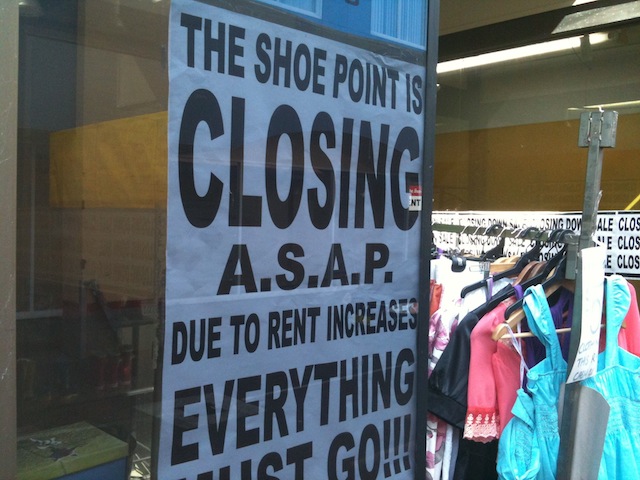
    Contrary to the bleating of Australian retailers, the biggest problem facing the sector is the nation’s high rents and property prices.

    For consumers, those huge rents and huge mortgages take money that could otherwise be buying more consumer goods, at the same time retailers are being slugged by some of the highest rents in the world, pushing up their costs and reducing competitiveness.

    That lack of competitiveness is affecting all parts of the Australian economy, particularly tourism, and the retail industry isn’t immune to those forces.

    Anyone who visits an Australian eating establishment will have experienced this, personally I had another experience last night at a pub that charged $4 (3.70 US) for a soda water.

    This wasn’t a trendy downtown bar but a pub in a lower middle class suburb with two overworked and under trained young bar staff. During the three hours there, our table of six was cleared once.

    no-table-service-in-australian-business.jpg

    Swiss prices coupled with service that would be barely acceptable in a 1970s outback Queensland roadhouse is not the formula for a successful economy.

    The business challenge

    Which brings us back to Solomon Lew’s whinge about the government, Sol handily overlooks the previous government’s  stimulus packages which kept the nation out of recession and put money straight into his and other retailers’ pockets.

    There’s a lesson there for the Australian Labor Party that the tweedle-dum, tweedle-dumber strategy of offering near identical corporate and middle class welfare policies to the Liberal Party is not going to win you friends with the nation’s business sector and its entitled leaders.

    For the incoming Liberal government, it is faced with the challenge of making Australia a competitive, high-cost economy along the lines of Japan, Switzerland or Germany.

    It’s hard to be optimistic about the Abbott government meeting this challenge given the bulk of its ministers are holdovers from the previous Howard Liberal government that was largely responsible for Australia flunking the transition to being a high cost economy along with institutionalising a middle class welfare culture into Australian society.

    Even if Abbott does genuinely attempt to address Australia’s lack of competitiveness, he can be sure he will get absolutely no help from the whingeing captains of the nation’s industries, as Solomon Lew has shown.

    While Solomon Lew and the Australian managerial class struggle with their perfect storms of economic, demographic and technological change, the nation also faces those headwinds.

    Hopefully for Australia there are capable leaders who can navigate those storm waiting to take the helm.

    Similar posts: