Tag: small business

  • No country for small business

    No country for small business

    Facebook’s latest changes to its layout creates more problems for small business using social media as the real estate available on its site for eyeballs gets smaller.

    The social media giant has been catching criticism recently for changes to its algorithm that make it harder for businesses to be seen online.

    In the hospitality industry, discontent was articulated by the Eat 24 website which closed its Facebook Page down after finding the problems too hard.

    With the changes to the online advertising feed, it makes it even harder for small business to be seen on the platform as reduced space means higher prices for the space that remains available.

    It’s hard to see small businesses getting much traction with the changes when they’re up against big brands with large budgets.

    On the other hand for the big brands, the importance of proper targeting becomes even greater as wasting

    A challenge for small business

    The big problem now for small business is where do you advertise where the customers are?

    A decade or so ago, this was a no-brainer – the local service or retail business advertised in the local newspaper or Yellow Pages. Customers went there and, despite their chronic inefficiencies, they worked.

    Now with Facebook’s changes, it’s harder for customers to follow small business and this is a particular problem for hospitality where updates are hard.

    The failure of Google

    Google should have owned this market with Google Places however the service has been neglected as the company folded the business listing service into the Plus social media platform.

    Today it’s hard to see where small business is going to achieve organic reach – unpaid appearances in social media and search – or paid reach as the competition with deep pocketed big brands is fierce.

    Services like Yelp! were for a while a possible alternative but increasingly the deals they are stitching up deals with companies like Yahoo! and Australia’s Sensis are marginalising small business.

    So the online world is getting harder for small business to get their message out onto online channels.

    For the moment that’s a problem although it’s an interesting opportunity for an entrepreneur – possibly even a media company – to exploit.


    Similar posts:

    • No Related Posts
  • Neglecting the small business sector

    Neglecting the small business sector

    I’ve previously flagged how the IT industry fixates on the consumer sector, the Kickstart forum on Australia’s Gold Coast emphasised this with vendors, particularly those in the Internet of Things market, focusing on home users.

    This is mindset is understandable given the huge numbers being cited for consumer applications, but the sneaking suspicion is that home users simply aren’t going to pay for these technologies and that the real money will be made in helping the retail sector deliver services to customers.

    On Networked Globe today we discuss that quandary, it’s something that both vendors, consumers and small businesses should be thinking about given the way it’s going to change supply chains and entire industries.

    Similar posts:

    • No Related Posts
  • Revisiting the Lipstick effect

    Revisiting the Lipstick effect

    During the recession much was made about the ‘lipstick effect’ – the idea some businesses and products would survive because they’re little luxuries that cash strapped consumers will spend on while scrimping and saving in other areas.

    Some of those areas are ladies’ cosmetics (lipstick), chocolate, movies and coffee shops. All of them offering small pleasures for a few dollars.

    It’s a theory I’ve always been sceptical of and an episode of the BBC’s World Of Business where Peter Day travels to Cork to see how Ireland’s second city is recovering from the great recession illustrates the reality is a lot more complex than the theory suggests.

    “We really struggled to keep alive,” Claire Nash of Nash 19 restaurant says in her interview with Day on her business experience during the recession.

    “My turnover just absolutely took a spiralling tumble and it wasn’t that the customer weren’t coming in – those that had lost their jobs weren’t coming in – but those that hadn’t lost their jobs were really hurting and they were very careful with their spend.

    “So they started using us as a treat, which was a model I never wanted to enter into but we weathered the storm.”

    It can be argued that Claire survived because of the lipstick effect – she kept enough customers to survive – but it was tough and had she taken out the loans offered to her during the boom it’s unlikely her restaurant would have survived.

    The key point though is the lipstick effect turned out to be a very different, and much less lucrative business, for Claire and other businesses in Cork.

    So assuming a business will remained unscathed because of the assumption the lipstick effect is a big risk, if that’s the plan then Sequoia Capital’s infamous Powerpoint of Doom comes to mind.

    While the presentation was aimed at tech companies and investors, it’s a good overview of how the Global Financial Crisis happened and Slide 49 – Survival of the Quickest – is probably the best lesson for any business: Act fast to adapt.

    The lipstick theory is a nice way to justify unsustainable business models, particularly those that rely on consumer spending, in the face of a recession but the assumption spending will remain the same as customers will seek little luxuries is deeply flawed.

    A business that doesn’t respond quickly to changed circumstances and reduced spending is one that might not survive a downturn.

    Peter Day’s Cork story is a good listen on how Ireland and Cork have weathered the global financial crisis, the main question from the piece is how much have the Irish and the rest of the world learned from the mistakes of the boom years at the start of the 21st Century.

    Similar posts:

  • Does small business really want high speed broadband?

    Does small business really want high speed broadband?

    One of the mantras of the digital economy is new technologies, such as the web and cloud computing, level the playing field for small businesses competing against large corporations. Could it be that belief is wrong?

    The Australian Centre for Broadband Innovation last week released its Broadband Impacts report where it examined how high speed internet is changing communities. The results weren’t good for small businesses.

    One of the key metrics the ACBI used was business use of websites, it’s shocking enough that only 70% of Australian corporations have an online presence but less than half of small businesses being on the web is disgraceful.

    Australian-business-internet-use

    An interesting quirk in the above table indicates that there’s quite a few microbusiness using online sales services and one wonders if the question being asked by the Australian Bureau of Statistics is too limiting in its definition of websites.

    The ABS defines businesses with a web presence as those with a website, home page or other web presence but excludes those listed solely as part of an online listing. A web presence was reported by 45% of Australian businesses as at 30 June 2012.

    With this definition excluding social media and listing services, it probably does understate the number of Microbusinesses that have an online presence but not a website as defined by the ABS.

    The relevance of broadband

    In the context of broadband it’s worth noting that websites and online commerce don’t need high speed internet connections, so it’s hard to conclude that giving these businesses faster access is going to make a difference to the way they work.

    Where high speed broadband and ubiquitous internet really make a difference is in business operations. As workers become more mobile and the internet of things rolls out, having access to reliable connections is going to become critical to most organisations. Again though, small business tracks poorly on this measure.business-reporting-new-operations-by-size

    legend-to-australian-business-barchart

    Overall the use of cloud services – which is what the bulk of these “new operational processes” will be – is pretty poor across the board although one suspects in the larger organisations various groups have changed their business practiced around services like Dropbox and Documents To Go without senior management being aware of it.

    What’s particularly disappointing about this statistic is small businesses are the group most suited to using cloud services and those not adopting these technologies are missing a competitive advantage.

    So who needs broadband internet?

    These results beg the question – does small business really need high speed broadband access? If they aren’t doing things that could be done on a dial up modem, like registering domains or setting up websites, it’s hard justifying the investment of connecting SMBs to fibre networks.

    While there’s no doubt high speed internet is essential to the economic future of communities and nations, we have to keep in mind that not all groups will take advantage of the new technologies. Some will be left behind and in Australia’s case, it may well be small business.

    Similar posts:

  • Shops of doom

    Shops of doom

    “Location, location, location” is the mantra for real estate investors and property speculators, that rule is just as true for those setting up a shop or cafe.

    When you pay attention to the retail strips or malls in your suburbs you’ll notice how some locations are doomed to fail.

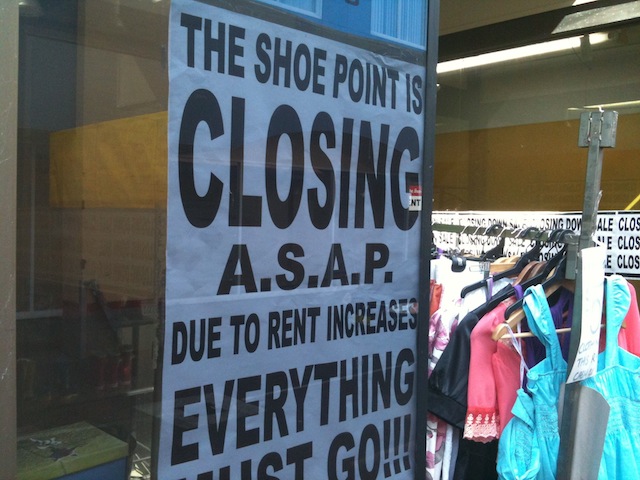
    The featured picture in this post is what should be a good location in the centre of a dining strip in an affluent Sydney suburb. Just fifty metres either side of the premises are successful and long running cafes.

    However this spot has had five different business fail in the last three years and in the past decade hasn’t had a single stable tenant.

    The question is what causes this? Is it because the landlord’s are greedy?

    In some cases it is, the featured premises had a stable tenant in a very nice and well priced fish restaurant for many years. When the landlord jacked up the rent, the seafood cafe moved out and the place has struggled ever since.

    Something many people have mentioned to me over the years is how difficult they find it to negotiate on price with landlords over commercial space with the owners very reluctant to budge on rents.

    Often, the letting agents are prepared to throw in sweeteners like fitout costs, rental holidays or paying utilities but it’s very rare that the headline rent will be negotiated down.

    Part of this could be due to the properties being valued as a multiple of their monthly rents; so if the leasing rate falls, so too does the property value which is bad news for the landlord and their bank.

    When landlords get too greedy properties lie vacant for a long time. A good example is nearby to the featured property.

    closed-bike-shop-in-bad-retail-location

    The bike shop that occupied this unit for about 12 months moved out over two years ago and before that it had been vacant for a long time. Despite being on a busy commuter strip in an affluent suburb, it’s a lousy location with poor visibility, truly awful parking and lousy amenities.

    In a genuine free market the rent should fall until a business that can operate in such a low turnover location can afford it, that no entrepreneur can make the numbers work indicates the asking price is too high.

    Although even the cheapest rents won’t help a truly blighted location which is why it might be a good idea to ask around the local shops and residents to see how a location has performed before signing that lease.

    It would be a shame to doom your business because of a lousy choice of location.

    Similar posts: