Tag: society

  • Being an industrial revolutionary

    Being an industrial revolutionary

    “The future isn’t pre-determined, technology doesn’t come from some outside force. It’s created by us. Some people have more power than others in that system, such as the big tech entrepreneurs, but at the end it’s people and organisations that have the power.”

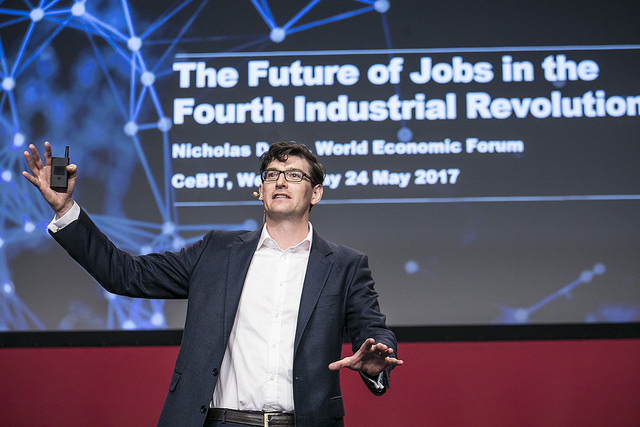
    Nicholas Davis, the World Economic Forum’s Head of Society and Innovation, was discussing at the recent Sydney CeBIT conference how we can take control of the digital economy and where workers fit into an increasingly automated world.

    Technology and online platforms aren’t neutral system, Davis observes. “It’s not just about how we use them, but the values that are designed into the systems, technology is not just a neutral thing. During a conversation like this if I put my iPhone between us, it’s proven that reduces our memory of that discussion and our sense of connection.”

    Politics and addiction

    “The purpose of the technology, the design of it, affects us in different ways.” Davis says, “if we design technologies for addiction, if we design business models that involve us being sucked into systems at the expense of other things in our lives, then that is a value choice that companies make and that we as users are trading off in our lives.”

    “In understanding that technology is not neutral then the question is how we, as revolutionaries have that political discussion? I don’t mean political like ‘Left’ and ‘Right’ but these are value decisions that we need to engage with.”

    “The difficulties about having discussions about technology is not getting sucked into a left-right divide and letting one group of people own innovation, but to say what do we want, How do we get there and how do we avoid the mistakes of previous industrial revolutions where the environment suffered, kids suffered and vulnerable populations suffered.”

    A change in thinking

    “One of the biggest problems is we don’t have regulatory or even democratic institutions where we can make collective decisions about technologies,” says Davis.

    “The average AI researcher, at the top of their game anywhere in the world, would only understand a small percentage of the AI space. So how do you expect a politician or a voter, to come to grips with it.”

    One of the key discussions missing in the public sphere is around automation and concepts like the Universal Basic Income, Davis believes. “We should have a serious chat about giving everyone the space to build up their skills.”

    In the development policy, Davis sees growing inequality and applying last century’s thinking to today’s challenges as among the biggest risks facing governments and communities.

    Rippling beyond business

    For business, the imperative is to recognise the effects of decisions on the wider community.

    “The big thing for business is understanding the technology decisions you make have a ripple effect beyond your company, you need to look forward to new ways of value adding.”

    Davis warns we are seeing a backlash against innovation and technology with concerns about privacy and security growing.

    “So much of the world is build on their use of data. Most companies and organisations don’t have good data hygiene or ontology to classify their information. People say data is their greatest assets – some say it’s the new oil – but it’s also their greatest liability. So understanding information security at the board level is critical.”

    The power of individuals

    For individuals, Davis believes the power lies with us in the choices we make as consumers.

    “Don’t underestimate your own power, but also don’t underestimate that more and more products around us are designed to influence our behaviour in ways we need to be aware of.”

    “In most cases, if the product is free then you and your data are the product, understand that and on what terms is important.”

    Conscious choices

    “Understand the externalities of these services as well. Appreciate the effects it has on your family, your mental health, on the ability to connect is important. Being able to make conscious choices about these things.”

    “Supporting open data standards and competition – not just accepting Android or Apple for instance – rather than allowing politicians and big business to fight over these things.”

    So in Davis’ view being an ‘industrial revolutionary’ in the digital era is a matter of being an informed, and empowered, consumer. Will that be enough?


    Similar posts:

  • ABC Brisbane on the future of retail

    ABC Brisbane on the future of retail

    This morning I’m talking with Steve Austin on ABC Brisbane about the future of retail as the city’s biggest shopping mall opens.

    What does such a huge complex mean to the local economy and is it sustainable as the retail industry evolves?

    Having had a massive upgrade, we can be sure Westfield Chermside will have plenty of technology to help customers spend money and we covered some of the ways modern retails have to understand consumer behaviour and predict what individuals will spend.

    Prior to the segment (which starts around the 60 minute mark), Steve took calls from listeners about how retail has changed in Brisbane over the past fifty years.  The demise of fondly remembered department stores is a reminder of how the sector changed as consumer behaviour changed over the last half of the Twentieth Century.


    Similar posts:

  • What’s next for small business – trends in the modern workplace

    What’s next for small business – trends in the modern workplace

    This week’s The Future is now – Trends in the Modern Workplace webinar was an opportunity to look at the trends affecting small and micro businesses.

    What’s notable is almost all the topics affecting small business are being felt by their corporate cousins. It shouldn’t be surprising the technology and social trends affecting society are equally being felt

    Now the webinar is over, I’ve posted the presentation to Slideshare with the commentary below, we cover established trends like the shift to mobile then ponder the future of business with artificial intelligence and virtual reality.

    The presentation ties up with the post I published a few days ago that provides the commentary to the slides.

    Similar posts:

  • Japan’s demographic ruins

    Japan’s demographic ruins

    As Japan’s society ages and urbanises, the effects are being seen in buildings and communities being abandoned.

    The Japan Times reports on how the nation is now becoming a magnet for urban explorers discovering what lies insides abandoned homes, hospitals, hotels and theme parks.

    Many of the abandoned tourist attractions are legacies of the 1980s economic boom that saw a massive over-investment in property plays. With a shrinking population, those facilities were always doomed but in a growing society, there would have been economic reasons for redeveloping them.

    In Japan though, those economic drivers don’t exist in much of the country as the Japan Times explains.

    “Japan is in some sense uniquely blessed as a land of ruins. Its rapidly aging population, low birth rate, urbanization and lack of immigration have left a legacy of ghost towns and more than 8 million abandoned homes, or akiya. That tally could hit 21.5 million, one-third of all residences nationwide, by 2033, according to the Nomura Research Institute.”

    Japan is the first of many nations that will face the consequences of an aging population, what they do will be a lesson to all of those who follow. Of those, China will probably the biggest experiment.

    One big lesson is property demand changes and once valuable assets don’t necessarily hold their value in the face of a societal shift.

    Similar posts:

  • Government in a digital era

    Government in a digital era

    Governments are struggling with the new channels of communication and the structures that will manage our societies are far from certain.

    Last night the University of New South Wales’ School of Computer Science and Engineering in Sydney held a panel discussion about Digital citizens and the future of government. The group looked at how the open government movement is progressing and how public servants and politicians are dealing with a data driven world.

    The panel featured Dominic Campbell, the founder of the UK’s FutureGov who are currently advising the Australian Digital Transformation office; Penny Webb-Smart, the Executive Director of Service Reform for the NSW Government’s clumsily named Department of Finance, Services and Innovation and Amelia Loye, a social scientist who worked on Australia’s first Action Plan for Open Government.

    Centralising decision making

    One key question for the panel was how governments use data which gives rise to two views. The prevalent view is information systems tend to centralise power – something that has been a feature of the last two centuries – while access to information is a democratising forces that hands control back to individuals and local communities.

    Amelia made the point in some respects we’re already at the point where individuals can take control, “the tools for participatory government are already available, we have to start looking at – and talking about – how to use them,” she said.

    That conversation certainly isn’t happening at the moment despite the odd blurting of fine words from ministers and public servants and while in some areas government data is being freed up, in others it’s increasingly being hoarded for political purposes or due to ill thought out privatisations.

    Commercial in confidence

    Private sector data is another problem for the open data movement as many of the functions carried out by governments are outsourced to companies which generally reluctant to share information with the public. This leaves communities with an incomplete picture of the data affecting them.

    The main unanswered question in the discussion was the relationship between local and central governments, the panel’s consensus was central government would become more dominant and in the Australian context the states would become irrelevant. This however may not be true.

    Centralised government is by no means a given, as the prevailing corporatist ideologies of Western governments strive to cut services it’s likely communities are going to increasingly find ways of delivering those services independent of national bureaucracies and politicians in capital cities.

    Cumbersome central governments

    Another unspoken aspect was the increasing cumbersome nature of central government. In fast moving economies it’s hard for the decision making structures based in capital cities to quickly react to societal and political changes. National governments may simply be too big to manage the data flows coming into them.

    The main conclusion out of the evening’s discussion is there is great uncertainty about the structure of government in the digital era.

    Uncertainty over how governments will be shaped by today’s changes isn’t surprising, increased communications and the change in public finances radically altered the role of government last century – the wars and economic downturns of the first third of the century saw the introduction of central government income taxes which central power in capital cities.

    Changing communications

    Similarly mass media communications, the radio and television, dramatically changed the politician’s role and how citizens interacted with government.

    One great mistake today is many of our political, public service and business leaders think the current models are inviolate and fixed when in actual fact they are dynamic systems which are evolving with technology.

    Governments are a reflection of the societies and economies they lead. Just as both the economy and society are changing so too will the structures of the public service and politics. We may not recognise some of those changes until well after they’ve happened.

    Similar posts: