Tag: startups

  • The quest to solve students’ problems

    The quest to solve students’ problems

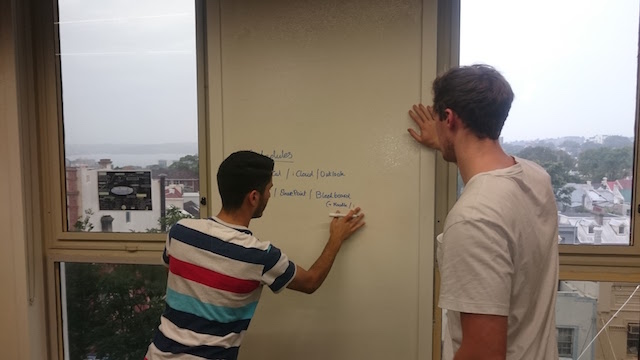
    17 year old Giorgio Doueihi had a problem, his school had just rolled out a student diary app that was unusable. So Doueihi, who’d started coding at 13, decided he’d write a new one.

    “I’d been dabbling with a bunch of projects at high school and I’d taught myself how to code,” Giorgio told Decoding the New Economy at Telstra’s Sydney Muru-D incubator.

    That app was quickly adopted by his high school which had spent $100,000 developing the unusable system. Giorgio finished school, started university and Backpack, as his app became known, was accepted into Sydney University’s student INCUBATE startup program.

    “I found out about INCUBATE and thought ‘I might just pitch this idea I had at high school’ then it kind of took a turn.”

    Backpack became Fluid Education and Giorgio was accepted onto the Muru-D program, the product was doing well in the market and gaining customers when he decided to shut it down and move to a new product.

    “Sales cycle was a large part of the pivot,” he explains. “Another part was that it had changed from a student orientated app to something more enterprise focused, something we were uncomfortable doing.”

    So Fluid Education pivoted and is now a service for matching tutors to students and managing their appointment with the new platform about to come out of beta, “We’ve gone back to our roots,” Giorgio explains.

    In many ways Giorgio Doueihi story is straight out of the startup textbook, he’s passionate, has identified a problem to solve and was agile enough to change the business’ course when he was unhappy with the direction.

    Fluid education and Giorgio will be a very interesting story to follow over the next few years.

    Similar posts:

    • No Related Posts
  • The challenges of an open organisation

    The challenges of an open organisation

    “We moved into a house we couldn’t afford” writes Buffer founder and CEO Joel Gascoigne on his company’s decision to fire ten of their 94 staff as revenues miss targets and the venture’s cash burn accelerates.

    A few years ago we wrote about Gascoigne’s commitment to being an open company and his post today is a brutal, but honest, reflection of that.

    Buffer’s problem is one familiar to many business owners when revenue projections aren’t being met and the tough reality of making unexpected cuts becomes apparent.

    Making Buffer even more unusual among tech and social media startups is how the company doesn’t depend up venture capital funding – an advantage for its owners but also a downside in situations like this where being able to raise more money for equity would give the business room to move.

    At present however companies following the VC model are in trouble as they are finding investors aren’t so willing to write cheques to loss making ventures unless there’s a clear path to profits.

    That reluctance to fund businesses is going to see more layoffs for companies dependent upon VC funding, some startups will fail because of it. The really fascinating part is how many of the tech unicorns will be amongst the failed business.

    One hopes though Buffer won’t be among the casualties, Gascoigne and his team deserve to be rewarded for their candour.

    Similar posts:

  • Don’t follow the normal route

    Don’t follow the normal route

    Two years ago I interviewed Technology One founder and CEO Adrian DiMarco about his company’s pivot to the cloud and the gold rush among consultants and services providers looking at making money out of cloud computing services.

    DiMarco’s founded Technology One in 1987 to compete in the enterprise software space with the likes of SAS and Oracle. At the peak of the dot com boom in 1999, DiMarco listed the company on the Australian stock exchange where it is one of the few genuine tech stocks on the nation’s finance and mining dominated bourse.

    Given the focus on listed companies at the moment, DiMarco’s views are worth noting. “if I were to do it again, I’d don’t think I’d go that path,” he says about listing the business. “I have a real issue with how public companies run in Australia.”

    DiMarco’s view is at odds with Netsuite’s Zach Nelson who told Decoding the New Economy last month how being on the stock exchange forces management to focus. “Managing a public company is a great discipline and in some ways gives us an advantage over non-public company who don’t have to have discipline and make good investments,” Nelson said.

    In DiMarco’s opinion, the regulatory and ‘box ticketing’ requirements of a listed company don’t reflect the true performance of a corporation’s management. “There are mediocre CEOs walking away with millions,” he says.

    While listing made sense for Technology One in 1999 those looking at starting a business today shouldn’t necessarily follow his path warns DiMarco, “tor startups these days, don’t follow up normal route.,” he says.

    “I think the world’s your oyster to do want you want. Don’t let anyone talk you out of anything,” DiMarco says. “When we started out we were told ‘don’t build enterprise software’. We did and we succeeded.”

    “Don’t be scared,” he advices. “It really is a great time to startup a business. The technology is redefining business. It’s a good time.”

    Similar posts:

  • Fearlessness and starting a business

    Fearlessness and starting a business

    “Just do it!” Almost every startup founder I interviewed for The Australian’s series on expat entrepreneurs had the same advice for budding entrepreneurs wanting to go global – don’t wait, just do it.

    Peter Grant of Brisbane founded Safesite did though inject a slightly different view when he pointed out that it may not make sense for a company with a good domestic business to make the move, “If it’s going to be too complex or you already have a profitable business in Australia you may not need to come to the US, you have to be realistic about it. It might make sense to find a local partner.”

    In Peter’s case though that move made sense. “We have a year on our competitors,” he notes.

    Not being scared of making the move was part of a discussion I had with TechnologyOne founder Adrian DiMarco today, I’d previously interviewed Adrian for Business Spectator a few years back and it was good to hear his views on the current startup mania and the Australian innovation push.

    One of the points DiMarco made was about not being scared when launching a venture, whether it’s the competition, the marketplace or the overall daunting task of running a business, being fearless is a key attribute to making the first steps, not just success.

    That fearlessness is something that should be acknowledged about business founders, whether it’s a tech startup, dog walking service or donut franchise. Every single proprietor is taking a great leap.

    Similar posts:

  • California dreaming – why the world’s startups are going to San Francisco

    California dreaming – why the world’s startups are going to San Francisco

    Why are the world’s startups flocking to San Francisco? In a five part series for The Australian I look at the motivations for Australian entrepreneurs heading to the Bay Area.

    The reasons for the moves are varied, as are the experiences, and it’s an interesting snapshot of a historical industrial shift as Silicon Valley evolves.

    Similar posts:

    • No Related Posts