Tag: technology

  • Breaking up the tech giants

    Breaking up the tech giants

    One of the stark realities of the technology industry is there is no third place – if you aren’t the biggest or second biggest in a mature market then you need to get out.

    With internet businesses it’s now appearing there may not even be room for second placed businesses as increasingly each market segment is dominated by one player.

    For Silicon Valley’s leaders, having a monopoly is their nirvana. As PayPal founder Peter Thiel once wrote, competition is for losers, which is ironic given his fortune is based upon challenging the banking and payment oligopolies.

    So with attitudes like Thiel’s, and the massive power of companies like Amazon, Facebook and Google, it’s not surprising there are now calls to break up the tech giants.

    There are some compelling arguments for this, the splitting of Bell Labs in the 1950s spawned the birth of Silicon Valley and the breaking up of AT&T created the conditions for development of the internet and mobile network. Monopolies stifle genuine innovation.

    For customers, the argument is moot. Very rarely does a monopoly result in anything but poorer service and higher prices.

    Even for shareholders, there’s a good argument for breaking up monopolies. A company with massive market power is often over staffed and poorly managed and the splitting of Standard Oil in the 1911 gave rise to dozens of new oil companies who returned far more to investors than the staid giant ever would.

    It’s hard though to see how companies like Google, Facebook and Amazon could be broken up. Unlike telephone networks, oil refineries and gas stations it’s difficult to separate assets or products. Breaking up Google, for example, may only result in more monopolies over smaller markets.

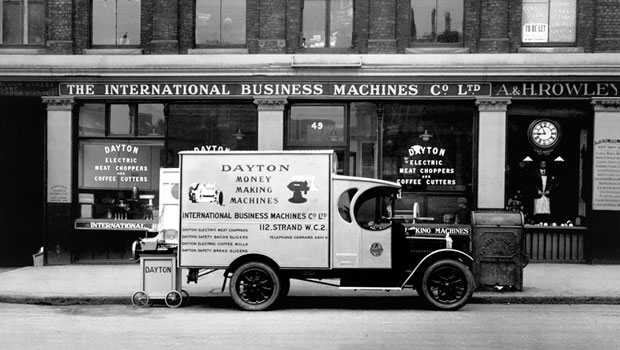
    However in the tech industry, a monopoly may not be permanent thing. Forty years ago IBM was the untouchable incumbent and twenty years ago it was Microsoft. Both today are shadows of what they once were as markets overtook them.

    So perhaps it’s too early to call for the breaking up of today’s tech giants because, like Microsoft and IBM, their success is based on a fleeting technological moment.

    Similar posts:

    • No Related Posts
  • Being an industrial revolutionary

    Being an industrial revolutionary

    “The future isn’t pre-determined, technology doesn’t come from some outside force. It’s created by us. Some people have more power than others in that system, such as the big tech entrepreneurs, but at the end it’s people and organisations that have the power.”

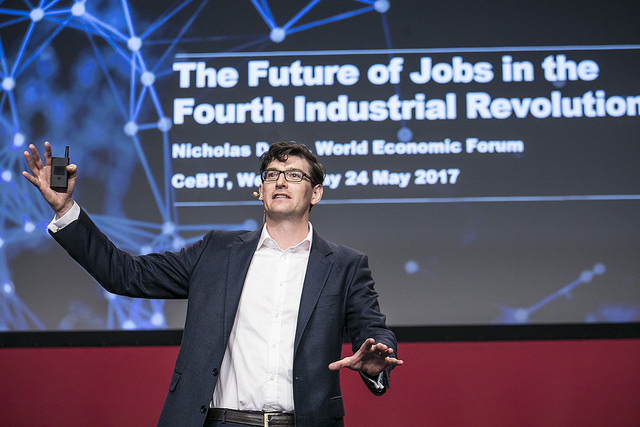
    Nicholas Davis, the World Economic Forum’s Head of Society and Innovation, was discussing at the recent Sydney CeBIT conference how we can take control of the digital economy and where workers fit into an increasingly automated world.

    Technology and online platforms aren’t neutral system, Davis observes. “It’s not just about how we use them, but the values that are designed into the systems, technology is not just a neutral thing. During a conversation like this if I put my iPhone between us, it’s proven that reduces our memory of that discussion and our sense of connection.”

    Politics and addiction

    “The purpose of the technology, the design of it, affects us in different ways.” Davis says, “if we design technologies for addiction, if we design business models that involve us being sucked into systems at the expense of other things in our lives, then that is a value choice that companies make and that we as users are trading off in our lives.”

    “In understanding that technology is not neutral then the question is how we, as revolutionaries have that political discussion? I don’t mean political like ‘Left’ and ‘Right’ but these are value decisions that we need to engage with.”

    “The difficulties about having discussions about technology is not getting sucked into a left-right divide and letting one group of people own innovation, but to say what do we want, How do we get there and how do we avoid the mistakes of previous industrial revolutions where the environment suffered, kids suffered and vulnerable populations suffered.”

    A change in thinking

    “One of the biggest problems is we don’t have regulatory or even democratic institutions where we can make collective decisions about technologies,” says Davis.

    “The average AI researcher, at the top of their game anywhere in the world, would only understand a small percentage of the AI space. So how do you expect a politician or a voter, to come to grips with it.”

    One of the key discussions missing in the public sphere is around automation and concepts like the Universal Basic Income, Davis believes. “We should have a serious chat about giving everyone the space to build up their skills.”

    In the development policy, Davis sees growing inequality and applying last century’s thinking to today’s challenges as among the biggest risks facing governments and communities.

    Rippling beyond business

    For business, the imperative is to recognise the effects of decisions on the wider community.

    “The big thing for business is understanding the technology decisions you make have a ripple effect beyond your company, you need to look forward to new ways of value adding.”

    Davis warns we are seeing a backlash against innovation and technology with concerns about privacy and security growing.

    “So much of the world is build on their use of data. Most companies and organisations don’t have good data hygiene or ontology to classify their information. People say data is their greatest assets – some say it’s the new oil – but it’s also their greatest liability. So understanding information security at the board level is critical.”

    The power of individuals

    For individuals, Davis believes the power lies with us in the choices we make as consumers.

    “Don’t underestimate your own power, but also don’t underestimate that more and more products around us are designed to influence our behaviour in ways we need to be aware of.”

    “In most cases, if the product is free then you and your data are the product, understand that and on what terms is important.”

    Conscious choices

    “Understand the externalities of these services as well. Appreciate the effects it has on your family, your mental health, on the ability to connect is important. Being able to make conscious choices about these things.”

    “Supporting open data standards and competition – not just accepting Android or Apple for instance – rather than allowing politicians and big business to fight over these things.”

    So in Davis’ view being an ‘industrial revolutionary’ in the digital era is a matter of being an informed, and empowered, consumer. Will that be enough?

    Similar posts:
  • Harnessing refugee talent

    Harnessing refugee talent

    Last week saw the inaugural Sydney Techfugees Meetup at the Australian offices of TripAdvisor, an initiative that not just assists new arrivals to the country but shows the importance of keeping a society diverse.

    Techfugees is a UK founded initiative harnessing the international tech community’s skills to assist with the global refugee crisis, the Australian offshoot was set up in 2015 with the aim of helping refugees settle into the Australian community.

    Moving countries is stressful for most people and migrants often face problems accessing services and capital. For refugees who’ve been traumatised by dislocation and war, the problems are even greater.

    Having had four hackathons, the Sydney meetup was an opportunity for the organisers to showcase their work and five new projects that addressed problems facing immigrant communities.

    A refugee’s story

    Kicking off the event was a brief presentation from Mahir Momand, former refugee from Afghanistan and now the Australian CEO of Thrive, a microfinance business for refugee businesses.

    Momand’s story tells us much about the refugee story, born in Afghanistan his family fled to Pakistan after the 1979 Soviet invasion. Twice he returning to his home country before having to flee each time after his charitable work incurred the wrath of the Taliban.

    For migrants and refugee families, microfinancing an important idea, with few assets or business links in their new country is hard for them to access capital so this is an important way to stimulate employment among groups that tend to be entrepreneurial. This is one area where an concept designed for developing communities applies just as well to advanced economies.

    Presenting the apps

    The groups that presented at the meet up were diverse, One Step App offers walking tours which aims to build bridges between the immigrant and established communities while Cinema of the Oppressed looks at using video and other creative tools to help alleviate depression and isolation among new arrivals.

    On a more functional level, Water Democracy is developing a cheap and accessible device to purify water in disadvantaged communities while mAdapt uses mobile technology to increase refugee access to essential reproductive health services.

    Upload Once, the first project to present, is intended to keep a new arrival’s documentation in one place to make it easier for them to maintain and access important records which is essential for dealing with the bureaucracy when arriving in a new country.

    Bringing in diverse skills

    All of the Techfugees projects showed the diverse range of needs and talents of refugees and new immigrants.

    In these troubled, and scared, times it shouldn’t be forgotten how refugees and immigrants have been the strengths of most the successful Twentieth Century economies – most notably the United States and Australia, countries which are erecting greater barriers at the same time they are congratulating themselves for their successful immigrant societies.

    With technology changing the workforce, harnessing the talents and work ethic of displaced people could well be one of the strengths for this century as well. Techfugees is a small taste of what could be done.

    Similar posts:

    • No Related Posts
  • Retail’s evolving face

    Retail’s evolving face

    On the back of last week’s discussion about Amazon’s Australian expansion, I spoke to Sydney community radio station 2SER-FM this morning about the challenges facing suburban shopping strips.

    Like the rest of the world, Australia’s suburban and small town retail strips have been doing it hard for a generation. While technology has a lot to do with this, it’s not online commerce that’s the killer.

    The decline, recovery and shift of the suburban retail strip really started in the 1960s as people moved to the suburbs and started shopping at supermarkets – the technology driving that shift was affordable motor cars and refrigerators.

    Around the developed world, the removal of tram (or streetcar) systems during the 1950s and 60s also hurt the inner city shops as local foot traffic declined. In Sydney it’s striking that fifty years after the removal of the tram system those suburbs that developed around them are still easily recognisable.

    Shifting back to the city

    In the 1980s another shift happened. Suddenly in the inner city became fashionable again for affluent and young residents and a new generation of shopkeepers sprung up attracted by relatively cheap rents.

    The shift we’re now discussing is that generation of the 1980s and 90s has been dispersed as rents become increased or shops are demolished for apartment blocks that cater for the populations moving back into the inner cities now suburbia isn’t so fashionable.

    Like all shifts this has consequences – just as the corner grocery store and local butcher was forced out of business by supermarkets in the 1960s and 70s, today the indy fashion store or old fashioned immigrant run cafe is being displaced by high priced gelato shops and restaurants catering for whatever the current food fad is.

    The push against consumerism

    With increasing rents, tenants increasingly become upmarket brands although the upper end of the market though is not what it was as the middle classes – particularly in cities like Sydney, San Francisco, Singapore and London – find soaring property prices make it harder to indulge in luxury items.

    So high rents are driving shopkeepers out of business and in Australia at least, the perverse incentives in taxation laws and investment regulations means that landlords have a positive disincentive to drop their asking prices, which means vacancies increase.

    Renew Newcastle successfully skirted landlords’ reluctance by ‘licensing’ space rather than leasing it from landlords. This allowed land banking property developers and valuation conscious commercial owners to let out space without formal leases that created legal or financial issues.

    Regional challenges

    It will be interesting to see how Newcastle will perform as that land banked buildings are being developed into apartments and, the developers hope, high rent shops.

    For other regional areas the news isn’t as great with technology in everything from mining to agriculture automating more jobs out of existence. Much of the decline in country towns and regions during the Twentieth Century was due to the mechanisation of farming.

    Pervasive broadband promises some hope for regional communities but at present both jobs and wealth are being increasingly concentrated into major population centres. This however may be a transition effect exacerbated by governments propping up financial sectors after the 2008 economic crisis.

    It’s interesting too that the financial sector now is undergoing an automation revolution not dissimilar to that of the twentieth century agriculture industries, something that’s bad news for cities and governments staking their future on those sectors.

    Technology driving change

    A lesson from the last hundred years is how technology changes our communities, the arrival of refrigeration and the motor car allowed suburbs and supermarkets to develop. While tractors and trucks radically changed the structure of rural communities.

    With the rise of new technologies in everything from agriculture to transport and manufacturing, we’ll see similar changes to our societies and businesses in coming years.

    The changes faced by today’s retail business are part of an evolving economy, just as the horse and tram dependent city of hundred years ago looked very different from car dependent suburbias of the late 20th Century, tomorrow’s cities will look very different from today’s.

    Similar posts:

  • De-hyping the hype cycle

    De-hyping the hype cycle

    One of the useful tools in describing how technology is accepted by the market and society is the Gartner Hype Cycle.

    Developed by the consulting firm, it describes the typical pattern of a technology product where at first it is ignored, then hyped before falling into the ‘Trough of Disillusionment” before maturing to find a productive role in the marketplace.

    The curve though isn’t perfect – many products crash without making the ‘plateau of productivity’ and every technology has its own unique timeframe. Gartner’s role as technology analysts as commercial considerations come into play as well.

    Given those imperfections, it’s worthwhile tracking how some of the technologies did on the hype cycle and how Gartner’s predictions went and on Imgur, Anton Tarasenkno has posted all the the Gartner end of year hype cycles from 2000 onwards to give us that opportunity.

    PDAs and Smartphones

    The ‘Personal PDA’ illustrates how technologies evolve and the original concepts become a dead end.

    In 2001, the Personal Digital Assistant – devices like the Palm Pilot, Sharp Zaurus and HP iPac – were the productivity must have for connected workers and Gartner flagged them to be on the ‘Plateau of Productivity in between three to five years.

    They never made it. The entire category crashed due to to poor product releases, confusing software wars – the buggy mess that Microsoft Windows CE scared many consumers away – and the rise of smartphones.

    PDA’s vanish from the Gartner cycle in 2003 and three years later Smartphones make an appearance grinding their way up to the ‘Plateau of Productivity’.

    There is a fair argument that smartphones are an evolution of the PDA – although not one of the PDA vendors or operating systems actually made it onto successful smartphones – but it does seem a bit of a sleight of hand simply to substitute one for the other.

    As it turns out though, the 2006 prediction for the smartphone was spot on given the iPhone was released the following year.

    Cloud computing

    The evolution of ‘cloud computing’ is an interesting tale in itself. At the time of the 2000 Gartner hype cycle is was being described as Application Service Providers (ASPs) although the concept and technology could claim to be the descendent of the much earlier time shared mainframe computing systems leased out primarily by IBM.

    In the 2000 Hype Cycle Gartner has ASPs just past the ‘Peak of Inflated Expectations’ and this was a fair call as ASPs were dragged down by the general ennui following the Tech Wreck a year later which saw the technology close to the ‘Trough of Disillusionment’.

    ASPs then vanish for four years before reappearing as ‘Software as a Service/ASP’ in 2005 on the grind up to the ‘Plateau of Productivity.’

    Portal mania

    In the early days of the World Wide Web, portals were hot. On the public web, Yahoo! and MSN were expected to be the go-to destination for surfers while within large organisations, the intranet page was expected to be the centre of all corporate knowledge and the first place employees were expected to log into in the morning.

    For the 2003 hype cycle, Gartner’s analysts certainly believed in portals with twelve different types of portals or related technology listed. The following year, the number had grown to fifteen.

    Interestingly, the most advanced portal technology on the curve, ‘mobile access to portals’, was stuck climbing out the trough for both of those years. That probably indicates even Gartner’s enthusiasm for the term and the technology was enough to prevent the idea being overtaken by search and social media.

    Looking to the future

    While it’s entertaining with the benefit of hindsight to look at where Gartner’s predictions of more than a decade ago, it is worthwhile considering what the company’s analysts are predicting this year.

    Virtual reality is the tech clawing its way up out of the ‘Trough of Disillusionment’ while augmented reality is hurtling towards the depths. Both are flagged to be mainstream on a five to ten year horizon.

    At the ‘Peak of Inflated Expectations’ sits Machine Learning with the connected home and Blockchain approaching the top. Towards the start of the curve are technologies like Quantum Computing and human augmentation, both are flagged to be more than ten years away from gaining mainstream adoption.

    Picking apart the Gartner Hype Cycle is a useful exercise in understanding the limits of the idea as well as reminding us of just how difficult it is to predict how technologies will mature and be accepted by society and industry.


    Similar posts:

    • No Related Posts