Tag: technology

  • Technology’s crisis of trust

    Technology’s crisis of trust

    Last night for the monthly ABC Nightlife tech spot we looked at Samsung’s spying TVs and some of the other aspects of security with connected devices.

    During the listeners’ calls it became very clear many are worried and scared by technology’s rapid progress. This is a challenge for the leaders of both the tech industry and governments.

    Trust in the tech industry isn’t being helped by the revelation Lenovo computers have been loaded with Adware that, among other things, interferes with secure website connections.

    Lenovo’s actions raise a serious concern for business as many of those home units may have been connected to office networks under corporate Bring Your Own Device policies and the spoofing of security certificates could cause no end of problems and risks for IT managers.

    Another concern Lenovo’s actions raise is about the Internet of Things; if various devices on a network are messing with data integrity, confidence in the information being generated is eroded.

    For the tech industry, it’s essential to regain the community’s trust. Equally however it’s essential for business and political leaders to have an honest conversation with voters and workers on how the structure of the workforce is changing.
    Similar posts:

  • Software ate the demonstration centre

    Software ate the demonstration centre

    Yesterday Australian incumbent telco Telstra took the media on a tour of its showpiece  Customer Insights Centre in downtown Sydney.

    The company is justifiably proud of the facility that includes  a 300 person auditorium, broadcast quality TV studio, a restaurant, workshop and collaboration spaces.

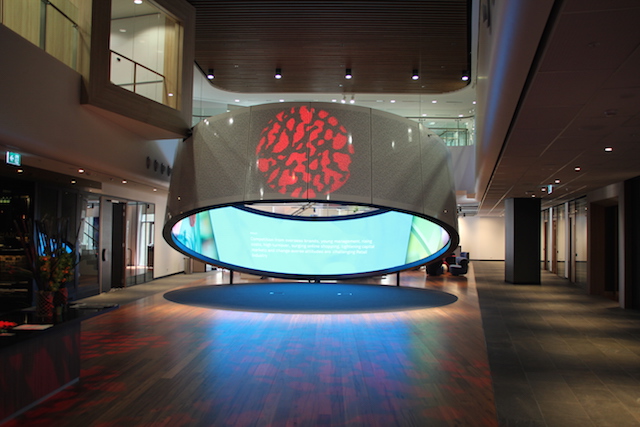
    Welcoming visitors is the centre’s Insight Ring, a nine metre circle-shaped platform that surrounds guests with digital insights mined from Telstra’s information services. Leading off the reception area are a range of displays showcasing the company’s products and capabilities including wearable technologies, 3D printing and Ged The Robot.

    Marking the centre as a modern facility the display spaces where Telstra and its partners can show off technologies to industry bodies and prospective clients.

    Ged, the Telstra robot
    Ged, the Telstra robot

    The previous space two floors higher in the building was beginning to show its age after seven years and the fixed displays of technology in the older facility dated the centre, something that’s a disadvantage in an industry changing as quickly as telecommunications.

    In the new centre, the demonstration facility is largely screen based so displays can quickly be adapted to show off the technologies aimed at whichever industry they are pitching.

    The fast moving technology world
    The software driven demonstration centre


    Andy Bateman, Director of Segment Marketing at Telstra, who lead the tour was proud to show off the current display that had been set up to showcase the company’s banking products.

    telstra_client_demonstration_consumer_insights_centre

    Bateman described how the facility can be quickly altered to suit the needs of specific demonstrations, this was a degree of flexibility missing in the PayPal innovation center in San Jose, which is more comprehensive in its displays but requires a major fit out to change anything.

    Venture capital investor Marc Andreessen stated that software will eat the world, Telstra’s Customer Insights Centre illustrates this starkly.

    However software doesn’t always have the upper hand, just opposite the Telstra centre is the Sydney City Apple Store. In some ways, the two facilities opposite each other illustrate one of the big technological and market battles of this decade.

    View of the Apple Store from the Telstra Centre
    View of the Apple Store from the Telstra Centre

    For most businesses, software will define the future way of working but for the smart hardware vendors will still be making good money.

    Similar posts:

  • Where will the next Silicon Valley come from?

    Where will the next Silicon Valley come from?

    In the development of any global industrial hub, there’s always a series of factors that attracted talent, capital and resources to that location. It’s true whether we’re talking about fifteen century Venice or the English Midlands of the eighteen century.

    Silicon Valley is today’s equivalent of those historical powerhouses and what drove California’s Bay Area to be the technological centre of the world was the massive government research spending of World War II, the Cold War and the Space Race.

    Which means declining research and development spending by the United States is going to hurt the region’s position in the medium to long term, a warning made by Fareed Zakaria in The Washington Post.

    So the question is ‘if Silicon Valley and the US are in decline, which will be hub of the next business and technology revolutions?’


    Similar posts:

  • Building inclusive cities

    Building inclusive cities

    Yesterday Barcelona won the 2014 Bloomberg Mayors’ Challenge — a ideas competition for European cities.

    Barcelona’s winning idea was collaborative care networks for older citizens. In Barcelona’s case one in five residents is over 65 and by 2o40 seniors will make up a quarter of the city’s population.

    The approach Barcelona’s council has proposed is a combination of high tech and the community working together.

    Barcelona will use digital and low-tech strategies to create a network of family members, friends, neighbors, social workers, and volunteers who together make up a “trust network” for each at-risk elderly resident.

    Last year I had the opportunity to interview the Deputy Mayor of Barcelona, Antoni Vives, on how the city was using the internet of things to improve citizens’ lives.

    In that interview Vives spoke on how important was that these technologies improved the lives of all citizens, not just the young and the rich. Today’s prize illustrates how the city is applying that philosophy.

    For technologists, one of the tasks ahead is to show how today’s inventions are more than the toys of rich men, but are things that genuinely improve society’s well being.


    Similar posts:

    • No Related Posts
  • When disruption is more than a buzzword

    When disruption is more than a buzzword

    A briefcase sized device could wreak havoc in today’s networked world warns William Radasky in the IEEE Journal.

    Fans of the  wave of nuclear war movies like The War Game or The Day After will remember the first bomb detonated in the attacks was a high level explosion designed to knock out electronic equipment.

    The resultant Electro Magnetic Pulse leaves everything from military radar to civilian communications systems unusable.

    In both The Day After and The War Game the high altitude detonations over Rochester and Kansas City destroyed motor cars’ ignitions leaving a key part of the nation’s infrastructure paralysed.

    Unlike a zombie TV series, the unlucky survivors of a nuclear strike weren’t going to leap into the nearest abandoned Camaro and speed away from the heaving hungry masses.

    What should be considered is The War Game was filmed in 1965 when electronics were not ubiquitous. Even then the scale of the damage from an EMP was substantial.

    In today’s world, an wide scale EMP would bring down a region’s entire economy.

    I’m writing this post on the 28th Floor of San Francisco’s St Francis hotel and were such a blast to happen now I’m not sure I’d be able to find the fire escapes as the emergency lighting would be fried — it’s not even worth considering the lifts.

    What a first world city like San Francisco would like after all its technology, including electrical and communications systems, were knocked out doesn’t bear thinking out.

    On the bright side, this means a devastating nuclear war killing millions may not be useful military strategy any more. To bomb a first world nation ‘back to the stone age’ just needs a handful of well targeted high altitude nukes.

    The IEEE article is a timely reminder of both the fragility of our systems and the society that depends upon them.

    Similar posts:

    • No Related Posts