Tag: Wine

  • Putting machine learning into wine

    Putting machine learning into wine

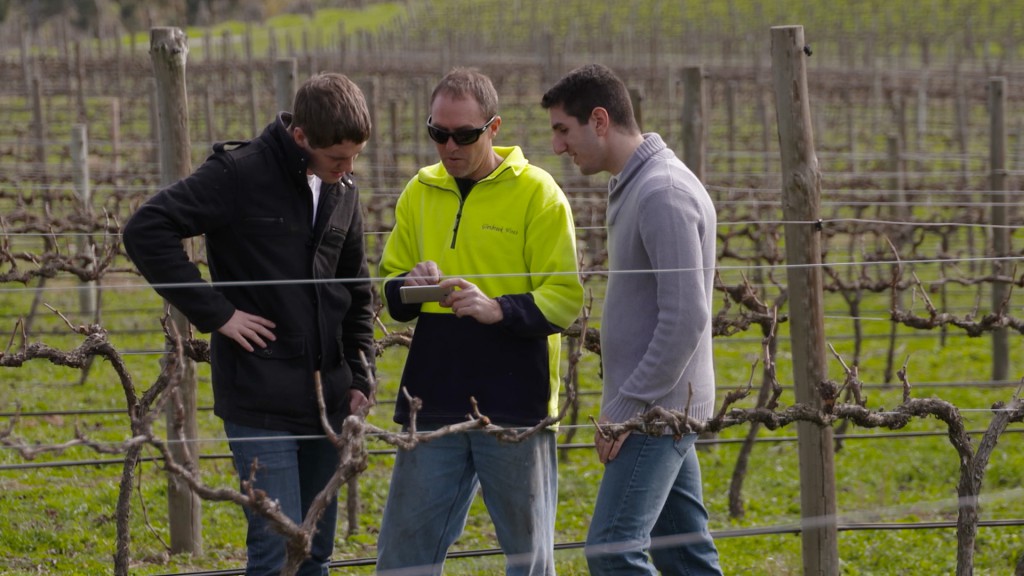
    As we gather more data, the opportunities to apply it become wider. A good example of this is Seer Insights, a South Australian company started by pair of university students that calculates the likely grape yields for vineyards.

    Seer Insights’ product Grapebrain is made up of two components, a mobile app that the farmer uses to count the grape clusters on the vines and then a cloud service that analyses the data and produces web based reports for the farmers.

    The current methods are notoriously unreliable with Seer Insights estimating mistakes cost the Australian viticulture industry $200 million a year as harvests are miscalculated resulting in either rotting fruit or wasted contractor fees.

    Born in an elevator

    Seer’s founders, Harry Lucas and Liam Ellul, started the business after a chance meeting on their university campus. “We started off doing this after being stuck in a lift together,” remembers Liam. “Originally we were looking at the hyper-spectrum imaging for broadacre farming but when we started looking at the problems we ended up talking to wine organisations about this.”

    “The technology predicts how many grapes will be coming off the vineyards at the end of the season to enable people to sort out their finances,” Harry says. “The growth process grapes go through is difficult to model so we use machine learning to do that.”

    For both the founders having an off the shelf product, in this case Microsoft’s machine learning tools, to run the data analysis made it relatively easy to launch the product.

    As a winner of Microsoft’s Tech eChallenge, the startup has won a trip to the United States as well as being profiled by the company as a machine learning case study.

    Over time as these tools become more accessible to small companies we’ll see more businesses accessing machine learning services to enhance their operations.

    As companies face the waves of data flowing into their businesses over the next decade, it will be those who manage it well and gather valuable insights from their information that will be the winners.

    Similar posts:

    • No Related Posts
  • Panning for digital gold

    Panning for digital gold

    Today social media analytics startup Vintank announced their acquisition by the W2O Group, a network of data driven marketing and communications firms.

    W2O’s acquisition shows how data analytics and visualisation is increasingly an important tool for management in a world where businesses are drowning in information.

    Last year Vintank co-founder Paul Mabray spoke to Decoding the New Economy about the company and how social media data is a valuable tool for the wine industry.

    “The wine industry is last industry to have been changed by internet,” Mabray says. One reason for this in his view is how that the sector hasn’t had a disruptive startup like Yelp or Open Table to drive change and upset incumbents.

    Despite the wine industry’s reluctance to adopt digital technologies, social media and the disruption of established media channels is having a profound effect on the sector’s marketing and sales.

    “In the old days there was a playbook originating with Robert Mondavi in the 1970s which is create amazing wine, you get amazing reviews and you go find wholesalers who bring this wine to the market,” Mabray told Decoding the New Economy during a visit to Australia in 2014.

    Dealing with global proliferation

    Mabray also flags the massive growth in the wine industry as being one of Vintank’s driving forces, “the global proliferation of brands the increase of awareness and consumption patterns where people like wine more, those playbooks didn’t work in 2009 when the crisis started.”

    A proliferation of new competitors coupled with disrupted communications channels isn’t unique to the wine industry, the attraction Vintank has to the w2O Group’s president Bob Pearson; “VinTank provides us with a way to create agile audience engines for a brand, where we can learn what an audience is doing online, understand what content they like.”

    For many businesses social media is a both an opportunity and a mystery; while customers are telling the world what they’re buying through services like Facebook and Twitter capturing, managing and using that information remains a challenge.

    Panning for digital gold

    As Robyn Lewis of Visit Vineyards whose database holds details on over 30,000 Australian wineries and associated tourism business says, “the gold is in the data.”

    Panning for that gold is Emma LoRusso of Sydney social analytics startup Digivizer who told Decoding The New Economy two years ago “the truth is in data”. Services like Vintank, Salesforce’s Radian6, Klout and startups like Digivizer attempt to add context to that data.

    Another aspect of Vintank’s technology is the ‘geofencing’ of information, creating a virtual geographic perimeter so only data relevant in that region is flagged. As well as reducing noise, this increases the value to local wineries and tourist operations.

    In some respects the geofencing is possibly the most powerful part of services like Vintank as it allows regional operators to focus on visitors and customers to their districts rather than worrying about national or global activity.

    W2O’s acquisition gives Vintank access to a broader market outside the wine industry as well as deeper data analytics capabilities. For W20 the purchase adds to the social media tools the company can offer.

    Data driven business

    The Vintank deal with W2O shows how the marketing and advertising industries are increasingly becoming data driven. For other business functions this is true as well.

    For businesses of all types, understanding the data pouring into their companies is going to be the difference between success and failure in an increasingly digital world. Providing those tools to do so is one of the great opportunities in today’s economy.

    Similar posts:

    • No Related Posts
  • Lost in the crowdsourcing masses

    Lost in the crowdsourcing masses

    The crowd is as smart as wine experts claims review app Vivino in a blog post comparing its users’ ratings of wines against the long established industry standards of Wine Spectator and Robert Parker.

    Crowdsourcing’s advantage claims Vivino is “the experts can’t rate everything. But 8 million (and growing) Vivino users just about can. Will a 4.0 wine on Vivino be the new ’90 point wine’?”

    Although Vivino are talking up their book on this, the message here is that the wisdom of crowds – or the Cult of the Amateur as author Andrew Keen described it in 2007 – is taking the place of all but the highest profile experts’ opinions.

    Removing the informed commentator

    This is true in almost every critical field from journalism to food and travel writing, if you don’t have, or a can build, a big following in your chosen niche then you’re just one of the crowd punching out a blog, Facebook posts or Instagram feed.

    Wine writers and experts are in the same position, if the aggregated opinions of eight million users can give you an informed opinion about a vintage then why spend good money to consult someone who has spent years studying and working in the industry?

    In some ways this is the downside of blogging; suddenly anybody with an internet connection can hold themselves out as being an informed critic. A case that stands out is an Australian food blogger who criticised a Sydney cafe for it’s ‘weird sushi sandwiches’ and strange Japanese fusion food without realising he was eating a Scandinavian open sandwich.

    One of the effects of the web is that it’s both diffused and concentrated influence – a vast array of informations sources meaans small international group of high profile experts find their standing grows as they become more accessible while most of the industry is drowned out by forums, apps and social media sites.

    The challenge for many of us is how are we going to stand out from the crowd.

    Similar posts:

    • No Related Posts
  • Links of the day – Mind games, wine growers and the Naples mafia

    Links of the day – Mind games, wine growers and the Naples mafia

    Mind games, wine growers and the Naples mafia are among today’s links along with last person in Britain who lived under Queen Victoria passing away and a touching series of portraits showing the end of the film photography industry.

    Cutting out the middle man

    Reka Haros is a wine maker in Italy’s Venuto region. Like many small producers her winery struggles with distribution and sales in a crowded market. Reba’s solution of going direct to the customer is one that many businesses should be considering in a noisy world.

    Life in protection

    I don’t fear death, I fear being discredited. The story of Italian journalist Roberto Saviano and his eight years in protection after writing about the Naples mafia.

    Picturing the decline of film photography

    Canadian photographer Robert Burley travelled the world with his 4×5 field camera to document the end of analogue photography. It’s a poignant portrayal of how an entire industry comes to and with one technological change.

    Last of the Victorians

    Ethel Lang, the last surviving Briton to live under the reign of Queen Victoria, died last week at the age 114.

    Manufacturing false memories

    A frightening physiological experiment shows a cunning interviewer can convince most of us  we committed crimes which we are totally innocent of. This truly is a disturbing story.

    Similar posts:

    • No Related Posts
  • A unicorn in the wine industry

    A unicorn in the wine industry

    “I was a closet tech guy until the 2000s,” says Vintank’s founder Paul Mabray in describing how digital technologies are changing the wine industry to the Decoding The New Economy YouTube channel.

    We’d spoken to Paul before about the forces changing the wine industry and visiting him in the Napa Valley gives some perspective on the opportunity the sector has in capturing the enthusiastic US wine market.

    Paul’s first venture into wine technology was with Inertia Beverage Group in 2002, “when I started Inertia I said ‘hey, there’s this thing called the internet’”, Mabray recalls. “They said ‘hey Paul you’re so cute, the internet won’t be around in a couple of years.’”

    The internet being a fad turned out not to be the case and Vintank evolved out of the rising importance of social media to industries like wineries.

    “Vintank is the mission control of social media, the one stop engagement platform for the wine industry,” says Paul of his social media listening service which he and co-founder James Jory established in 2009.

    Wine is lagging other industries in adopting social media and other digital technologies because it’s avoided many of the disruptions other sectors have had to deal with.

    “The wine industry is the last industry that hasn’t been changed by the internet,” Mabray says. “If you look at hotels with expedia.com or restaurants with Yelp or Open Table, that hasn’t happened yet.”

    A key facet of Vintank is its use of the freemium business model in offering a basic service for free; a common practice in the consumer (B2C) market but fairly rare in business (B2C) software services.

    “It’s a very different way to do freemium in B2B. Freemium in B2C you do mass adoption — that tiny fraction that pay makes it profitable because so many people have it.”

    “In the B2B freemium model what you have to do is distribute it for free and then you measure the usage; who is using it the most is where you send the sales team in.”

    For Mabray, we’re in early days of using digital media and the wine industry is one of the sectors that needs to adopt the technologies quickly: “The driver for me is this horribly complex problem that needs to be solved — the wine industry needs digital to survive.”

    Similar posts:

    • No Related Posts