the price on our heads

Are we selling our privacy too cheaply?

Over 500 million people have signed up on Facebook, trading their privacy for the ability to connect with friends and online communities. In turn, Facebook has built that massive group of people into an asset worth an estimated $41 billion dollars. But does it rely on us selling our privacy too cheaply?

A common factor in many of our communication channels in the last fifty years has been how we, as a group, have been prepared to trade something personal in return for a cheap service.

Broadcast media’s model offers us free or – in the case of newspapers, magazines and Pay TV – subsidised news, sport and entertainment in return for shrill or intrusive commercials that usually wastes our time.

Similarly with social media tools, in return for a free and easy way to find friends and relatives, we trade our privacy for targeted online advertising which can be so precise a commercial can be designed just for one individual.

The social media advertising model is on many levels a great idea, it cuts out irrelevant messages to the consumer and for the advertiser it’s more effective than the “throw it against the wall and see what sticks” methods of the broadcast advertising world.

A weakness in social media advertising in that it relies on users being prepared to trade away their privacy. Until now, all of us have been fairly relaxed about this despite the evidence mounting that giving away all our privacy and access to our networks often has costs to our reputations and friendships.

That cost can be great,  with the worst case seeing people lose jobs, friendships or even their liberty for something that they, or one of their friends, thought was quite innocent.

Under the old trade off, we could turn off the TV or not buy a magazine if we found the advertising too distracting or offensive. With new media we can’t recover our privacy once it’s been given away.

As we begin to understand the nature of our connected society and the values of our online reputations, we’ll expect a better price for our privacy. The challenge for platforms like Facebook and other social media tools over the next few years will be to convince us that these trade offs and potential risks are worthwhile for the benefits they offer.

Australia’s one trick economy

Businesses need fall back plans, particular when the nation doesn’t have one.

Earlier this week, Reserve Bank of Australia Governor Glen Stevens gave a speech to the Australian Industry Group on the world’s changing economic currents.

That presentation has a number of pointers for Australian businesses on how we use technology, our investments and, most importantly, where the Canberra sees our economy going.

Much of the Governor’s speech discussed how those of us who at the beginning of the century believed Australia’s economy had to diversify into new industry sectors — such as the IT sector — were proved wrong by the Dot Com Bust and the subsequent boom in the resources sector.

“Australia would probably do best, in its production structure, to stick to its comparative advantages in minerals or agriculture or various services.” Mr Stevens quoted from ten years ago, “but it was hard going trying to make sensible points against the barrage of market and media commentary.”

Perfect hindsight

It’s impressive the Governor had this perfect hindsight which can overlook the role of ramping the housing markets by the Rudd and Howard governments to avoid the 2001 and 2008 US recessions along with the sheer good luck of having a resources boom through the last half of the decade.

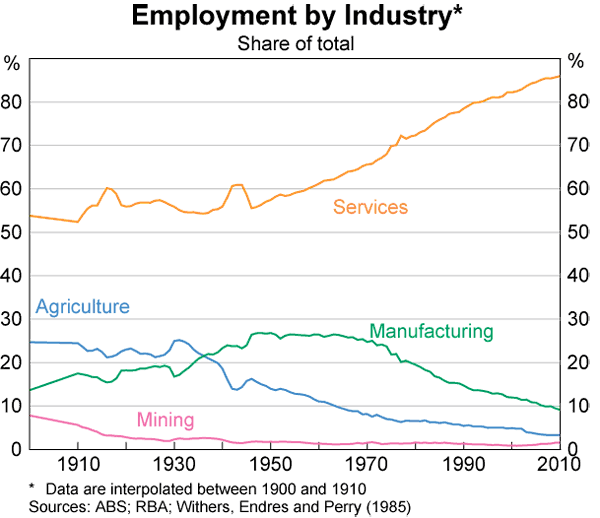
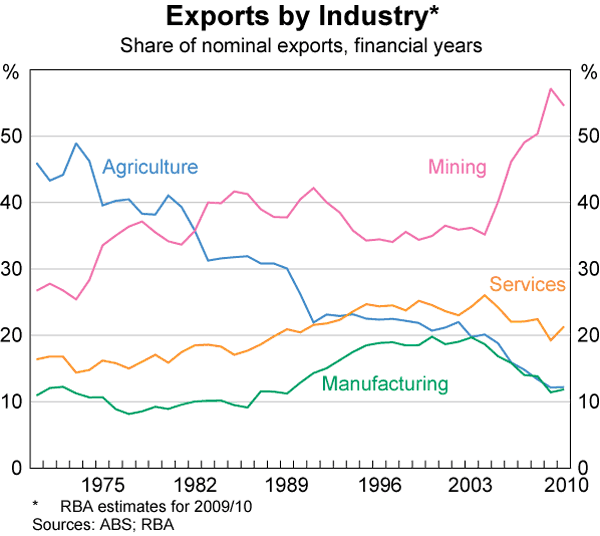
During his speech the governor referred to an RBA research paper, Structural Change in the Australian Economy which casts an interesting light on the comparative advantages in those “various services”.

That paper shows that service sector employment has risen to nearly 85% while its share of GDP has stayed around the same for the last twenty years, which to this non-economist’s mind implies the portion of national wealth is declining for service based workers and businesses.

Sleepwalking into the dutch disease

Of course those of us in the service sector could make it up by exporting but here again, service sector exports haven’t done much over the last decade which won’t be helped by the current high Aussie dollar — another aspect of the Dutch Disease we seem to have sleep walked into over the Howard and Rudd years.

Those same statistics show mining employment has declined over that period as well and if you’re considering sending your kids down the pit, or even packing in your own city job to drive a mining truck, you might want to read the interesting work being done by the University of Sydney’s school of robotics.

Generously, Governor Stevens didn’t completely write off the role of technology observing that, “in the old versus new economy stakes, it was probably in the use of information technology, rather than in the production of IT goods, that the gains would be greatest.”

Invest in, but don’t develop, technology

The Governor’s messages are clear to business people; our businesses have to invest in technology to be more efficient and we need to understand that government policy will be geared around the mining sector.

Most importantly, we need to understand that on a national level there is no Plan B.

In the last election it was clear both sides of politics based their policies, such as they were, on the assumption the China boom will last for the foreseeable future. Yesterday’s speech shows Glenn Stevens and the Reserve Bank share that outlook and no other alternative is being planned for.

That’s fine for Glenn, Julia, Tony and their colleagues as they have safe, indexed pensions when they deign to cease giving us the benefit of their visionary leadership.

In the business community we don’t have that luxury; a plan B is required just in case things don’t quite work out the way we hope. As the Governor says:

Succeeding in the future won’t ultimately be a result of forecasting. It will be a result of adapting to the way the world is changing and giving constant attention to the fundamentals of improving productivity. That adaptability is as important as ever, in the uncertain times that we face.

That’s excellent advice. How adaptable is your business in these uncertain times?

ABC Nightlife October 15 2010

The new business web trends

Update: You can download the show from the ABC Nightlife homepage included in the program are some ideas on how kids use the net, the challenges for franchises and the importance of search engine optimisation.

The Internet is changing how businesses are working online. Join Tony Delroy, Paul Wallbank and Chistena Singh from Sensis to discuss some of the ways customers and businesses are changing the way the buy and sell on the Internet.

Business has changing for last fifteen years as customers move online to check the deals and products available. With most people now on broadband and more using their mobiles, the game is changing again.

We’ll be looking at the e-business report which is a free download available from the Sensis website.

Tune in on your local ABC radio station or listen online at www.abc.net.au/nightlife.

If you’d like to join the conversation with your questions or comments phone 1300 800 222 within Australia or +61 2 8333 1000 from outside Australia.

You can SMS Nightlife’s talkback on 19922702 or twitter @paulwallbank using the #abcnightlife hashtag

On being a price taker

does your business rely on being cheap?

As Australia’s dollar reaches parity with the US dollar for the first time in thirty years, the nation’s newspapers and politicians are awakening to the reality that this is not a good thing for most Australian exporters, particularly for those mineral industries which are cited as being responsible for the Goldilocks economy.

Those concerns are real, as this affects the employment of millions of Australia in the agriculture, mining and tourism industries.

Selling a price dependent commodity product locks a country or business into cycles they can’t control; currency movements, trade wars and cheaper competitors.

Adding value and creating products that can withstand the commodity cycles is the future for advanced economies. It’s as true for the businesses within these countries as it is for the entire nation.

If your business sells on price, then you’ll need to think on how you can change your customer’s perception about your product before they see it as a commodity which can be bought cheaper from someone else.

The innovation smugglers

Those dissenters sneaking new tools into your business are the future. Your organisation needs to embrace them.

“Sales staff have bought a pile of iPad’s!” wailed a senior executive last week “they didn’t get authorisation through IT, there are all sorts of security and business risks!”

This echoed the comments I’d heard a few weeks earlier while doing a workshop on cloud computing, that people were running software as a service applications alongside their businesses’ software without telling their management what they were doing.

All of this is reminiscent of the spread of personal computers in the late 1980s where IT departments, such as they then were, banned the use of IBM compatible or Macintosh computers because they were outside the control of the organisation.

The prevailing view was that computer systems were the domain of a select few, running the payroll and doing complex calculations in batches at two in the morning. There was no reason why the average worker should need this sort of technology.

Eventually, managements realised those subversive personal computers running programs like Wordstar and VisiCalc improved productivity and made businesses more flexible. Within five years few businesses didn’t have computers on the desks of every office worker.

We’re at the same stage now with cloud computing, social media and portable devices as many of today’s managers see them as at best toys and a threat to their organisation’s integrity. Quietly though, groups within are using theses tools to improve their teams’ effectiveness while not letting IT or senior management know how they are doing it.

These dissenters are an organisation’s innovators and in a perfect world they would be embraced by managers, directors and shareholders alike as the future of the company.

Many large organisations though don’t see it this way, as their view of the workplace is that innovation and new ideas have to be signed off by seven layers of management after being cleared by legal, HR and the facilities department.

This is where the opportunity lies for the smaller, smarter companies. These tools make organisations faster and more responsive to threats and opportunities which is perfect for the nimble and flexible enterprises.

If you have staff who are smuggling in these tools and devices into your business, consider sitting down with them and getting them to show you how these products improve their work. You may be surprised and it may save you some time in writing stern memos which will be ignored anyway.

The beauty of these tools is you don’t need to throw out your existing equipment and methods as often these new innovations sit happily alongside the legacy stuff. Cloud services are good example of this where services such as Salesforce and Google Apps work with and often plug into the older, established tools.

Because they play nice with existing business tools it’s easy to introduce or evaluate new systems by encouraging the innovators to set up groups or pilot projects within the organisation, which is probably what they are doing anyway without telling you.

In a competitive world, your dissenters are one of your greatest assets, by questioning how and why we use the tools we do, these folk are figuring out how businesses will run in the connected economy.

The question is, do you want your business to be succeed in this new economy?

the failure imperative

To succeed, we need to risk failure

Reading an Inc Magazine profile of TechCrunch founder Mike Arrington, one of the quotes that leapt out of the story was Arrington’s view on entrepreneurs and failure;

Our main competitive advantage is that my team and I truly love entrepreneurs. They’re my rock stars. I’ve always been fascinated by entrepreneurs. I had four businesses that did not work out. TechCrunch is my first real success, and it happened by accident. If I were to write a book, it would be about what drives entrepreneurs. I meet the winners, and the losers, too. Most of them could go out and get a perfectly reasonable job as an accountant or a lawyer. Instead, they risk everything for almost certain failure. The losers are actually more interesting sometimes. You learn a ton from failure.

“You learn a ton from failure”

We have a habit of celebrating the winners and ignoring the ventures that didn’t work out, if we don’t outright scorn them.

The thing is we learn from the failures — the misjudgements, bad luck and downright stupid ideas that we all have when running a business teach us about ourselves, our partners and the world around us.

We need to be valuing those lessons as they prepare us for when we do have a success.

The world is becoming increasingly risk adverse and the paradox there is that by avoiding failure, we ultimately reduce our chances of success.

Why hung Parliaments are good for business

A government answering to independents is the best result for businesses

Heather Ridout, the Australian Industry Group chief executive, is quoted that Independent control of Parliament will result in “instability, uncertainty and short-termism in policy development” which is an interesting view, given these are exactly the reasons voters have punished the major parties.

Indeed Heather has seen this first hand as a member of the Henry Tax Review Panel, where the final report was hidden for six months, then the bulk of the recommendations were ignored and the few accepted were mutilated and taken out of context.

All of this with no debate or consultation with the community in a review that would “position us to deal with the demographic, social, economic and environmental challenges of the 21st century.

So much for the vision of the big parties.

Leadership isn’t delivered by risk adverse, focus group obsessed political managers doing deals with big corporations and lobbyists; it’s delivered by leaders who are capable of stating their case and steering their views, visions and policies through fair and robust debate, not hiding behind well crafted communications strategies and sound bites.

We need leadership in both business and politics to face those 21st Century challenges the Treasurer identified when he announced the Henry Tax Review.

A hung Parliament is a once in a generation opportunity to rebuild leadership and confidence in our governments. It’s one we shouldn’t squander.

Failing Fast: Google Wave’s real business lesson

The fail fast philosophy is changing how businesses in all industries are operating.

A key philosophy underlying much of Silicon Valley’s successful companies is the “fail fast” concept where a business releases a rough version of a new idea and asks the world what it thinks. Should people like the idea, it gets developed and if they don’t, it gets dropped and everybody moves on to the next brainwave.

The “fail fast” philosophy was behind Google Wave’s dropping last week, as CEO Eric Schmidt said at the Techonomy Conference on the day it was announced; “….we release it and see what happens. It works, you announce product, you ship it…”

Until recently, “failing fast” was restricted to hot shot Internet businesses but as the cost of product development falls due to better collaboration tools, testing methods and global outsourcing, it’s become easier for all businesses to experiment without risking an organisation’s future.

This is very different from the old style of doing business, a good example of how things used to work was Boeing’s development of the 747 Jumbo Jet which was a $2 billion dollar bet, $14bn in 2010 dollars, on a big lumbering subsonic jet in the mid 1960s when the future of aviation seemed to be with sleek supersonic aircraft like the Concorde.

While Boeing’s bet paid off, it took 15 years and nearly sent the company broke.

Most of today’s businesses aren’t locked into 14 billion dollar and 15 year investment cycles as we can test products with simulation tools, computer aided design programs, fast prototyping and oursourcing services like o-desk for labour and alibaba.com for manufacturing without risking the farm.

For most businesses, it’s not even a matter of spending time and money actually developing ideas, usually it’s something as simple as testing a new idea by buying a domain name and setting up a low cost website on a cheap hosting service for under $200. If the idea flies then you start looking at spending real money on making the product ready for the broader market.

Failing fast presents a great challenge to the traditional organisation where the slightest failure is a stigma. In the new economy, a risk adverse culture is going to be punished by competitors who accept that not every idea is right for its time and learn lessons rather than punish those associated with the unsuccessful project.

While this is bad news for large organisations run by risk adverse managers it is one of the great opportunities for nimble and smart companies. If your business is prepared to take small risks, learn from the misses and celebrate the wins then your business could well be on the way to being the next Google.

The freeways of the future

How the Internet is changing Maggie’s life

“I don’t see why the Internet is important to me” said Maggie, the first caller to our “is the Internet the ultimate consumer’s revenge “ radio program.

Maggie’s question is a very good one at a time when governments, businesses and households are investing heavily in Internet technology. Just a few hours before the radio show I’d been invited by television program A Current Affair, to discuss if Australia’s 43 billion dollar investment in a National Broadband Network is worthwhile.

For Maggie and ACA’s viewers, the answer is “yes, it is very important” — the Internet today is what the motor car was to the early 20th Century and railways were to the 19th Century. Communities that aren’t connected will miss the benefits of the 21st Century economy.

To illustrate how important it will be, let’s have a look at Maggie’s life. We’ll assume she’s an older person living in a regional Australian town or one of the fast growing fringe suburbs of a big city.

Probably the most immediate change the Internet delivers for Maggie is how it is giving her a stronger voice as a consumer and citizen. This is what we discussed on the ABC program, how Internet tools like social media are giving customers and voters their voices back.

With reliable broadband Maggie can be researching products and voicing her dissatisfaction with government and private organisations to the world in a way that would have been impossible a few years ago.

Those Internet tools also growing communities around her as like minded people across the world and in her own district are connecting online then meeting in real life at events like Coffee Mornings.

Not only does the Internet connect communities, it connects families — one lady recently described to me how she speaks more to her daughter living in Brazil through Skype than she did when they lived nearby. The net brings friends and families back together and helps overcome social isolation.

Exclusion in education has always been a pressing issue, once upon a time you had to be in Cambridge or Oxford to access the world’s great minds. With a fast reliable Internet connection, the kids in Maggie’s neighbourhood can listen to a Harvard or MIT professor’s lecture without leaving their hometown.

Bringing knowledge to local communities will also help Maggie should she have to have to go to the local hospital, the local doctors will be able to consult specialists without Maggie having to travel long distances to get specialist advice.

Importantly for Maggie and her local hospital, the access to online training resources mean the local staff will be up to date with their professional development and across new trends, ensuring Maggie’s standard of care will be equal to the big city teaching hospitals.

Solving staff training issues also delivers benefits for the local business community. It means the Maggie’s son Tim, the owner of a local plumbing business, doesn’t have to pay for expensive training courses or to travel into town to attend business conferences.

The net also means Tim can access the world’s best business minds without leaving his office. Which gives him benefit of running his business more efficiently and profitably.

For Tim’s kids, it also means they aren’t excluded from the entertainment world. They can stream and download the latest things happening and share equally on social networking sites. They may be in a small town, but they can play in the big world.

Having these education, business, training and entertainment resources strengthens communities. It means kids and entrepreneurs can live in their home towns and still participate in the global economy. It means Maggie is a valued and important citizen of her country and the world.

Fast accessible Internet is more than important, it’s vital just in the ways roads, railways, canals and the telegraph were in their eras. The investment in these freeways of the future is necessary to grow strong and dynamic communities.

5 ways to manage information overload

If President Obama struggles with his information overload, how can the rest of us deal with it? Here’s five ideas on how to manage the inbox deluge.

In a speech to university graduates on the weekend President Obama described some of the problems we face with information overload. That the US President struggles with it despite his army of secretaries, assistants and advisors shows just how big the task has become for the rest of us.

Albert Einstein famously said “information is not knowledge” and that’s certainly true of the net. We need ways to process the data that comes pouring in so we understand the context and value of what we’re reading. Here’s five ways to manage your information overload;

Mail Rules

For most business people, email is the first thing we look at each morning and it’s where half the day can easily disappear. The mail rules built into every email reader help you filter the important from the not so important.

It’s also worthwhile reviewing your email subscriptions every few months and unsubscribing from newsletters that no longer interest you. The less clutter, the better.

Google Alerts

“Unknown unknowns” is a quote from a less esteemed historical figure and there’s a lot we don’t know happening on the net that can affect our lives and businesses. The Google Alerts tool gives you a regular email summary of what’s appeared on the web for any search term you enter.

The right terms in Google Alerts gives you an insight on news and trends about your industry, competitors and customers. It’s a great, but underused, market intelligence tool.

Twitter

90% of what you read about Twitter discusses marketing, in my view Twitter’s real value lies in following smart people who tweet smart things. You get the benefit of the accumulated wisdom of the people you follow and the things they find interesting.

These days I find I spend as much time reading links I’ve saved from Twitter as I do surfing the net. It’s become an invaluable tool.

RSS Feeds

Most websites have a built in feature called Really Simple Syndication, or RSS feed, which pumps out updates to the site as they happen. You can use the built in RSS features in your browser’s bookmarks folder or a dedicated feed reader to keep up to date with your favourite websites. Just click on the subscribe button most websites feature.

Favourites

Bookmarks or favorites is the oldest way to save information off the web and it can result in overload of its own. If you keep your bookmark folders organised, it can be a treasure trove of useful information.

We’re at the early days of the information economy and the flood of data which engulfs us is going to get even greater. The challenge for all of us is to learn how to manage this so we can derive the best benefits from this new economy for our businesses, society and families.

As President Obama said in last weekend’s speech at Hampton University, Virginia;

“What Jefferson recognized… that in the long run, their improbable experiment — called America — wouldn’t work if its citizens were uninformed, if its citizens were apathetic, if its citizens checked out, and left democracy to those who didn’t have the best interests of all the people at heart.

“It could only work if each of us stayed informed and engaged, if we held our government accountable, if we fulfilled the obligations of citizenship.”

The same is true of our personal and business lives as it is of our citizenship. Get informed.

The elephant in the room; why online publishing is very sick

Depending on cheap or free labour is a doomed business model and this is a problem for online publishers

Media 140’s Sydney meetup last week attempted to discuss the future of journalism. While it wasn’t really successful, it did expose the fundamental flaw in the online publishing model and the other crowdsourcing business ideas that rely on cheap or free labour.

All three panellists agreed that as publishers “The sustainability of our business is very much linked to the quality of content.”  because with several million online voices a site needs compelling and relevant content to attract and retain readers.

Yet every panel participant agreed the cost of content is falling and in many cases is now free.

There lies the paradox; if content is so valuable, why is it so cheap or even worthless?

The model for online publishers is the same as it was in the days of every city having three evening newspapers or when the six o’clock TV news was the most watched show on television. Compelling content attracted readers and viewers which in turned attracted eager advertisers.

In the days of metro evening newspapers and the six o’clock news there were substantial barriers to competition with printing presses, broadcast licenses and distribution networks required. Today anyone who can afford $10 a month for website hosting can be a publisher.

Worse, the rates for online advertising are plummeting and with the site owners only making a few dollars there’s little for publishers, let alone the content creators.

Which brings us back to the fundamental problem, if there isn’t any money for those who create the content then there’s little point in the middle men distributing it.

Many of today’s online publishers are like the loom weavers of the early 18th Century who derived a short term benefit from the change that eventually destroyed them. The same forces that make journalists work for nothing are the same ones that will render the bulk of publishers insolvent.

And that could be where the future of journalism, writing and publishing really lies — the bulk of the industry eking out an existance providing commoditised, generic pap and a few niche publications with readerships that attract  good incomes that in turn can pay a small number of  writers.

That’s certainly the model the panel at Media 140 are betting on and I hope they all do well.

The Future of Journalism

Many occupations are faced with free or cheap labour swamping their marketplace. Journalism is one of those trades. Media140 met in Sydney to discuss exactly where the future of journalism lies.

Last week’s Media 140 meeting in Sydney looked at the future of journalism and how publishers are paying, or rather not paying, contributors to their online publications.

The evening was well documented by Martin Cahill and the message was clear — publishers are not going to pay for content because even if they want to they can’t afford it.

The prevailing view was journalists will have to learn how to multi task; but given YouTube is even more poorly rewarded than online journalism, it’s unlikely sites will be any more generous to video or audio contributions than they are to text contributors. Which only suggests a future of journalists doing more work for no money.

Valerio Veo, Head of SBS News and Current Affairs Online pointed out SBS is paying a 19 year a $1000 per contribution for covering Obama’s visit to Indonesia.

Ignoring this is pocket money in terms of sending a camera crew and traditional reporter, the fact SBS are one of the few Australian organisations paying online contributors suggests ABC Managing Director, Mark Scott’s, view at a previous Media140 that only government supported organisations will be able to afford to pay journalists is part of the future is correct.

So what is the future of professional journalism? Will it be restricted to a few subsidised outlets? Is it the gifted amateur contributing for their love of the masthead? Or is it that of the professional pushing their own or their employer’s agenda?

Maybe journalists will become editors cleaning up the shoddy contributions of not so gifted writers that have the only benefit of being free. Could it be that curating other people’s content will be the role of future journalists?

Or perhaps journalists are the new poets, starving in garrets and working in desperate jobs while waiting for the phone call from the ABC, BBC or PBS, penning great works that will lie undiscovered on obscure blogs which will only be found after their passing?

We didn’t really glimpse the answers at Media140 and this is an important discussion to have as the rise of the digital sharecropper isn’t confined to journalism.

Many professional and white collar occupations are going the same way and we need to understand what this means for large parts of our economy. Even if we choose not to discuss it, it’s the reality we face.