Transition effects and changing employment

As the economy changes, so too do the opportunities and threats to our livelihoods

On Australia Day, it’s worthwhile considering one group of convicts in the early fleets who stood against an earlier time of economic change.

As the automation of the cloth weaving process accelerated through the 18th Century,  many trades in the English fabric industry, such as Croppers, found their skills in great demand.

Yet by the early 19th Century, their trades were near extinct as automation reduced the cost of weaving fabric dramatically and labourers replaced skilled workers.

This massive wave of change and loss of once well paid skilled jobs helped accelerate the Luddite movement, many of whom were transported to Australia for their role in attacking factories using the new technologies.

We should keep the plight of the croppers and Luddites in mind in today’s period of massive economic and technological change.

One notable aspect of the workforce when industries are going through major changes is how many high paid skills and business niches pop up for a short time before being overwhelmed by change.

We shouldn’t consider that many of the services and opportunities in today’s economy are permanent, quite a few businesses and skills that have appeared in the last two decades might not survive this one.

A good example is the web designer. In 1996, a punk with a little basic HTML knowledge could call them selves a web developer and three years later many of those punks were driving Porsches and Lamborghinis. By the mid-2000s most of those expensive cars were just memories for those who assumed those basic skills set them up for life.

Today we see the same thing with social media, group buying and cloud computing. Many of the services we see – some of them being valued for billions – are transition effects as markets adjust to changed conditions.

As we begin to understand the effects of trading our privacy for connections, trusting valuable data to anonymous corporations and mass selling for discounts, we’ll see consumers, governments and business adapt.

Some of today’s superstars will adjust to those changes and become the next Microsoft or General Motors while many others will fond memories after their reason for existing vanishes.

We should grab opportunities when we see them – many of the thousands of Groupon clones are doing exactly that ­– but we shouldn’t assume they are permanent and forever.

A time of change means none of us can assume our livelihoods, skills or assets are safe, just as those 19th Century industrial workers found when they were transported to Australia.

Mule-spinning room in Chace Cotton Mill in 1909 by Lewis Hine courtesy of Wikimedia

Australia’s one trick economy

Businesses need fall back plans, particular when the nation doesn’t have one.

Earlier this week, Reserve Bank of Australia Governor Glen Stevens gave a speech to the Australian Industry Group on the world’s changing economic currents.

That presentation has a number of pointers for Australian businesses on how we use technology, our investments and, most importantly, where the Canberra sees our economy going.

Much of the Governor’s speech discussed how those of us who at the beginning of the century believed Australia’s economy had to diversify into new industry sectors — such as the IT sector — were proved wrong by the Dot Com Bust and the subsequent boom in the resources sector.

“Australia would probably do best, in its production structure, to stick to its comparative advantages in minerals or agriculture or various services.” Mr Stevens quoted from ten years ago, “but it was hard going trying to make sensible points against the barrage of market and media commentary.”

Perfect hindsight

It’s impressive the Governor had this perfect hindsight which can overlook the role of ramping the housing markets by the Rudd and Howard governments to avoid the 2001 and 2008 US recessions along with the sheer good luck of having a resources boom through the last half of the decade.

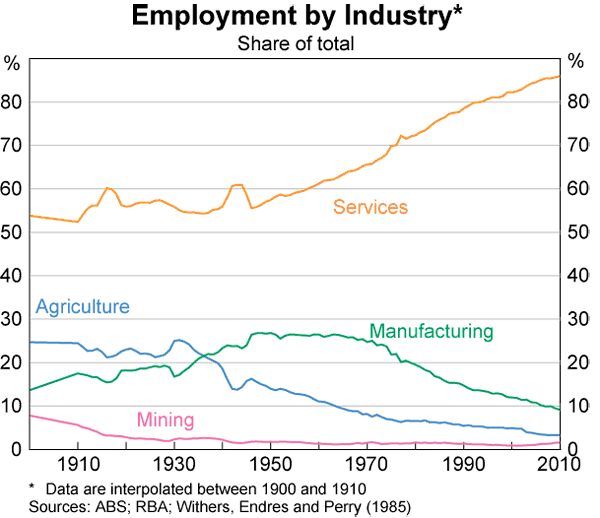
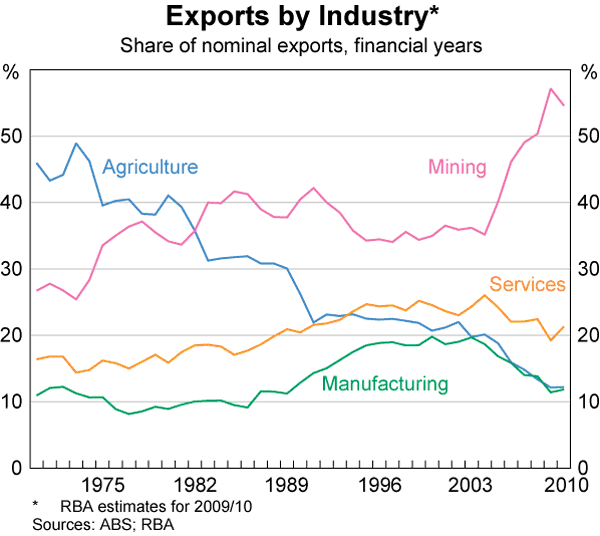
During his speech the governor referred to an RBA research paper, Structural Change in the Australian Economy which casts an interesting light on the comparative advantages in those “various services”.

That paper shows that service sector employment has risen to nearly 85% while its share of GDP has stayed around the same for the last twenty years, which to this non-economist’s mind implies the portion of national wealth is declining for service based workers and businesses.

Sleepwalking into the dutch disease

Of course those of us in the service sector could make it up by exporting but here again, service sector exports haven’t done much over the last decade which won’t be helped by the current high Aussie dollar — another aspect of the Dutch Disease we seem to have sleep walked into over the Howard and Rudd years.

Those same statistics show mining employment has declined over that period as well and if you’re considering sending your kids down the pit, or even packing in your own city job to drive a mining truck, you might want to read the interesting work being done by the University of Sydney’s school of robotics.

Generously, Governor Stevens didn’t completely write off the role of technology observing that, “in the old versus new economy stakes, it was probably in the use of information technology, rather than in the production of IT goods, that the gains would be greatest.”

Invest in, but don’t develop, technology

The Governor’s messages are clear to business people; our businesses have to invest in technology to be more efficient and we need to understand that government policy will be geared around the mining sector.

Most importantly, we need to understand that on a national level there is no Plan B.

In the last election it was clear both sides of politics based their policies, such as they were, on the assumption the China boom will last for the foreseeable future. Yesterday’s speech shows Glenn Stevens and the Reserve Bank share that outlook and no other alternative is being planned for.

That’s fine for Glenn, Julia, Tony and their colleagues as they have safe, indexed pensions when they deign to cease giving us the benefit of their visionary leadership.

In the business community we don’t have that luxury; a plan B is required just in case things don’t quite work out the way we hope. As the Governor says:

Succeeding in the future won’t ultimately be a result of forecasting. It will be a result of adapting to the way the world is changing and giving constant attention to the fundamentals of improving productivity. That adaptability is as important as ever, in the uncertain times that we face.

That’s excellent advice. How adaptable is your business in these uncertain times?

The real digital divide

We’re often told that there’s a divide between the “digital natives”, those who grown up with computers, and the “digital immigrants”, those who’ve had to learn about computers. In reality this isn’t true, the real digital divide is about being prepared to learn and explore the possibilities being opened up every day by the Internet and computers.

The real digital divide isn’t between the young and the old; it’s between those who are prepared to explore new technologies and those who hide from change.

We’re often told that there’s a divide between the “digital natives”, those who grown up with computers, and the “digital immigrants”, those who’ve had to learn about computers.

In reality this isn’t true, the real digital divide is about being prepared to learn and explore the possibilities being opened up every day by the Internet and computers.

I was reminded of this shortly before Christmas when talking to a group of forty year old business owners who dismissed Internet tools like Twitter and LinkedIn out of hand – “a waste of time” “just for kids” and “I tried and received Chinese spam” being a few of the objections.

The contrast is the Australian Seniors Computer Clubs Association who prove you’re only as young as the computers you tinker with. These seniors, some of whom were retired well before computers became commonplace, are prepared to explore and discover possibilities that change their lives and the lives those around them.

The forty somethings all had successful businesses and they were the first to admit mobile phones, email and websites had changed the way they work. Yet nearly half of them didn’t have a website for their own business; a statistic consistent with business surveys that find almost 50% of small enterprises don’t have a website.

In many respects these businesses and their owners are reminiscent of the handloom weavers of the early 19th Century. At first technology worked in their favour and pushed wages up but as industrialisation continued they found their skills redundant and incomes falling. Eventually their trades and businesses disappeared; which is what will happen to complacent companies and industries in today’s industrial revolution.

A similar thing is happening to society and individuals. While you won’t disappear if you aren’t using the net, those who won’t will find it harder to do pay bills, communicate and simply get things done. Eventually they’ll find themselves marginalised as not being connected will make it harder for family and friends to keep in touch.

All of this is unnecessary, it’s just a matter of being prepared to try and to give something a go. The real digital divide is between those who choose to give things a go and those who don’t.