Tag: google

  • Enter the Dragon

    Enter the Dragon

    Once up a time our parents laughed at the tinny little Japanese cars – in the 1960s companies with silly names like Toyota and Mazda could never threaten world giants like Chrysler, Ford and General Motors.

    Within two decades the Japanese had moved their products up the value chain leaving their American and European competitors running scared while governments in western countries offered the new leaders of the manufacturing industries bribes to set up plants in their towns and states.

    It was always obvious China would follow the same course as the Japanese, particularly given the country’s position as the world’s cheap labor supplier had a time limit thanks to the demographic effects of the 1970s One Child Policy.

    So it’s no surprise that Alibaba, China’s biggest e-commerce service, has built its own mobile operating system to compete with Google’s Android.

    If Aliyun follows the Japanese development path, the first version is terrible but within five years – the development cycle of software is a lot quicker than that of cars – Alibaba will be a viable competitor to Google and Android.

    Chinese developers moving into the mobile market is terrible news for the also rans like Microsoft and Blackberry. As Apple dominate the premium mobile sector and Android the mass market, it’s very hard for those running third or lower to achieve the critical mass needed to be competitive. Aliyun makes it much harder for them to gain any traction in high growth developing markets.

    An interesting aspect of the Wall Street Journal’s story is how Aliyun is aimed at the domestic Chinese market for the moment. This is part of China’s economy moving away from being overly reliant on exports, having locally made products that meet the needs and aspirations of a growing domestic economy is an important part of this process.

    Exports though will remain an important part of the Chinese economy for most of this century and value added products like Aliyun will be important for China as the cheap labour advantage erodes over the next two decades.

    Businesses who think their markets are protected because their quality is better than their Chinese competitors may be in for a nasty shock, just like the 20th Century auto makers who dismissed the Japanese were in the 1970s.

    Whether Aliyun is successful or not, we’re once again seeing many of the facile assumptions about Chinese growth being tested as the country’s economy and society evolves.


    Similar posts:

  • Do we really want fibre broadband?

    Do we really want fibre broadband?

    Despite the enthusiasm to be the first US city to have the high speed broadband offered by Google Fiber, it turns out interest in the Kansas City rollout is only running at half the rate expected.

    This is consistent with the Australian NBN experience, with the takeup rate so far a dismal with less than 20% of Tasmanian properties passed taking the opportunity to get connected – only 10% of accessible premises are projected to sign up in 2012 according to NBNCo’s corporate plan.

    Both the poor take up rates in the US and Australia raise the question “do we really want fibre broadband?”

    The main difficulty are the incumbent players. In Kansas City reports are that Time Warner, the incumbent cable operator, is offering deals to lock their customers into existing plans.

    A similar thing has happened in Australia with the major operators locking customers into existing ADSL and phone plans so subscribers face penalties if they churn across to an NBN service.

    Most of those subscribers don’t need to churn right now, for most users the data plans they are currently on are fine and the NBN prices aren’t substantially different to the existing ADSL charges. In Kansas City, Google’s prices are lower, but the service is some way off and Time Warner can offer a connection now.

    Another problem is demographics, neither Tasmania or Kansas City are major digital industry hubs and parts of both regions are economically distressed, which means they are less likely to take up the offer – or be able to make the investment – to get get connected.

    That latter problem is the most concerning, as regional disadvantaged areas have the most to gain from being connected to broadband.

    Just as towns lobbied in the 19th Century to get railways routed through their communities, in the 21st Century fast Internet connectivity is seen as essential to a region’s development.

    But if individuals won’t get connected then it makes the business case for setting these networks up difficult to justify for corporations like Google or Governments like Australia. In future, it will make it harder to get incumbent network operators to replace aging copper infrastructure with modern and faster fibre.

    As both projects mature, hopefully we’ll see a greater takeup, in the Australian case greater acceptance should be inevitable as the incumbent Telstra copper network is shut down and subscribers migrated across to NBN infrastructure.

    The question does remain though of just how useful homes and businesses see fibre Internet connections to their homes, if they remain unconvinced about the value of a high speed data link then it maybe our communities miss out on the vital communications tool of the 21st Century.

    Similar posts:

  • Google announces eTown awards for Australian towns

    Google announces eTown awards for Australian towns

    I don’t normally post media releases onto the site, but it appears there’s no posting of the Google eTowns announcement. As I’m writing a story for Technology Spectator on it, here’s the release.

    One thing that leaps out when reading the media reports on this is how many outlets just copy and paste. Only the Fairfax entertainment reporter went to the effort of rewriting the release and adding some additional context. You have to wonder how long ‘churnalism’ can survive given readers are onto this laziness.


    EMBARGOED UNTIL THURSDAY 30th AUGUST, 4:30PM (EST)


    Perth wins top spot in Google’s eTown Awards

    Western Australia capital beats out eastern states as centre of digital boom

    Perth leads the list of Australia’s top 10 eTowns, Google announced today. This new Google award recognises and ranks those communities which are outpacing the rest of the country in having its small businesses use the web to connect with customers and grow.

    The web is transforming all businesses in Australia, not just those typically considered to be “Internet businesses”. The digital economy is already worth as much as Australia’s iron ore exports, according to Deloitte Access Economics, and it’s forecast to grow by $20 billion to $70 billion by 2016.

    To provide a snapshot of this vital economic activity, Google looked at more than 600 local government areas to analyse which communities are contributing the most to the digital economy. The top 5 metropolitan and top 5 regional eTowns for 2012 are:

    Metropolitan

    1. City of Perth, WA
    2. City of Yarra, VIC
    3. City of Adelaide, SA
    4. North Sydney, NSW
    5. Ryde, NSW
    Regional

    1. Byron Shire, NSW
    2. Meander Valley, TAS
    3. Cessnock, NSW
    4. Wingecarribee Shire, NSW
    5. Scenic Rim Regional Council, QLD

    Federal Small Business Minister Brendan O’Connor, who is launching the inaugural eTown Awards at an event in West Perth today, said;

    “The digital economy is fuelling Australia’s economic growth and it’s important businesses of every size are well equipped to take advantage of the potential.  I hope this award encourages other small businesses to get online to connect with people who are actively looking for their products and services.”

    Perth’s Lord Mayor Lisa Scaffidi said, “Perth may be known for its mining boom but this award shows that our businesses are actively grabbing hold of the digital boom. The City of Perth is proud of its eTown Award and I am delighted to represent an area whose businesses are so connected with both their local community and the entire world thanks to the web.”

    Online advertising is a growing phenomenon and Google, through its online advertising and other services, is in a good position to act as a barometer for the strength of this commercial activity – particularly in small businesses. To come up with the eTown Awards list, Google analysed data on the number of local businesses in each local government area which are advertising with Google AdWords and/or have created a free website using Google and MYOB’s Getting Aussie Business Online initiative.

    Byron Shire, home to the popular holiday destination, leads the regional eTowns list with a high proportion of accommodation, recreational hire and tours providers using the web to drive their businesses.

    Claire Hatton, Head of Local Business for Google Australia said, “The eTown Award winners show that anyone anywhere can reap the benefits of the digital economy. These days being on the web is as important as having a phone. Australians expect to be able to seek out products and services online, and local businesses need to be found to compete.”

    For more information about the eTown Award winners and for case studies on how local businesses are succeeding online and driving economic growth, visit www.google.com.au/ads/stories [NB: website will be available after embargo lifts].

    Media are invited to attend the announcement of the eTown Awards with the Minister for Small Business, Perth’s Lord Mayor and Google Australia.

    Local businesses located in each eTown may be available for interviews.

    Thursday, 30th August at 2:00pm – 3:00pm
    The Yoga Space
    Shop 11, Seasons Arcade,
    1251 Hay Street, West Perth.

    To RSVP to the event or for interviews please contact:

    Redacted

    Notes to Editors

    1. AdWords is Google’s online advertising system which enables businesses of all sizes to advertise relevant text ads next to Google search results. Businesses decide the text and their budget and only get charged when someone clicks on their ad.
    2. The Google eTown award top ten list was created by comparing the number of small and medium sized enterprises that used AdWords in each local government area and/or have created a website using Google/MYOB’s Getting Aussie Business Online. The results have been normalised for the relative population of each LGA.

    Similar posts:

  • How much server space do Internet companies need to run their sites?

    How much server space do Internet companies need to run their sites?

    “How much server space do companies like Google, Amazon, or YouTube, or for that matter Hotmail and Facebook need to run their sites?” is the question I’ve been asked to answer on ABC Radio National Drive this evening.

    This isn’t a simple question to answer as the details of data storage are kept secret by most online services.

    Figuring out how much data is saved in computer systems is a daunting task in itself and in 2011 scientists estimated there were 295 exabytes stored on the Internet, desktop hard drives, tape backup and other systems in 2007.

    An exabyte is the equivalent of 50,000 years worth of DVD video, a typical new computer comes with a terabyte hard drive so one exabyte is the equivalent of a million new computers.

    The numbers when looking at this topic are so great that petabytes are probably the best way of measuring data, a thousand of these make up an exabyte. A petabyte is the equivalent to filling up the hard drives of a thousand new computers.

    Given cloud computing and data centres have grown exponentially since 2007, it’s possible that number has doubled in the last five years.

    In 2009 it was reported Google was planning to have ten million servers and an exabyte of information. It’s almost certain that point has been passed, particularly given the volume of data being uploaded to YouTube which alone has 72 hours worth of video uploaded every minute.

    Facebook is struggling with similar growth and it’s reported that the social media service is having to rewrite its database. Last year it was reported Facebook users were uploading six billion photos a month and at the time of the float on the US stock market the company claimed to have over a 100 petabytes of photos and video.

    According to one of Microsoft’s blogs, Hotmail has over a billion mailboxes and “hundreds of petabytes of data”.

    For Amazon details are harder to find, in June 2012 Amazon’s founder Jeff Bezos announced their S3 cloud storage service was now hosting a billion ‘objects’. If we assume the ‘objects’ – which could be anything from a picture to a database running on Amazon’s service – have an average size of a megabyte then that’s a exabyte of storage.

    The amount of storage is only one part of the equation, we have to be able to do something with the data we’ve collected so we also have to look at processing power. This comes down to the number of computer chips or CPUs – Central Processing Units – being used to crunch the information.

    Probably the most impressive data cruncher of all is the Google search engine that processes phenomenal amounts of data every time somebody does a search on the web. Google have put together an infographic that illustrates how they manage to answer over a billion queries a day in an average time of less than quarter of a second.

    Google is reported to own 2% of the world’s servers and they are very secretive about the numbers, estimates based on power usage in 2011 put the number of servers the company uses at around 900,000. Given Google invests about 2.5 billion US dollars a year on new data centres, it’s safe to say they have probably passed the one million mark.

    How much electricity all of this equipment uses is a valid question. According to Jonathan Koomey of Stanford University, US data centres use around 2% of the nation’s power supply and globally these facilities use around 1.5%.

    The numbers involved in answering the question of how much data is stored by web services are mind boggling and they are growing exponentially. One of the problems with researching a topic like this is how quickly the source data becomes outdated.

    It’s easy to overlook the complexity and size of the technologies that run social media, cloud computing or web searches. Asking questions on how these services work is essential to understanding the things we now take for granted.

    Similar posts:

  • Extending the knowledge graph

    Extending the knowledge graph

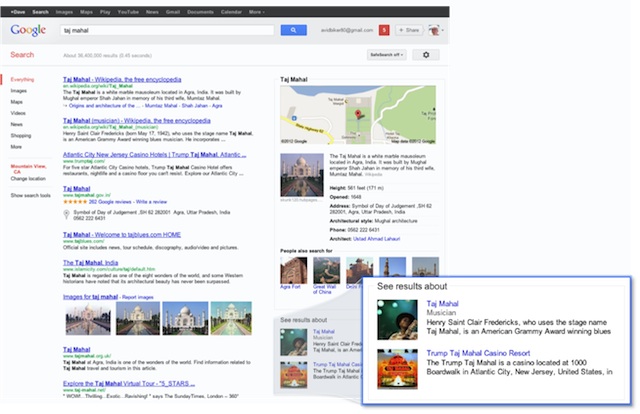
    Google’s latest search changes – introduced by Search Senior Vice President Amit Singhal – are another development, or baby step as Amit would call it, in making data more useful for us.

    The flood  of data that’s washed over us since the web arrived has left most of us befuddled. Increasingly, a basic keyword search just hasn’t been enough to find the information we’re looking for and we’ve had to trawl through pages of irrelevant information.

    One of the aims of Google’s new features is to make data more relevant to a user – so if someone in the US types “Kings” into Google, they will be given details of the Los Angeles Kings hockey team or the TV series “Kings”.

    Those details will include snippets of information about the topic. It could be the teams venue or the cast of the TV show. For tourist locations it could be some basic facts or transport information.

    Amit is particularly proud of integrating tourist information and flight details into search and Gmail which indicates Google is beginning to leverage its buyout of the ITA travel booking network last year.

    Google’s treatment of data reflects what’s happening with other services. At the recent Australian Xero conference and in an interview with MYOB executives, it’s been emphasised how knowledge is being aggregated to give customers and users better, more useful results.

    With Google’s knowledge graph we’re seeing the realisation of what big data can do, there’s many baby steps ahead but there’s a lot of potential.

    Similar posts: