Tag: google

  • Cloud computing and Small Business September Digital Day

    Cloud computing and Small Business September Digital Day

    As part of the NSW state government’s Small Business September Digital Day for Startups and Growth Businesses, we’ll be looking at exactly what cloud computing is and how it can help businesses.

    Some of the services we discuss in the presentation are listed in the Netsmart’s web post on the 5 essential cloud computing tools for business. Although there’s many more we’ll mention that can help organisations of all sizes.

    Given the time constraints and the event’s focus is on the specific social media and cloud computing tools available to small business, much of the background information to the Online Tools to Turbocharge Your Business session is available in the previous series of posts about cloud computing previously done for the 2011 City of Sydney Let’s Talk Business series.

    Detailed information from that presentation can be found on the following pages;

    The networked business Part 1: What is cloud computing?
    The networked business Part 2: The benefits of cloud computing

    The networked business Part 3: Managing risk in the cloud

    The networked business Part 4: The business case for cloud computing

    All of the tools discussed in the Small Business September presentations are available in our ebook, Online Business Essentials which is available for all subscribers to our newsletter.

    If you’d like to see the presentations themselves, both The Networked Business and Online Tools to Turbocharge your Business are available through the Slideshare service.

    Seats are still available for both of the Digital Day presentations at the Telstra Experience Centre, Level 4, 300 George Street, Sydney. The Start Up session begins at 8.00am and the presentations for growth businesses begins at 1.00pm.

    Come along if you’d like to learn how social media and cloud computing can help your business improve productivity while building an online brand.

    Similar posts:

  • How Google’s identity obsession hurts

    How Google’s identity obsession hurts

    Imagine giving a presentation at a conference where you fire up a live demonstration of a product you’ve been urging the audience to use and the audience start giggling.

    You turn around to find a bright red message at the top of the screen stating your account has been suspended. It wasn’t there the night before and you certainly didn’t receive an email warning you this had happened.

    Embarrassing or what?

    That happened to me with Google Local earlier this and the many stories like it illustrates a serious management problem within the world’s biggest search engine company.

    Local search – where businesses can be found online based on their location – is one of the main web battlefields with Google and Facebook, along with outliers like News Limited and Microsoft, are competing to get business of all sizes to sign up.

    Recently though Google seems to be going out of its way to squander the massive opportunity they have in this sector despite the CEO, Larry Page, identifying local services as one of their priorities.

    Despite Google’s intention to promote Places – as their, and Facebook’s, local search platforms are called – many businesses are finding the company’s arbitrary and often incorrect application of its own rules and Terms of Service difficult to understand and use.

    “I have found that with the ‘moving target’ Google is presenting to businesses” said Bob, a commenter on one of my blogs, “is paralyzing them from doing exactly what Google wants, which is updating and providing fresh content on their listings pages.”

    In many ways, this is a small front on the “nymwars” that has broken out since Google introduced their Plus social media service and started enforcing their “rules” on “real names”.

    Unfortunately their real names “policy” – and I use inverted commas deliberately – is vague and arbitrary with users finding their accounts suspended despite signing up with “the name your friends, family or co-workers usually call you” as required by Google.

    Account suspensions are wide and varied; some people, quite legally, have a name without a surname, others have a combination of languages such as Chinese or Arabic, while others have simply fallen foul of the computer and Google’s secretive bureaucratic culture.

    This secretive bureaucracy would be funny if it wasn’t so downright hypocritical. Any correspondence with Google about account suspensions either on Places or Plus is signed off by an anonymous functionary from “no-reply” email address. So it appears real identities, and accountability, don’t extend to the company itself.

    Last week at the Edinburgh International TV Festival, Google’s chairman Eric Schmidt, announced Plus is not a social media platform, but an “identity service”. Good luck with that, Eric as your staff’s arbitrary and often incorrect interpretation of the company’s own rules doesn’t engender confidence in any identity verified by Google.

    That announcement by Google’s chairman should worry investors, as this is a company that is first and foremost an advertising company powered by the best web search technology.

    Management distractions such as becoming an “identity service” or buying a handset manufacturer distract focus from the core business and result in the mess we’re seeing around business and private accounts.

    For the moment, Google Places remains a service that businesses must list on given the visibility the results have when customers search the web for local services and products.

    If you aren’t already on Google Places, do sign up but make sure you get your listing right first time as editing your profile once it’s up risks your account being suspended or cast into “pending” purgatory.

    Should you have already an account, leave it alone as any change risks coming the attention of Google’s anonymous bureaucrats.

    Hopefully, this madness will pass and Google will clarify their policies, ground them in the real world then enforce their terms fairly and consistently. Until then, you can’t afford to rely on your personal and business Google accounts.

    Similar posts:

  • Be careful with your Google Places listing

    Be careful with your Google Places listing

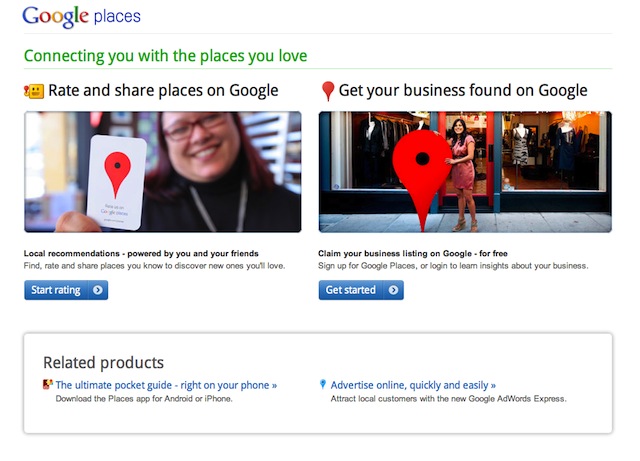
    Google Places is a service that every business should sign up to, however Google’s policies at the moment mean you have to take care with how you use the listing.

    At present Google are enforcing their listing rules in unpredictable ways and we’re hearing businesses are having their accounts suspended for what appears to a misreading on Google’s part of their own policies.

    More importantly, there are stories of businesses who have updated their details and found their listing goes into “pending” status and their page is pulled from local search results until their revisions are reviewed by a Google staffer.

    Often when the review is done, the listing is denied as being in breach of the rules which effectively bans the business from Google Places until the error is fixed.

    Fixing the problem is difficult as the Google rejection emails are cryptic and, unfortunately in this era of the social business, come from a “no-reply” account with no sign off name, so there’s no way to find out exactly where the problem lies.

    Given the uncertainty around Google’s policies in this space, it’s best not to make any changes to your Google Places account unless it’s absolutely necessary to update essential information.

    If you haven’t already listed your business on Google Places, we’d still urge you to do so. Just make sure you get all of your details correct and pictures uploaded before you submit the entry.

    Similar posts:

  • Greater fools and lesser fools

    Greater fools and lesser fools

    As Groupon struggles to get its public offering to the market and the startup mania continues in the tech sector, it’s worthwhile having a look at what underpins the modern Silicon Valley business model along with it’s limitations and risks for those who want to imitate it or invest in it.

    Distilled to the basics, the aim of the venture capital funded startup is to earn a profitable exit for the founders and investors. While there’s some exceptions – Apple and Google being two of the most notable – most of these businesses are not intended to be profitable or even sustainable, they are intended to be dressed up and sold onto someone else.

    This can be seen in what many of these companies spend investors’ money on; in an example where a startup receives 10 million dollars VC investment, we may see a million spent on developing the product, five million allocated customer acquisition and four million on PR. The numbers may vary, but the proportions indicate the investors’ and management priorities.

    Focussing on PR and customer acquisition is essential to attract buyers, the public relations spend is to place stories in the business media and trade press about the hot new business and spending millions buying in customers backs the narrative of how great this business is. By creating enough hype about a fast growing enterprise, the plan is prospective buyers will come knocking.

    But who buys many of these business? In some cases a company like Microsoft or Google may buy the startup just to get the talents of some smart developers or entrepreneurs, but in many cases it’s fools being parted from their money.

    Greater Fools

    The greater fool model the core tech start up model; two guys set up a business with some basic funding from their immediate circle; the friends, family and other fools. A VC gets involved, makes an investment and markets the company as described above.

    With enough hype, the business comes to the attention of a big corporation whose managers are hypnotised by the growth story and possibly feel threatened by the new industry or have a Fear Of Missing Out on the new hot, sector.

    Eventually the big business buys the little guys for a large sum, meeting the aim of the founders and venture capital investors. The buyer then steadily runs down the acquired business as management finds they don’t understand it and find it a small, irritating distraction from their main business activity.

    While there are hundreds of examples of this in the tech sector, the funny thing is the biggest examples are in the media industry with Time Warner’s purchase of AOL and News Corporation of MySpace.

    Lesser Fools

    As a bubble develops we start seeing the Initial Public Offering arrive and this is where the lesser fools step in.

    The mums and dad, the retiree, German dentists, the investment funds and all the other players of the stock market are offered a slice of the hot new business.

    Usually the results are interesting; the IPO is often underpriced which sees a massive profit for the initial shareholders and underwriters in the first few days then a steady decline in the stock price as the pie in the sky valuations and the realities of the underlying business’ profitability become apparent.

    Steve Blank, a Silicon Valley investor and entrepreneur, put the greater or lesser fool scenario well in a recent article asking Are You The Fool At The Table? Sadly too many small and big investors, along with big corporations, are the fools at the table ignoring Warren Buffet’s advice on avoiding businesses you don’t understand and finding themselves the patsies that the Silicon Valley startup model relies upon.

    The fundamental misunderstanding of the venture capital driven Silicon Valley model of building businesses is dangerous as our governments and investment mangers are seduced by the glamorous, big money deals. It’s also understandable funding from banks and other traditional sources is difficult to find.

    An obsession with this method of growing businesses means that long term ventures with profitable underlying products and services are overlooked as investors flock to the latest shiny startup. That’s a shame and something our economy, and investment portfolios, can’t really afford in volatile times.

    For business owners, the venture capital model might be a good option if your aim is a quick, profitable sale to a fool. If your driving reasons for running a business are something different, then maybe the Silicon Valley way of doing business isn’t for you.

    Similar posts:

  • Why online listings are an essential business tool

    Why online listings are an essential business tool

    Online listings with the major search sites are free and effective. Even more importantly, those listings form the basis for many of the location based services that are springing up on Smart Phones. This article originally appeared on the 19 January Smart Company Business Tech Talk column.

    Since Global Positioning System (GPS) equipped smartphones arrived on the market, we’re seeing all kinds of location based phone applications springing up.

    Recently I’ve been playing with two of these services – Foursquare and Urban Spoon to find there are some lessons for businesses in how these products work.

    These services are terrific at telling you where the nearest cafes, service stations or places of interest are, although at the same time I’ve noticed how inaccurate some of the business locations can be.

    Often, particularly in the case of Foursquare, the wrong spot has found its way into the system because customers have taken a guess at the address, added the details while on the way to or from the business or just simply got the location wrong. Which can be awkward, particularly if your competitors are closer to the incorrect location.

    So it’s worthwhile getting your businesses address correct on these services. Fortunately, it isn’t as hard as having to track down every single one of these new services and spend hours plugging your details into them.

    The most important single service is the Google Local Business Centre, as many of these location based services use Google Maps. Every business should be on this already as the listing is free and the information also feeds into Google search results. If your organisation is correctly listed here, it will appear in all Google searches for your product in your neighbourhood.

    Microsoft are in this market too with their Local Listing service which feeds into Bing results in a similar way to Google’s service. Like Google Maps, it’s free and listing only takes a few minutes.

    The traditional advertising medium for most Australian small businesses has been in the Yellow Pages. Sensis also offer a free listing which will get you in their maps and directories (although to get a priority listing you’ll need to pay more).

    So check your details are correct on all these services, it only takes a few minutes and given most customers, particularly in the business-to-business markets, use the web to research potential suppliers you’ll probably pick up a few customers just by having the right details online.

    With mobile internet usage expected to overtake desktop surfing in the next few years, it’s critical your details are correct on these phone applications which customers are going to increasingly rely upon.

    Similar posts:

    • No Related Posts