Tag: software

  • Becoming an all mobile executive

    Becoming an all mobile executive

    “I don’t want to use a laptop again,” Marc Benioff told the closing Dreamforce 2013 customer Q&A. “The desktop remains the biggest security threat to corporations — it’s a nightmare. The PC and laptop we never designed to be connected to a network.”

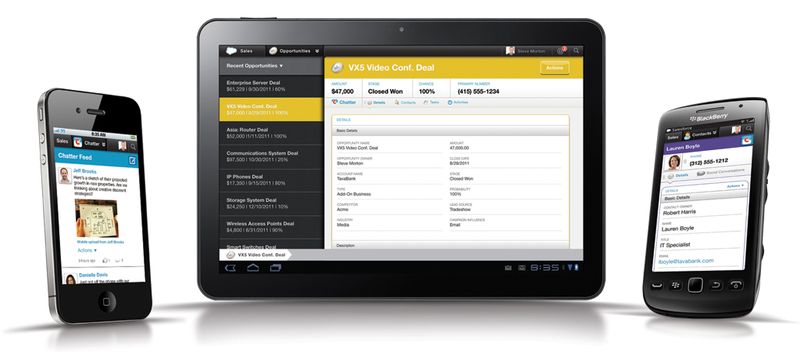
    Benioff was walking his talk in promoting his company’s Salesforce One mobile platform, claiming at the Dreamforce conference opening that he hadn’t used a PC or laptop or nine months as he’s moved over to tablet and smartphone apps.

    That push to move the company and its customers onto mobile services was emphasised by Peter Coffee, Salesforce’s Vice President for Strategic Research.

    “Your mobile device is no longer an accessory,” says Coffee. “It’s the first thing you reach for in the morning and it’s the last thing you touch at night.”

    Salesforce’s push into into the post-PC market follows Google and Apple’s lead, much to the distress of Microsoft and its partners.

    “We saw the phenomenal engineering work of Scott Forstall at Apple and the visionary work of the late, great Steve Jobs,”  Benioff told his cutomers at the final Dreamforce Q&A. “When we saw the iPhone we sat up and thought ‘wow, what are we going to do about this?’”

    “This is a paradigm shift, we’re moving from the desktop world to the mobile phone world and then of course we saw the iPad world emerge and that amplified it.”

    Salesforce’s impressions were shared by much of the business community as senior executives, board members and company founders quickly embraced the first version of the iPad, which on its own triggered the Bring Your Own Device (BYOD) trend in enterprise computing.

    In a mobile age, Benioff now sees three key priorities for Salesforce; “we want to be feed first, we want to be mobile first and we want to be social first.”

    Regardless of Benioff’s vision, not everyone will go mobile which is something that Peter Coffee acknowledges.

    “The laptop will occasionally be used to author creative work like a presentation or to deal with something that needs a large screen like pipeline analysis,” says Coffee.

    Marc Benioff though is adamant. “Honestly I don’t ever want to use a laptop again,” he told his audience.

    It will be interesting to see how many business leaders follow him in abandoning their desktops and portable computers as the post-PC era of computing develops.

    Similar posts:

    • No Related Posts
  • The end of HTML 5?

    The end of HTML 5?

    One of the big debates in web design since the rise of smartphone apps has been the question of ‘going native’ or following web standards.

    In an ideal world, all apps would follow the HTML web standards so designers would only have to create one app that would run on any device — a smartphone, tablet or PC — regardless of what type of software it was running.

    However the HTML 5 standard has proved problematic as developers have found applications written in the language are slow with limited features, so the attraction of writing ‘native’ apps that are designed for each system remains strong as users get a faster, better experience.

    The problem with that approach is that it results in having to design for different operating systems and various devices which is costly and adds complexity.

    For the last two years at Dreamforce, Salesforce CEO Marc Benioff has trumpeted the advantages of the company’s HTML5 Touch product.

    This year Benioff unveiled the company’s Salesforce One product — a suite of Application Program Interfaces (APIs) that simplifies building smartphone and web apps. At the media conference after the launch, Benioff even went as far to describe the once lauded Touch product as a “mistake”.

    So Salesforce has abandoned HTML5, which is a blow for standard applications.

    If others follow Salesforce, and it appears that is the trend, then we’ll increasingly see the smartphone industry dominated by iOS and Android as most companies lack the resources or commitment to develop for more than two platforms and their form factors.

    Open standards have been one of the driving factors of the web’s success, it would be a shame if we saw the mobile market split into two warring camps reminiscent of the VHS and Beta video tape days.

    Similar posts:

    • No Related Posts
  • In business, be careful what you wish for

    In business, be careful what you wish for

    Yesterday’s blog post looked at MYOB’s journey into cloud computing, in some ways this is a good example of being careful what you wish for.

    Like all box software suppliers, MYOB and Microsoft desperately wanted to move customers to a subscription model through the 1990s and early 2000s, the theory being a steady cashflow would be better than the ‘lumpy’ sales of box product every time a customer upgraded their system.

    Eventually, the box software suppliers got their wish when cloud computing took off after many false starts.

    Unfortunately for the box software suppliers,it turned out their products had to be completely redesigned to run as a cloud service.

    Worse, the new business model also lowered the barriers for entry into their industries which meant the incumbents had to compete dozens of hungry new competitors who weren’t lumbered with legacy code and customers.

    The box software companies got the subscription model they wished for, but turned out not to be the bonanza they hoped.

    Wishing well image courtesy of Deboer through SXC.HU

    Similar posts:

    • No Related Posts
  • MYOB’s journey into the cloud

    MYOB’s journey into the cloud

    The big winners of the Personal Computer era were the software companies. During that time firms like Microsoft, Oracle and Adobe became some of the most profitable companies on the planet.

    With the arrival of cloud computing those profits started to dry up and those software companies that did so well out of the PC era are now scrambling to develop new products to meet a very different market.

    Accounting software provider MYOB is a good example of this changing industry – a business that dominated the Australian small business market and supported an army of certified consultants now finds cloud based competitors like Xero nibbling away at their industry position.

    MYOB Chief Technology Officer Simon Raik-Allen describes his company’s journey to the cloud in the latest Decoding the New Economy video clip.

    “The cloud has amazing benefits for small business,” says Simon. “For twenty-two years we’ve had desktop products and for the last three or four years we’ve had cloud based services.”

    “It’s been a really interesting journey, we’ve been on it for three or four years now where we’re converting the company to a cloud company.”

    “But it’s also a cultural journey,” Simon observes. “I love seeing how people start to think differently when stuff is in the cloud.”

    “Having things in the cloud opens the opportunity for employees to start slicing and dicing data in different ways.”

    “It opens up the innovation curve to what’s possible.”

    Bringing partners on the journey

    Like Microsoft, one of MYOB’s strengths is its partner community – in particularly the company’s twenty thousand strong Certified Consultant program.

    Those consultants, like Microsoft’s partners, are seeing their traditional revenue streams challenged as their business models change, a topic discussed with Growthwise’s Steph Hinds in a previous video interview.

    “Everybody takes the cloud journey at their own place,” says Simon. “For bookkeepers in particular this is an opportunity to change their business in a positive way.”

    “Normally a bookkeeper would drive around and visit two, three or four customers a day and help then with their books. Now they can help twenty customers in a single day.”

    Looking beyond the cloud

    Simon sees more than cloud computing changing accounting software with connected devices like the Pebble Watch, voice and gesture recognition along with Near Field Communications technology all being built into MYOB and computers in the near future.

    “NFC is a very powerful technology,” Simon states. “Imagine in the accounting world where you are doing your books by moving your phone.”

    “In retail NFC is going to be big where you can walk up to a product, wave your phone in front of it and it will tell you about the product.”

    “We are very much driven by what our clients want,” says Simon. “It comes down to the use case of will it add to our customers’ business.”

    An enthusiastic advocate

    One of the things that’s impressive about talking with Simon Raik-Allen is his enthusiasm for technology, whether it’s Pebble Watches, NFC enabled robots or gesture controlled accounting software.

    MYOB needs that enthusiasm in its move away from the once immensely profitable box software business onto the cloud where margins are thinner, the advantages of incumbency aren’t great and the competition from well funded competitors like Xero is immense.

    As with many other ventures, MYOB is dealing with a huge disruption to their core business and the challenges are immense.

    Image courtesy of Morrhigan through sxc.hu

    Similar posts:

    • No Related Posts
  • Big Data needs big databases

    Big Data needs big databases

    While the tech industry’s startup hype this week has been focused on the impending Twitter Initial Public Offering, a much more fascinating company quietly completed a major capital raising.

    MongoDB provides an open-source, document database program and last week raised another $150 million from investors that values the company at $1.2 billion dollars.

    Databases lie at the heart of Big Data and businesses need better computer programs to manage the overwhelming amount of information that’s pouring in every day.

    As every business is unique, larger corporations find they spend huge amounts of money on their databases. The enterprise that buys an Oracle, IBM or SAP system usually spends tens, if not hundreds, of millions of dollars in adapting the system to work for them, often with less than spectacular results.

    While implementing MongoDB or any other open source program doesn’t eliminate implementation costs, it is often easier to setup and maintain as most of the information about the system is shared and freely available rather than locked inside the vendor’s proprietary knowledgebases.

    Probably most important of all, the data structures themselves are open so customers don’t find themselves locked into a relationship with one vendor because all their information is in a format that can only be read by one system.

    Open source is where Big Data, social media and cloud computing intersect – without the data itself being open and accessible, most cloud computing and social media services will almost certainly fail.

    So MongoDB and the other open source products are the quiet, back of house technologies that keep the internet as we know it ticking along.

    Bloomberg Businessweek reports there’s some very serious investors in MongoDB.

    The deal attracted new investors such as EMC Corp. (EMC:US) and Salesforce.com Inc. (CRM:US), along with previous backers Red Hat Inc. (RHT:US), Intel Corp. (INTC:US), New Enterprise Associates and Sequoia Capital, according to MongoDB.

    Sequoia Capital are one of the longest lasting Silicon Valley venture capital firms whose greatest success was being one of the first investors in Apple Computers and New Enterprise Ventures have a similar pedigree with companies like 3Com, Juniper Networks and Vonage. Investment by industry leaders like Intel, Red Hat, Salesforce and EMC in the company also shows MongoDB isn’t the standard Silicon Valley Greater Fool play.

    When there’s a gold rush, it’s those selling the shovels who make the big money and the investors in MongoDB and similar services are hoping they’ve found some of the modern day shovels.

    That may well turn out to be the case and while the smart folk make more money from the technologies that drive social media and cloud computing services, the rest of us are distracted by the latest shiny thing.

    Similar posts:

    • No Related Posts