Month: November 2013

  • The real thing behind the internet of things

    The real thing behind the internet of things

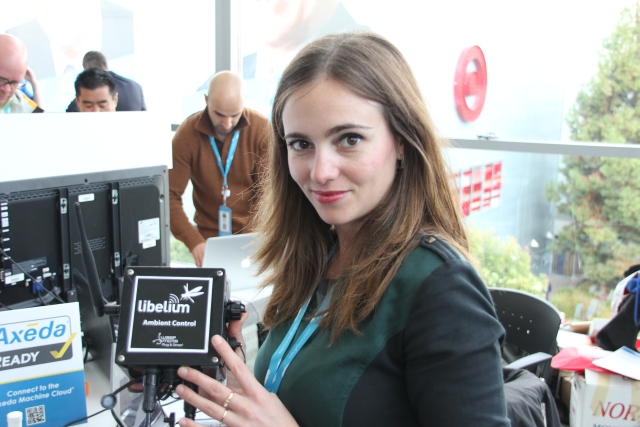
    We need to think beyond technology to get value the real value from the internet of things says Alicia Asin, the CEO and co-founder of Spanish sensor company Libelium.

    Libelium and its CEO Alicia Asin has been covered previously on this blog and we had the opportunity to record an interview with Alicia at the 2013 Dreamforce conference.

    Alicia told us about her vision for how she sees cities and governments evolving in an era of real time accessible information, in many ways it’s similar to where the Deputy Lord Mayor of Barcelona sees his city being at the end of this decade.

    “I would say the biggest legacy the internet of things can bring is transparency,” says Alicia. “In the smart cities movement the IoT gives an opportunity for have a dashboard for cities.”

    “You can see the investment made for reducing traffic investment downtown, the carbon footprint reduced and the return on investment,” says Alicia. “You can have very objective facts to supply to the citizens and they can make better decisions.”

    For this vision to become true, it means government data has to open to the community which is something that challenges many administrations, however Alicia also told the story of how her company supplied Geiger counters to volunteers monitoring the radiation fallout around the damaged Fukushima nuclear reactor in Japan.

    “We made a project in Fukushima when the nuclear accident happened where we sent some Geiger counters to the hacker space,” says Alicia. “Suddenly all the people with the Geiger counters started to publish the data onto the internet.”

    “They were keeping a totally independent radiation map made by the activist citizens.”

    Alicia raises an important point of how citizens can be using technology independently of governments. This was most notable in the Occupy movements across the United States that sprung up in late 2011 where hackers set up independent communications networks and recorded events outside the control of mainstream media and government agencies.

    While citizens can use these tools to get around official restrictions, governments play an important role in developing new industries around these technologies, Alicia sees the smart city investments made by Spanish cities as creating the start of a Spanish Silicon Valley.

    “Despite the economy, we are seeing a number of projects in Spain around smart cities,” Alicia observes. “In fact, I’m saying Spain is becoming the Silicon Valley for smart cities.”

    “In terms of attracting big companies to look at what’s going on in Spain and to build a bigger brand around the Internet of Things, I think that really helps.”

    With government and citizens working together, Alicia sees the Internet of Things delivering great changes to society as it enables citizens and makes governments more accountable.

    “It’s the real thing, it’s beyond technology.”

    Similar posts:

  • News organisations and social media copyright truths

    News organisations and social media copyright truths

    One of the long running scandals of modern journalism is how media organisations have misused social media.

    Haitian photographer Daniel Moran’s victory over Agence France Press and Getty Images is a reminder to journalists and media organisations that when something is posted to social media it doesn’t mean it’s free to use.

    Since the rise of social media sites it’s become common for journalists to grab images or videos from them to illustrate stories. At best, the media organisations have credited the sites they’ve stolen the content to allay copyright concerns.

    The problem is media companies and journalists don’t have the right to do that; users don’t give away their rights when they post to Twitter or Facebook — they grant a license to the company to use those that content as they wish.

    If a photographer, writer, computer programmer or musician wants to give away their work for free then there’s a range of ways they can do it and many are happy to make their efforts available to the community without charge. It just happens posting to a social media site isn’t one of those ways.

    Hopefully journalists and media organisations will learn a lesson from Daniel Moran’s case, social media doesn’t mean open slather.

    Similar posts:

    • No Related Posts
  • Becoming an all mobile executive

    Becoming an all mobile executive

    “I don’t want to use a laptop again,” Marc Benioff told the closing Dreamforce 2013 customer Q&A. “The desktop remains the biggest security threat to corporations — it’s a nightmare. The PC and laptop we never designed to be connected to a network.”

    Benioff was walking his talk in promoting his company’s Salesforce One mobile platform, claiming at the Dreamforce conference opening that he hadn’t used a PC or laptop or nine months as he’s moved over to tablet and smartphone apps.

    That push to move the company and its customers onto mobile services was emphasised by Peter Coffee, Salesforce’s Vice President for Strategic Research.

    “Your mobile device is no longer an accessory,” says Coffee. “It’s the first thing you reach for in the morning and it’s the last thing you touch at night.”

    Salesforce’s push into into the post-PC market follows Google and Apple’s lead, much to the distress of Microsoft and its partners.

    “We saw the phenomenal engineering work of Scott Forstall at Apple and the visionary work of the late, great Steve Jobs,”  Benioff told his cutomers at the final Dreamforce Q&A. “When we saw the iPhone we sat up and thought ‘wow, what are we going to do about this?’”

    “This is a paradigm shift, we’re moving from the desktop world to the mobile phone world and then of course we saw the iPad world emerge and that amplified it.”

    Salesforce’s impressions were shared by much of the business community as senior executives, board members and company founders quickly embraced the first version of the iPad, which on its own triggered the Bring Your Own Device (BYOD) trend in enterprise computing.

    In a mobile age, Benioff now sees three key priorities for Salesforce; “we want to be feed first, we want to be mobile first and we want to be social first.”

    Regardless of Benioff’s vision, not everyone will go mobile which is something that Peter Coffee acknowledges.

    “The laptop will occasionally be used to author creative work like a presentation or to deal with something that needs a large screen like pipeline analysis,” says Coffee.

    Marc Benioff though is adamant. “Honestly I don’t ever want to use a laptop again,” he told his audience.

    It will be interesting to see how many business leaders follow him in abandoning their desktops and portable computers as the post-PC era of computing develops.

    Similar posts:

    • No Related Posts
  • Book publishers and the cost cutting quandary

    Book publishers and the cost cutting quandary

    Traditional book publishers face a challenging future as authors find they get more value from self-publishing.

    It was good to head across to Oakland’s East Bay Social Media Breakfast for Shel Israel’s and Robert Scoble’s discussion about their latest book, The Age Of Context.

    While the book itself is an interesting overview of how the internet of things is changing the world, Scoble’s and Israel’s self publishing journey though combination of corporate sponsors, crowdfunding and alternative distribution models is an interesting tale in itself.

    “Self publishing gives writers much more power than they’ve ever had before,” says Israel. “In many aspects, the traditional publisher just isn’t there any more.”

    “By using the tech community and social media to market the book, I’ve sold more copies of The Age of Context in seven weeks than my previous four books combined,” Israel states.

    Israel’s point illustrates the challenge facing traditional publishers, like many other industries the publishing houses have reacted to a changing market by cutting costs such as replacing experienced staff with fewer, less experienced workers.

    Failing to add value

    That cost cutting has the effect of making the businesses irrelevant; if a publicist has to rely on HARO or Source Bottle to contact journalists rather than a contact book built up over years of experience, then they are doing little the writer can’t do themselves.

    One of the biggest advantages book publishers offered authors was rigorous editing — good editors are worth their weight in gold to both a writer and their book and in the past self-published books were notable for their lousy editing.

    Today, that function has been almost eliminated by publishers have eliminated most in house editors. If a harassed, time poor contractor only has a few days to spend editing the manuscript, as what happened with my last book, then the publishers hasn’t added much to the product at all.

    Similarly with design and layout, historically publishers have been strong on this front with experienced editors knowing what covers will work for certain genres in the bookshops. The cheapest graduate worker in the world can’t replicate that understanding of the marketplace.

    Most damaging of all though to publishers was losing the distribution channels; when bookstores were the way most readers bought their books the publishing house’s sales team were essential for getting books on shelves. In an age of Amazon and online shopping, they are no longer the gatekeepers they once were.

    Self publishing risks

    That’s not say there aren’t risks with self publishing, particularly with having corporate sponsors pay for development costs.

    Scoble and Israel overcame the increasingly stingy author advances by raising $105,000 from corporate sponsors to cover the initial researching and writing costs.

    “We were scared to death that this was a credibility issue,” said Israel. “However our sponsors were incredibly good with not messing around with editorial credibility. They, like others in the book, got to see what was written to check for technical accuracy but not change the content.”

    “An example is that Google was not a sponsor and Bing was, yet we said an awful lot more good things about Google than we did about Bing.”

    Adopting the financial risk

    The biggest risk of all for self-publishing though is being stuck with a stack of unsold books with a pile of bills for editors, designers and printing. In the past the publisher carried all the financial risk which was probably the greatest service they provided to authors.

    Even that risk isn’t as great as it was a few years ago as print runs are cheaper and shorter while outsourcing sites make it cheaper and easier to find professional help.

    As Israel and Scoble illustrate, book publishers have made themselves irrelevant to most authors. It’s probably the best case study of an industry reacting to change with cost cuts that ultimately destroy their own competitive advantage.

    That’s something that other businesses and industries should consider when looking at how to deal with their own disruption.

    Similar posts:

    • No Related Posts
  • Tuxedos and cocktail dresses — the real cost of being an entrepreneur

    Tuxedos and cocktail dresses — the real cost of being an entrepreneur

    venture capital investor and blogger Mark Suster said at the Dreamforce 2013 conference yesterday.

    Suster’s mission is based upon having seen the process of building business up close having been involved in two successful startups and trade sales before joining Salesforce as head of product development then branching out to the investor side of the business.

    There’s also a personal reason for Suster wanting to tell the truth about starting your own venture, “the reason I’m on a personal mission to explain this is because a friend committed suicide.”

    “His company had raised four million dollars but, by his standards, it wasn’t succeeding.”

    Suster’s story resonates with anyone who has founded a business — it’s not something everyone is suited to and it’s a tough, demanding lifestyle.

    Tuxedos and cocktail dresses

    Part of the problem is public perceptions, Suster describes a conflict between “public persona and cognitive dissonance”; while an individual startup is struggling with their own flaws and failings, it appears that everyone else is doing well from their carefully crafted and placed publicity stories.

    “Everyone else’s PR is their tuxedos and cocktail dresses,” Suster points out. “You on the other hand are seeing yourself naked in the mirror every morning.”

    On being a marriage councilor

    It’s often said that a business partnership is like a marriage and Suster finds much of his work as a venture capital investor involves counseling founders over their relationship.

    “Sometimes one has to go,” Suster says. “It doesn’t matter what your preference is — and we all have our favourites — but the business cannot survive with the two of them.”

    When two founders split, there is also the problem of equity, should both have equal shares then it becomes difficult to split the business; “should one partner leaves, it’s often easier to shut down the company and start again.”

    Buy in your skills

    A similar problem happens when there’s more than one partner and Suster cautions it’s better to employ people with the skills you need rather than offer equity in a new business.

    “Having too many founders is the greatest dilution you’ll ever face,” Suster warns and his advice is to hire the skills required by the business rather than give away equity in your business.

    Another benefit of hiring people is having a good team on the payroll is the validation good investors are looking for. “Having a good team proves you’re able to hire good people which is the most important skill an entrepreneur needs,” Suster explains.

    Ultimately, Mark Suster sees the journey of building a business as a decade long process, the billion dollar startups are the exception rather than the rule.

    The biggest advice Suster has is to understand your goals, “if you don’t define what success is, you’ll never achieve it.”

    Building a business is tough, and not everybody is suited to doing it. Mark Suster’s advice isn’t just appropriate for technology startups, it’s also valid for anyone starting any type of business.

    Similar posts: